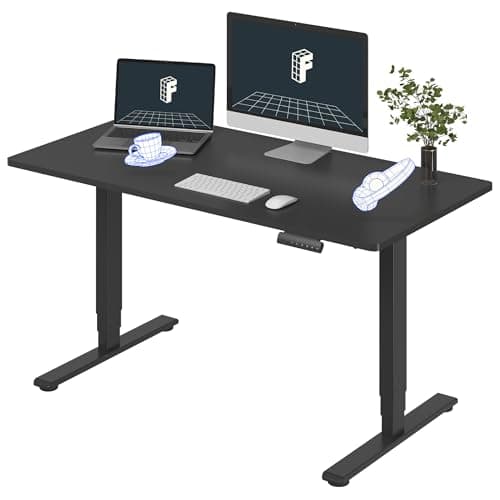
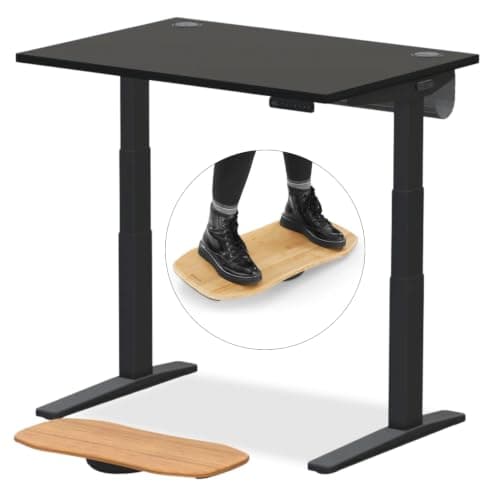
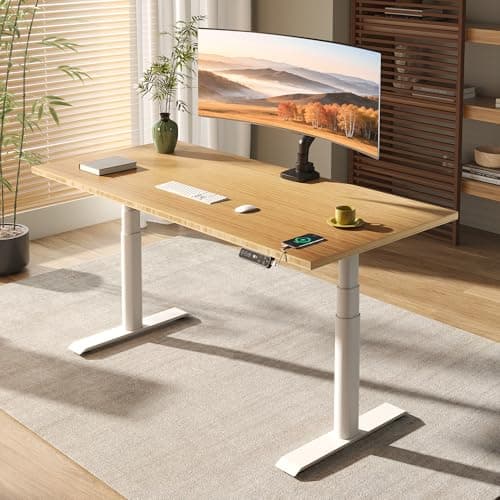
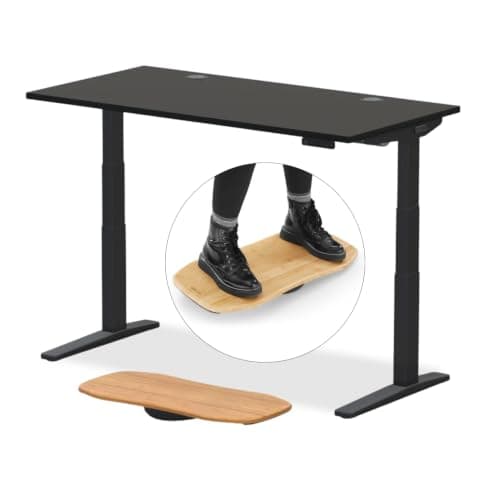
Buy the UPLIFT V3 laminate if a certificate and a long warranty are why you are shopping: 22.6 to 48.7 inches of travel, 355 lb of lift, a 15-year warranty, and a published GREENGUARD Gold document on the laminate desktop line. Buy the FlexiSpot E6 if they are not: 23.6 to 48.4 inches, 275 lb, and a five-year frame warranty, for well under half the money. Both are good desks. This page is about what the extra money buys, stated in the brands' own published numbers rather than in feel.
Where the two brands genuinely differ
These are the two most searched names in the category, and the comparison is usually written as a build-quality argument. It is not one. Both desks are dual-motor, three-stage frames from established manufacturers with large owner bases. Put them side by side on the things each company is willing to print, and the differences get specific:
- Height range.UPLIFT publishes 22.6 to 48.7 inches for the V3 frame, a stated 26.1 inches of travel. FlexiSpot's E6 frame page publishes 23.6 to 48.4 inches. The UPLIFT reaches an inch lower and a fraction higher — a real advantage at both ends of the stature range, and the reason the V3 leads our desks for short people roundup.
- Capacity.UPLIFT states 355 lb of lift capacity. FlexiSpot's E6 frame page states 275 lb, while the Amazon listing for the complete E6 desk we rank states 220 lb. Those are different products, and we report each figure to its own source rather than picking the flattering one — which is exactly the sort of gap that makes cross-brand spec comparison harder than it should be. What the number means is unpacked in our weight capacity guide.
- Warranty. The widest gap on the page. UPLIFT states a full 15-year warranty on everything, extendable to 25. FlexiSpot publishes five years on the frame, motor and mechanisms and two years on the controller, switch and electronics. A manufacturer writing a fifteen-year check on its own motors is making a statement about its failure rate that a two-year electronics term does not.
- Certification.UPLIFT publishes a GREENGUARD Gold document covering its laminate desktop line, and states its frames are tested to ANSI/BIFMA X5.5-2021 for structure and G1-2013 for ergonomic compliance. FlexiSpot's E6 page lists FCC and UL — electrical and radio approvals — and no emissions or furniture-durability certification. For the buyer this site is written for, that is the decisive line.
What FlexiSpot is genuinely better at
Price, and it is not close. The E6 lands at a fraction of what a comparable UPLIFT configuration costs once you have chosen a top, and at that price it still brings the two specs that actually predict stability at standing height: two independent motors and three leg stages. A single-motor desk fights itself when one side carries a monitor and the other carries nothing; a two-stage leg has less overlapping steel at full extension. The E6 has neither problem.
And if your worry is wobble rather than paperwork, the money is often better spent on nothing at all — most wobble comes from un-leveled feet, load placement and frame bolts that have settled, not from a fundamentally bad frame. Our wobble guide works through the causes in the order they usually turn out to be the culprit, and standing desks on carpet covers the case where the floor is doing it.
The desktop is the part that decides the emissions question
Both brands sell a bamboo top and a laminate top, and on both brands the interesting thing is which one is documented. UPLIFT's published GREENGUARD Gold statement covers the laminateline — so the certified UPLIFT desktop is also the cheaper UPLIFT desktop, and the bamboo version, which most people assume is the "natural" choice, is the one without the certificate. FlexiSpot publishes no emissions certificate for either of its tops.
That does not make bamboo a bad material. A laminated grass panel uses far less adhesive than a particleboard or MDF core, which is the whole argument in MDF vs solid wood. It means that on this comparison the only third-party emissions document available belongs to one specific desktop line from one of the two brands — and if that document is why you are here, it points at exactly one product.
Which one to actually buy
If you want the certificate, the fifteen-year term and the lowest published travel, the V3 laminate is the answer and the price is the price. If you want a competent electric desk and the certificate was never your reason for shopping, the E6 is the better value in the category and we will not pretend otherwise. What you should not do is buy the UPLIFT bamboo top believing the GREENGUARD document comes with it, or buy the E6 believing "UL listed" on the spec sheet says anything at all about what the desktop puts into your air. Both are the category's standard misunderstandings, and both cost real money.
Neither brand is the price floor. If the budget is the constraint rather than the paperwork, our budget desks roundup goes further down the ladder and says plainly what you give up. And if you want the brand-level view across the whole category rather than these two, the brands page ranks every maker we track on what it publishes.
How to compare two desk brands without a lab
1. Put the two published height ranges next to each other
Both of these brands print one, which already makes them unusual. Check the bottom of the range against your seated number and the top against your standing number before you look at anything else — a desk that cannot reach your heights is not a candidate at any price.
2. Read the warranty as a probability statement
Warranty length is the most useful uncertified signal available to you and it is free to check. Fifteen years on the whole desk against five on the frame and two on the electronics is the clearest difference between these two products — and the electronics are the part that actually fails.
3. Separate the electrical approval from the furniture certification
UL and FCC mean the power supply and the radio emissions were assessed. They say nothing about formaldehyde, off-gassing or structural durability. Those belong to GREENGUARD and ANSI/BIFMA and they are separate documents — see BIFMA explained.
4. Check the certificate against your exact desktop
Certification is granted per product. A brand that certifies its laminate line has not certified its bamboo, and a 60-inch top is not the same SKU as a 42-inch one. Ask about the size and finish in your cart, then confirm it yourself at UL SPOT.
5. Count motors and leg stages, then stop reading the spec sheet
Two motors and three stages is the configuration that stays still at full height. Both desks here have it. Past that point the remaining spec-sheet differences are mostly marketing, and your money does more good on the desktop or a monitor arm.