Skip to content
Riser & Rail

02 — Anti-Fatigue Mats

How Thick Should an Anti-Fatigue Mat Be?

Three-quarters of an inch. That is the answer for almost everyone — and the interesting part is why the mats that break the rule break it, and which ones will not tell you the number.

By Stephen V.Updated How we research
#ad

We earn a commission when you buy through our Amazon links, at no extra cost to you. It never affects our rankings, and we say so when the cheaper — or the direct-only — product is the better buy. How this works.

Buy three-quarters of an inch. It is thick enough to deform usefully under your foot, thin enough that the edge is not a trip hazard, and it is the figure almost every serious manufacturer has independently landed on — which tells you more than any marketing claim about "extra thick" foam. The only thickness worth breaking that rule for is a sculpted mat, where the number means something different.

What thickness is actually doing

An anti-fatigue mat does not work by being soft. It works by giving your foot something to deform into, so that the small involuntary postural shifts you make while standing are easier — and those shifts are the whole point. Standing still requires continuous muscle contraction in the lower limbs, hips and spine; shifting redistributes that load, keeps blood moving and stops one muscle group holding a static contraction for an hour. A mat that encourages shifting is doing its job. This is also why the evidence base is about comfort and perceived fatigue rather than about curing anything: the Yonsei analysis of prolonged standing at work notes that standing on a floor mat, or wearing shoe insoles, has been reported to provide comfort and reduce standing fatigue, citing King's 2002 comparison of the two in Applied Ergonomics.

Thickness governs how much room there is to deform. Too thin and your foot bottoms out onto the hard floor, which is the same as no mat. Too thick and two separate problems arrive at once.

Why thicker is not better

The edge becomes a trip hazard. This is the one nobody mentions and it is the real constraint. A mat is an object with a perimeter, sitting where you step backwards without looking. At three-quarters of an inch, a bevelled edge is a gentle ramp. At an inch and a half it is a curb. The taper matters more than the raw number, which is why every mat we rank has a bevelled edge and why we flag square-edged mats as a hazard in the main mats roundup.

Stability drops. Deep soft foam lets your ankle roll further before it meets resistance, so your stabilizing muscles work harder to keep you upright. That is the opposite of relief for anyone with an ankle, knee or hipcomplaint, and it is why the "more cushioning is more comfort" instinct is wrong here. If you want instability on purpose, that is a balance board, which is a different product with a different goal.

And the desk gets taller. Every inch of mat raises you an inch relative to the desk, which un-does the height you carefully set. Set your standing desk height while standing on the mat — the number from our height calculator assumes your feet are on the floor.

What the manufacturers actually publish

Here is the published thickness for every mat we rank, which is a more useful table than any recommendation:

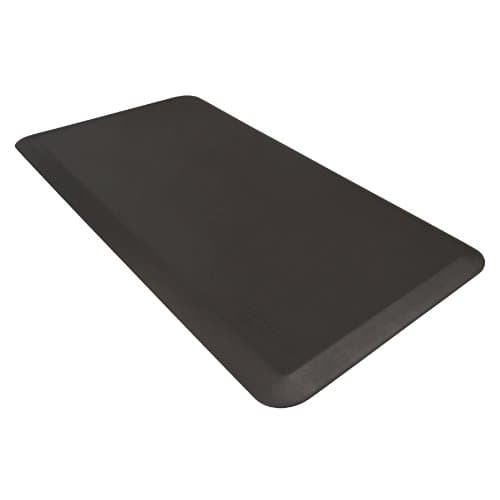
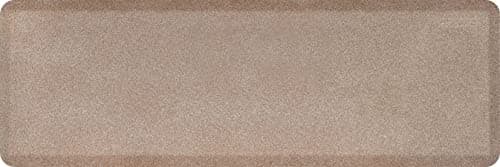
  • 3/4 inch — GelPro Eco-Pro (20 × 48 in, polyurethane Bio-Foam core), WellnessMats Granite (100% polyurethane, single-piece construction, 20-year residential warranty), ComfiLife and Sky Solutions. Four manufacturers at four price points, all landing on the same figure. That convergence is the strongest signal in the category.
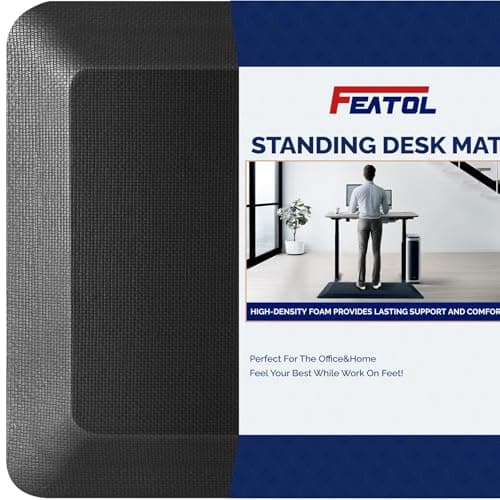
  • 9/10 inch — FEATOL, which is listed slightly thicker than the standard and is the honest budget option if you want a little more give.
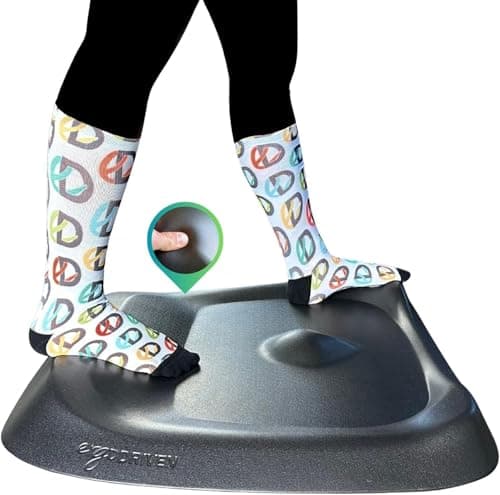
  • 0.85 inch in the neutral area, 2.7 inches at its highest point — the Ergodriven Topo, which is the exception that proves the rule. Ergodriven publishes both numbers, plus 29 in wide by 26.25 in deep and 8 lb, because on a sculpted mat a single thickness figure would be meaningless.
  • No published figure —Gorilla Grip, whose listing says "thick cushion". It is a perfectly reasonable mat and its high-grip base is genuinely the best answer for a slick floor. But "thick" is not a specification, and a brand that will not print a number has not committed to one. We say so rather than inventing a measurement we did not take.

The sculpted exception, and when to take it

The Topo is not trying to be a thicker mat. Its 0.85 inch neutral area is thinner than the category standard — the 2.7 inch figure is the height of its calf mounds and edge features, not cushioning underfoot. The mechanism is different: instead of making standing still more comfortable, it gives you defined places to put a foot, so you change position without deciding to. If your problem is that you stand rigidly in one spot for an hour at a time, that is the more useful design, and it is why the Topo leads our hip pain picks. If your problem is a hard floor under your heels for six hours, a flat 3/4 inch mat is the better and cheaper answer.

Two specs worth more than the last quarter-inch

What the foam is made of. Polyurethane and PVC are the two options and they are not equivalent — the material argument, including where PFAS can hide in a stain-resistant surface coating, is the whole subject of non-toxic anti-fatigue mats and PFAS in mats. A 100% polyurethane single-piece mat with no laminated layers is the structurally cleaner answer, and two of the picks below are exactly that.

What the base does on your floor. On tile, laminate or sealed concrete, a mat that slides is worse than no mat, and a certified high-traction base — the GelPro carries an NFSI high-traction certification — is worth more than extra foam. On carpet, grip is a non-issue and so is most of the case for a mat at all, which we work through in standing desks on carpet.

Whether you need a mat in the first place is a fair question and we answer it honestly in do you need an anti-fatigue mat. If the floor is carpeted and you alternate between sitting and standing properly, the answer may well be no.

The short answer

Quick picks

#ProductBest forScorePrice
01
GelPro NewLife by GelPro Eco-Pro Anti-Fatigue Mat (20×48)
NewLife by GelPro Eco-Pro Anti-Fatigue Mat (20×48)

The plush flat pick — a thick, forgiving cushion if you'd rather stand on a soft slab than sculpted terrain.

People who want a soft, flat cushion
8.0
$119.95Amazon
02
Ergodriven Topo by Ergodriven Standing Desk Mat (full size)
Topo by Ergodriven Standing Desk Mat (full size)

The full-size not-flat mat: sculpted terrain over a real footprint, and the clearest material disclosure in the category.

Standing-desk users who want movement, not just cushion
8.2
$109.00Amazon
03
WellnessMats WellnessMats Granite Collection Anti-Fatigue Mat
WellnessMats Granite Collection Anti-Fatigue Mat

The materials answer: one solid piece of polyurethane, made in the USA, with the most specific ingredient disclosure in the category.

The buyer whose first question is what the foam is made of
8.4
$264.99Amazon
04
FEATOL FEATOL Extra-Thick Anti-Fatigue Standing Mat
FEATOL Extra-Thick Anti-Fatigue Standing Mat

The thickest cushion for the money — the pick when sore heels, not certificates, are the problem you are solving.

Maximum cushion on a budget
7.2
$44.99Amazon

#ad · Live prices from the Amazon Product API, as of Sep 17, 2026. Where we have no verified live price, we show none — we would rather leave a gap than print a number that has rotted.

In detail

The picks, in full

01
GelPro NewLife by GelPro Eco-Pro Anti-Fatigue Mat (20×48)

People who want a soft, flat cushion

NewLife by GelPro Eco-Pro Anti-Fatigue Mat (20×48)

3/4 in thick20×48 inPolyurethane Bio-Foam coreNFSI high-traction base

Certification & materials

Polyurethane "Bio-Foam" with plant-based renewable content; GelPro states the mat is not made with natural rubber latex. It publishes no GREENGUARD or third-party emissions certificate, so the chemistry is a manufacturer statement like everyone else's here. What it does publish is a National Floor Safety Institute high-traction certification for the bottom surface — a genuine third-party certification, but of slip resistance, not of what the foam is made of. Do not read it as an emissions claim.

8.0/10

The plush flat pick — a thick, forgiving cushion if you'd rather stand on a soft slab than sculpted terrain.

Cushioning
9
Edge & safety
9
Materials
7
Durability
8
Value
7

Pros

  • Genuinely thick and forgiving underfoot for long standing sessions, and GelPro warrants it for five years against bottoming out
  • Beveled edges and rounded corners reduce the trip hazard a square-edged mat creates
  • The only mat we rank whose non-slip base carries a third-party traction certification, which is the difference between a mat and a fall on a sealed floor

Cons

  • A soft flat mat encourages you to stand still, which is less good for circulation than a mat that makes you move
  • The traction certification is the only third-party document here — the foam chemistry is still GelPro's own word

Don't buy this if…

you want the constant micro-movement of a sculpted mat. Plush and flat is the opposite design philosophy from the Topo.

$119.95View on Amazon

$149.9520% off

Price as of Sep 17, 2026. Prices change — Amazon's is the one that counts.

#ad · we may earn a commission from this link to NewLife by GelPro Eco-Pro Anti-Fatigue Mat (20×48)

02
Ergodriven Topo by Ergodriven Standing Desk Mat (full size)

Standing-desk users who want movement, not just cushion

Topo by Ergodriven Standing Desk Mat (full size)

Ergodriven lists 29 in wide × 26.25 in deep2.7 in at its highest point0.85 in thick in the neutral areaErgodriven lists 8 lb

Certification & materials

Ergodriven states the Topo is PVC-free, and markets the line as containing no PFAS or PVC. That is a material disclosure, not a third-party certificate — no GREENGUARD or comparable registration is published for it. Polyurethane foam is nonetheless the lower-concern class here, because the plasticizer and chlorine chemistry criticized in vinyl mats belongs to PVC.

8.2/10

The full-size not-flat mat: sculpted terrain over a real footprint, and the clearest material disclosure in the category.

Cushioning
8
Edge & safety
8
Materials
9
Durability
9
Value
7

Pros

  • The calculated terrain gives your feet somewhere to go, which is the actual mechanism behind reduced standing fatigue
  • PVC-free and PFAS-free as stated by the maker — a rare, specific claim in a category full of vague ones
  • Firm foam that holds its shape instead of bottoming out like cheap gel

Cons

  • No third-party certificate backs the material claims — it is the brand's own disclosure
  • Ergodriven notes performance is optimized up to around 240 lb of user weight

Don't buy this if…

you want a flat surface you can roll a chair across. The Topo's whole point is that it is not flat.

$109.00View on Amazon

Price as of Sep 17, 2026. Prices change — Amazon's is the one that counts.

#ad · we may earn a commission from this link to Topo by Ergodriven Standing Desk Mat (full size)

03
WellnessMats WellnessMats Granite Collection Anti-Fatigue Mat

The buyer whose first question is what the foam is made of

WellnessMats Granite Collection Anti-Fatigue Mat

100% polyurethane3/4 in thickMade in USA20-year residential warranty

Certification & materials

WellnessMats states its mats are 100% polyurethane made with its own process and are free of formaldehyde, heavy metals, PVC, BPA, latex, plasticizers and phthalates, that they are odor-free and will not off-gas the way rubber, vinyl and biodegradable foam mats do, and that they pass CFR 1630/1631 surface-flammability testing. That is a manufacturer disclosure plus a flammability standard, not an indoor-air certificate like GREENGUARD — but it is by far the most specific material statement any mat brand here publishes.

8.4/10

The materials answer: one solid piece of polyurethane, made in the USA, with the most specific ingredient disclosure in the category.

Cushioning
8
Edge & safety
8
Materials
10
Durability
10
Value
6

Pros

  • The clearest ingredient disclosure in the category: named exclusions, not a 'non-toxic' badge
  • A single-piece construction that will not delaminate or compress into a dead spot
  • A 20-year residential warranty, which is a decade longer than anything else here

Cons

  • Two to five times the price of a good budget PU mat
  • Firm rather than plush — people expecting a soft cushion are sometimes surprised

Don't buy this if…

you want maximum softness underfoot. This mat supports rather than sinks, and a plush foam mat feels very different.

$264.99View on Amazon

Price as of Sep 17, 2026. Prices change — Amazon's is the one that counts.

#ad · we may earn a commission from this link to WellnessMats Granite Collection Anti-Fatigue Mat

04
FEATOL FEATOL Extra-Thick Anti-Fatigue Standing Mat

Maximum cushion on a budget

FEATOL Extra-Thick Anti-Fatigue Standing Mat

Listed at 9/10 in thickFoam coreBeveled edgesNon-slip base

Certification & materials

No third-party emissions certificate is published for this mat, and the brand does not document its foam chemistry beyond marketing language. Treat any non-toxic claim as unverified and give a new mat a few days of ventilation before daily use.

7.2/10

The thickest cushion for the money — the pick when sore heels, not certificates, are the problem you are solving.

Cushioning
9
Edge & safety
7
Materials
5
Durability
6
Value
9

Pros

  • Close to an inch of cushion, which is more than most mats at any price
  • Beveled edges, so it is not the trip hazard a square-edged mat becomes

Cons

  • No material documentation at all — the weakest disclosure of the mats we list
  • A deep, soft mat encourages standing still, which is not what you want long-term

Don't buy this if…

material documentation is why you are here. This is a comfort-first budget pick, and we would rather say so.

$44.99View on Amazon

$51.9913% off

Price as of Sep 17, 2026. Prices change — Amazon's is the one that counts.

#ad · we may earn a commission from this link to FEATOL Extra-Thick Anti-Fatigue Standing Mat

Choosing a thickness in four checks

1. Default to 3/4 inch unless you have a reason not to

Four manufacturers at four price points converged on it. That is the category's collective answer and it is right for most floors, most feet and most working days.

2. Look at the edge before the thickness

A bevelled edge on a thicker mat is safer than a square edge on a thinner one. If a listing shows a square-cut perimeter, treat it as a hazard regardless of the foam.

3. Re-set your desk height while standing on it

The mat raises you. Set the desk with your feet on the mat, not before it arrives, or you will be reaching up all day for the sake of an inch.

4. Match the base to your floor, not the foam to your ambition

Hard slick floor: prioritize a certified high-traction base. Concrete: prioritize thickness and recovery, which is its own case in mats for concrete floors. Carpet: consider whether you need a mat at all.
How we picked

We do not run a testing lab

We compiled specs from manufacturer manuals, verified every certification claim in the certifying body's own registry (UL SPOT for GREENGUARD, BIFMA, CARB), did the cost-to-own math, and read the aggregated owner reviews, then scored each product against a published rubric. The scores are judgments from documented research — they are not measurements we took, because we do not have a lab and we are not going to pretend we do.

Questions

Frequently asked

How thick should an anti-fatigue mat be?
Three-quarters of an inch for almost everyone. It is the figure GelPro, WellnessMats, ComfiLife and Sky Solutions all publish, and it balances useful deformation under the foot against edge trip risk and ankle stability.
Is a thicker anti-fatigue mat better?
No, past about an inch. Thicker foam raises the edge into a trip hazard, lets your ankle roll further before meeting resistance, and lifts you relative to a desk height you already set. The edge bevel matters more than the raw number.
Why is the Ergodriven Topo listed at 2.7 inches?
That is the height of its sculpted features, not cushioning underfoot. Ergodriven publishes 0.85 inches for the neutral standing area — thinner than a standard mat. The design is about prompting position changes rather than adding softness.
Does a thick mat change my standing desk height?
Yes, inch for inch. Set your desk height while standing on the mat. A three-quarter-inch mat means your desk needs to be three-quarters of an inch higher than the calculator figure, which assumes bare floor.
Which mats do not publish a thickness?
Of the mats we rank, Gorilla Grip describes a "thick cushion" without a figure. It is still the best pick for a slick floor on the strength of its high-grip base, but treat the thickness as unspecified rather than assuming it matches the 3/4 inch standard.

Keep reading

Receipts

Sources

We do not run a testing lab, and we do not pretend to. We verify certifications in the certifying body's own registry, compile specs from manufacturer manuals, and cite health claims to recognized authorities — by name, with a link. Where we could not verify something, we say so on the page rather than quietly leaving it out. Read our full method.