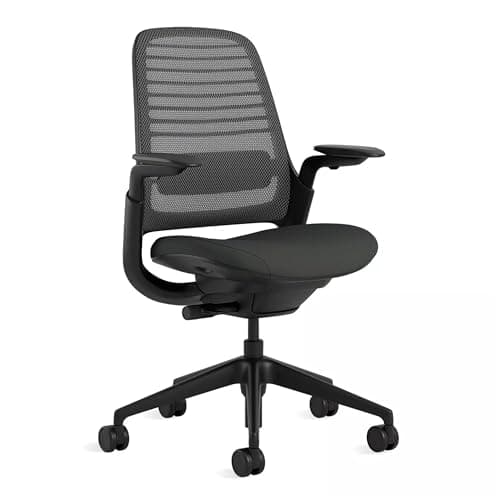
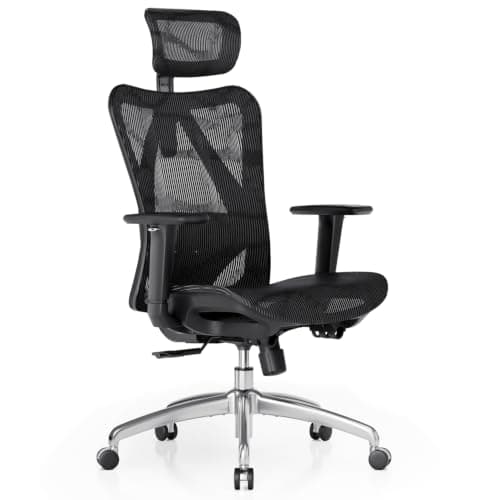
Your chair is not worn out and you are not doing it wrong. A seat that holds its height empty and drops the moment you sit on it has a leaking pneumatic gas cylinder — a sealed, pressurised component that is not serviceable. The lever is not the problem, the gas is. You have three honest options: clamp the chair at one fixed height for almost nothing, replace the cylinder for a little more, or replace the chair.
Before anything else, run the ten-minute test above. It is the whole diagnosis. A chair that sinks only under load is a cylinder; a chair that will not rise, or that drops while empty, is more often a lever or linkage problem, and that one you can genuinely fix for free.
What the cylinder actually does
The tube under your seat is a gas spring: compressed nitrogen on one side of a piston, a valve at the top, and a set of seals keeping the two sides apart. Pull the lever and you open the valve, which lets gas move between chambers so the seat can rise or fall; release it and the valve closes, trapping the gas and locking the height.
When the seals wear, gas bleeds past the piston under pressure. Empty, the chair has nothing pushing it down, so it holds. Sit on it, and your weight becomes the pressure that forces gas through the failed seal — slowly at first, which is why most people spend weeks pumping the lever before they accept what is happening. There is no fluid to top up and no seal you can replace. It is a sealed unit, by design.
This is also the most common reason a cheap chair reaches end of life, and it is worth knowing before you buy the next one. A chair can have a perfectly sound frame, mesh and foam and be finished off by a ten-dollar part. It is the single best argument for buying a chair from a manufacturer whose warranty is long and whose parts are orderable years later — the Steelcase chairs we rank carry a published 12-year term, against five to seven on most of the direct-to-consumer range. Check what your own policy actually names, though, because warranty length and parts coverage are different promises.
The hose-clamp fix, honestly described
It works. Tighten a hose clamp hard around the exposed cylinder tube at the height you want, and the seat physically cannot travel below it. Many people run a chair like this for years.
What it costs you is adjustment, and that is not a trivial loss. Your seat height is the figure that sets your forearm position against the desk, and the ability to change it is the thing that lets you sit differently in the afternoon than in the morning. If you share the chair, it is unusable. And if you have a sit-stand desk, a fixed-height chair undoes part of what you paid for — you can still raise the desk, but you have lost the seated half of the range.
Two practical notes. Wrap the tube with a strip of rubber or inner tube under the clamp so the clamp bites rather than slips, and set the height while sitting at your desk rather than guessing — if you are going to be stuck at one height, be stuck at the right one. Use our height calculator to work out what that height is, because it is set by your elbows and the desk, not by your legs.
Replacing the cylinder
The proper fix, and genuinely within reach: cylinders are largely standardised across the category, they are inexpensive, and removal tools exist because the taper that holds the cylinder into the base is a friction fit that gets stubborn with age.
Measure before you order. The three dimensions that matter are the tube diameter, the taper that seats into the base, and the overall extended length — and "largely standardised" is not "universal", especially on chairs from manufacturers who make their own. If your chair is from a brand with a real parts operation, order the part from the brand. If it is from a brand with no parts operation, that tells you something about the next chair you buy.
And one safety line that is not boilerplate. Do not cut, drill or puncture a cylinder.It is pressurised. The CPSC's recall record includes a 2019 recall of roughly 76,000 sit-stand workstations precisely because their gas cylinders could separate and forcefully discharge — one incident damaged office drywall. That is a manufacturing fault rather than a DIY injury, but it tells you how much energy is stored in the component you were thinking about taking a saw to.
When it is not the cylinder
Three other faults get reported as "sinking" and have different answers.
The chair will not rise at all. Usually the lever linkage rather than the gas. Look for a cable that has stretched, a lever that has rotated out of engagement, or a release pin that is no longer being pressed. Often free to fix.
The seat tilts forward or the back has loosened. That is the mechanism or its bolts, not the height. Check every bolt under the seat pan — this is also the failure class the CPSC recall record treats most seriously, including a 2025 recall of office chairs whose back-to-base bolts could fail and a 2012 recall over a weld between the seat plate and the gas lift. If a structural part of a chair is moving in a way it did not when new, stop sitting on it and look up whether your model has a recall.
The chair sinks into the carpet, not on its cylinder. Soft casters on thick carpet feel exactly like a slowly dropping seat. Swap to carpet-rated casters — the Steelcase listings, for instance, differ by caster type and the part number is the only way to tell which you ordered, which our Series 1 review decodes.
When a new chair is the cheaper answer
Do the arithmetic honestly. A replacement cylinder plus a removal tool, against the price of a chair that has real lumbar adjustment and a warranty. If the chair is otherwise sound — frame square, mesh intact, foam not flattened, armrests still adjusting — replace the cylinder; that is the lower-waste and lower-cost answer and it is what we would do.
Replace the chair instead if any of these are also true: the seat foam has gone flat, the lumbar support was never adjustable, the armrests do not move, or the chair was bought for under about a hundred dollars and this is its second failure. In that case you are repairing a chair that was never going to support an eight-hour day, and the money is better spent on one that adjusts. Our budget office chairs page is the realistic shortlist, and best ergonomic office chairs is the buy-it-once version. If your back is the reason you are reading this at all, start instead with office chairs for back pain — a chair that sinks is also a chair whose lumbar pad has been in the wrong place for weeks.
One last thing worth checking before you spend anything: performance standards exist for this. ANSI/BIFMA X5.1 is the office-seating standard, and chairs tested against it have had their height mechanisms cycled under load as part of the assessment. A manufacturer that publishes a dated certificate to it has committed to something measurable — which is the distinction we chase across the whole site, and which we set out in BIFMA explained.