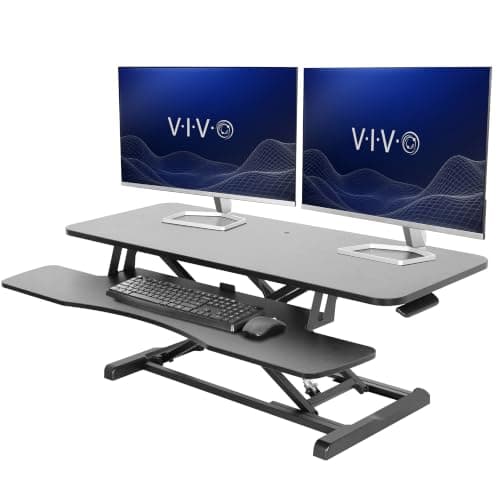
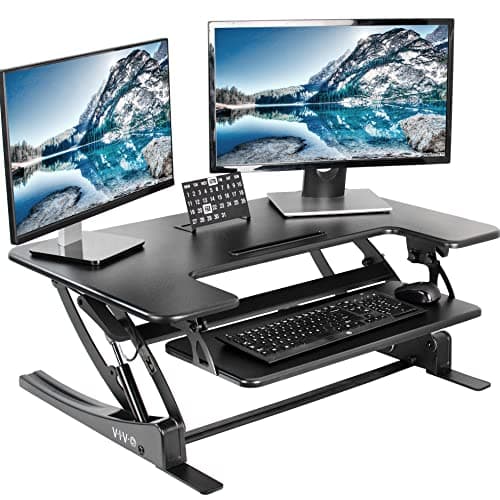
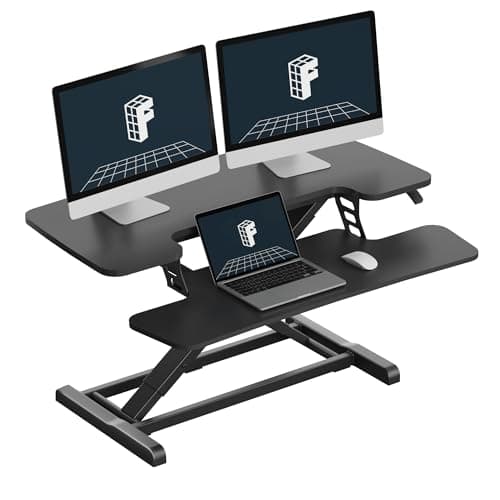
Under two hundred dollars, buy the FlexiSpot 36-inch converter. It is the cheapest unit here and the one we would hand to someone whose real question is "will I even use this", which makes it both the top pick and the budget pick on this page. If your desk is wide enough and you run a monitor plus a laptop, step up to the VIVO 42-inch instead — the extra six inches of surface is the only upgrade in this band that changes how the thing is used rather than how it feels. What no converter in this band buys you is a desk. Read the last section before you spend.
All three units carried a live price under $200 at the last price check; the figure and its as-of date render beside each pick rather than being typed into this page.
Who each pick is for
- FlexiSpot 36-inch converter (budget pick) — the lowest-risk way to find out whether standing to work suits you at all.
- VIVO 42-inch converter — a monitor and a laptop side by side, on a desk with the width to take it.
- VIVO 36-inch converter — the mid option, for a single-monitor setup on a standard-depth desk.
What two hundred dollars actually buys
A converter is three things: a surface, a lift mechanism and a keyboard shelf. In this band the surface and the shelf are fine — they are sheet material and they do their job — and the mechanism is where the money went missing. Above this band you find gas-strut and counterbalanced designs that rise under one hand with a load on them. Inside it you find spring-assisted and lever-locked lifts that want two hands and a deliberate movement.
That difference sounds cosmetic and is not, because a converter that is annoying to raise gets raised less. The entire health argument for sit-stand working is that you change posture several times a day — NIOSH's own writing on prolonged standing makes clear that standing all day is its own problem, not the solution to sitting all day — and a mechanism you avoid quietly turns a sit-stand desk back into a sitting desk. If you already know you will stand daily for years, the honest advice is to skip this band entirely.
The spec that decides it is depth, not height
Every converter in this band lifts far enough for most people. What catches buyers out is what the unit does to the desk it sits on. A converter occupies the full depth of your work surface and then adds its own base, so a 24-inch-deep desk with a converter on it has no room left for anything in front of the keyboard shelf. Measure the desk depth first and the converter's footprint second, in that order.
The second measurement is the lifted keyboard height against your elbow. OSHA's workstation guidance and Mayo Clinic both put the target in the same place — forearms roughly parallel to the floor, wrists straight — and a converter raises the keyboard shelf a fixed distance above the desk. If your desk is already tall, the shelf at full extension can overshoot your elbow height, which is the one failure mode a taller converter makes worse rather than better. Our standing desk height calculator gives you the target number before you buy, and our full converter ranking covers the units above this band where the mechanism is the point.
The uncomfortable arithmetic
Here is the thing the category does not advertise. For roughly the price of the cheapest converter on this page you can buy an electric standing desk — a whole desk, with a motor — and for a little more you can buy a dual-motor one. That is not a hypothetical: the cheapest full electric desk we rank sits inside this band, and our budget desk ranking is written about exactly that end of the market.
So a converter under $200 makes sense in three situations and not otherwise. You rent, and the desk is not yours to replace. You own a desk you love — a solid top, an heirloom, a fitted run — and replacing it is not on the table. Or you genuinely do not know yet whether you will stand, and the cheapest reversible experiment is the right one. We lay the comparison out in full on standing desk versus converter, and if the answer turns out to be a desk, the best standing desks is the page to read.
One materials note, because it is the reason this site exists. None of these three units publishes a GREENGUARD, BIFMA or CARB registration, and all three use laminate or engineered sheet material for the work surface. Treat them as uncertified on emissions, unbox in a ventilated room and give a new unit a few days before an eight-hour day — the same advice we give on off-gassing in the first 72 hours. If a certificate is your hard requirement, the answer in this category is a frame and a solid top, not a converter.
Before you buy
Measuring for a cheap converter
1. Measure the desk depth, then the converter footprint
A converter eats the whole depth of the desk. On a 24-inch-deep surface there is nothing left in front of the keyboard shelf.
2. Work out your standing elbow height first
Forearms parallel to the floor, wrists straight. A converter adds a fixed rise to whatever your desk already is, so a tall desk plus a tall converter overshoots.
3. Count the monitors honestly
One screen fits a 36-inch unit. A screen plus a laptop wants 42 inches, and two full monitors want a different product — see our two-monitor converter page.
4. Expect a two-handed lift
Spring-assisted and lever lifts in this band are not one-hand mechanisms. If you want that, it is above the band, and it is worth knowing before the parcel arrives.
5. Check the desk underneath can take the load
The converter plus a monitor plus the shelf all land on one patch of your existing desk. A thin or flexing top is the weak link.
6. Then compare it with a whole desk
At this money an entire electric desk is available. If you can replace the desk, the arithmetic usually favors doing so.