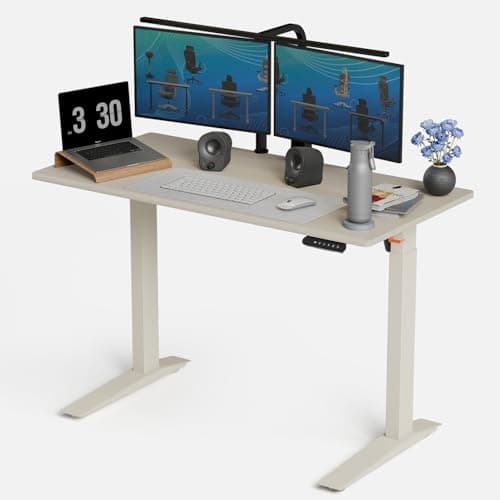
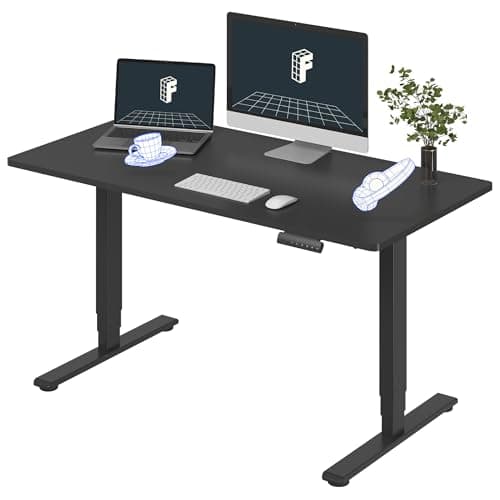
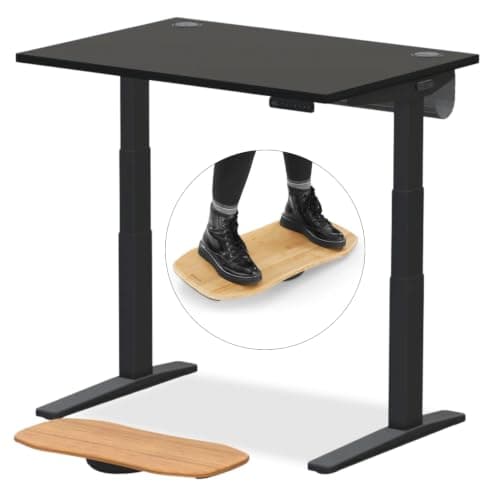
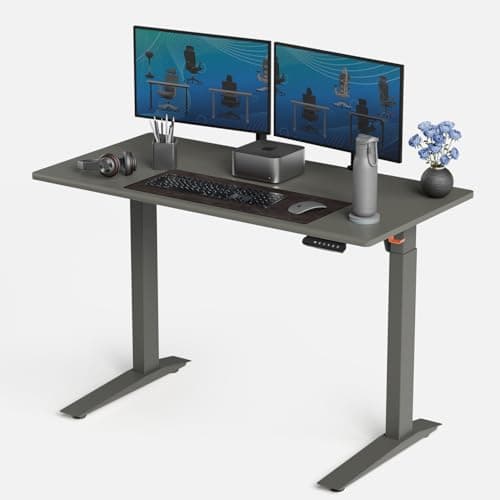
Autonomous does something almost nobody else in this category does: it manufactures its own frames, measures its own desk at full height, and prints the result. "A deliberate 15 lb shove moves the top under a quarter inch," its Desk 5 page says, with TÜV Rheinland named as the measurer. That is a real disclosure and it deserves credit. But there is one number on the Amazon listing that decides whether you should buy this desk, and it is not the capacity or the motor: the minimum height is 29.4 inches. A conventional fixed desk is 28 to 30 inches. So at its lowest setting, this sit-stand desk is about where the desk it replaces already sat. It adds standing. It does not fix sitting — and for most people, sitting is the half of the day that is wrong.
The number that decides this desk
We read both live Amazon listings on 2 October 2026 and pulled the detail table from each one separately rather than assuming the two colorways matched. Both print the same figure: Minimum Height 29.4 inches. Autonomous's own Desk 5 page gives 29.5"–48.5" for the Pro configuration. Those two numbers agree with each other, and they agree on the thing that matters: the bottom of the range is a normal desk height.
Cornell's ergonomics guidance describes a fixed work surface of 28 to 30 inches as suiting most adults — which is exactly the problem a sit-stand desk is supposed to solve for everyone outside "most adults". Using the stature ratios behind our desk height calculator, a seated surface lands near 24.6 in at 5 ft 0, 25.4 in at 5 ft 2 and 26.2 in at 5 ft 4. A desk that stops at 29.4 in cannot reach any of those. It is three to five inches too high for a shorter sitter, permanently, in exactly the way a standard desk already was.
For context inside our own catalog: the UPLIFT V3 publishes 22.6 in at the bottom, the FlexiSpot E6 23.6 in, and the Branch Duo 28 in — and we rank the Branch Duo LAST on our standing desks for short people page precisely because 28 in is too high. The Desk 5 sits above even that. It is the highest floor of any desk on this site.
One important exception, and it is Autonomous's own: the Desk 5 Pro AI is published at 24.25"–53.5", which is a genuinely excellent range. That is not the desk on Amazon. If the low end matters to you and you want this brand, the configuration you need is the one you have to buy direct.
Three height ranges for one desk
This is where the disclosure gets slippery, and it is worth being precise because it is not a rounding difference. For the same desk family, three published figures:
- The listing bullets: "The adjustable range (approx. 28" to 47" depending on model)". That sentence hedges twice — "approx." and "depending on model" — on a product page for one specific model.
- The same listing's detail table: Minimum Height 29.4 inches. Amazon's structured field, filled in by the seller, contradicts the seller's own bullet by an inch and a half.
- Autonomous's own Desk 5 page: 29.5"–48.5" for the Pro, 24.25"–53.5" for the Pro AI. Two tiers, two ranges, and the Amazon listing never says which tier it is — although its part number field reads "Desk 5 AI" while its bullets describe none of the Pro AI's sensors.
We are not going to resolve that for you by picking the most flattering number, which is what a spec table would do. The honest reading is that the structured field and the manufacturer's own site agree on roughly 29.5 in, the bullet is the outlier, and a buyer who needs a specific minimum height should ask Autonomous in writing before ordering. Our standing desk size guide covers how to work out the number you actually need first.
What Autonomous publishes about materials, and what it does not
Autonomous's Desk 5 page carries a small block of material claims, and it is a good example of why this site reads labels literally. Here is every one of them, verbatim, with what it commits to:
- "Eco-certified", next to a rating of "Green". No certifier is named, no program is named, no certificate number is given. "Eco-certified" by whom, to what? There is nothing here to look up, which means there is nothing here to verify.
- "HDF top sealed with Green Standard paint, no off-gassing." "Green Standard paint" is not a published standard we can find; it reads as a product name. And "no off-gassing" is an absolute claim about a high-density fiberboard panel — a composite board bound with adhesive resin, which Amazon's own detail table calls "Engineered Wood". Sealing a panel reduces emissions; it does not take them to zero. Our formaldehyde in desks explainer walks through the chemistry.
- "Formaldehyde emission <0.5 mg/L". This is the most useful line on the page, because it is a number rather than an adjective. But no test standard is named beside it and no certifier is named — and 0.5 mg/L is a threshold that only means something once you know which method produced it. State it as Autonomous's figure, which is what we are doing.
- TÜV Rheinland. A real, serious certification body — and on this page it is attached to the stability measurement, not to emissions and not to a durability standard. "TÜV Rheinland measured every point" follows the shove-test figures. No report number and no test standard is given, so it is an attribution rather than a certificate.
What is absent is the whole list this site exists to check: no GREENGUARD certificate, no GREENGUARD Gold certificate, no third-party BIFMA mark, no ANSI/BIFMA X5.5 compliance statement, and no certificate number for anything. That is not an accusation — an unpublished certificate and a nonexistent one look identical from outside, and we say so rather than guessing. But a certificate nobody points you at cannot be verified, and "Eco-certified" is not the same kind of object as a registered GREENGUARD Gold listing. If a real certificate is your filter, our GREENGUARD-certified standing desks page is the shorter list you want.
The warranty clause is the sharpest risk here
Autonomous's Desk 5 page advertises a generous warranty: frame lifetime, top two years. Its warranty policy page, read the same day, says something that sits awkwardly beside that:
"All Autonomous products purchased from dealers or resellers are not eligible for a warranty. We only sell replacement parts for customers who bought products directly from Autonomous."
Two things matter about that sentence, and they point in opposite directions. In Autonomous's favor: both live Amazon listings ship from and are sold by AUTONOMOUSINC. — the brand itself, not a marketplace reseller. We checked the sold-by line on both. That is the best case available on a marketplace, and it is the same test we apply to Steelcase and Herman Miller listings.
Against it: the policy does not name Amazon as an authorized channel the way Branch's policy does, and the term table on that policy page lists the Desk Levitate, the Desk Business Edition, the Desk Connect, the Desk Core / SmartDesk 2, the Desk 2 Home Edition and several ErgoChair models — and never names the Desk 5 at all. So the lifetime-frame figure lives on a marketing page rather than in the policy that governs claims, and Amazon's own structured field for this listing just says "Warranty Type: Limited", with no term.
The practical advice is short: before you order, ask Autonomous support in writing whether a purchase from its own Amazon storefront carries the Desk 5 frame warranty, and keep the answer with your order confirmation. On a desk whose single best feature is a frame, a frame warranty you cannot invoke is the difference that matters — more than any discount.
What the desk genuinely gets right
It would be easy to read the sections above as a hatchet job, and that is not the finding. On construction, Autonomous is doing more than most of the brands we rank:
- It makes the thing. "We cut and weld our own steel, finish our own tops, and check every unit before it ships." Most desks in this price band are assembled from contract-manufactured parts by a brand that specifies rather than builds. Vertical integration is not a certificate, but it is a real difference in who answers for a defect.
- It publishes its own wobble numbers. Under a quarter inch of movement at full height under a 15 lb shove, under a tenth under a 5 lb nudge. We did not measure that and we are not endorsing it as tested — but a brand that commits to a figure can be held to it, which is strictly better than the adjectives the rest of the category uses. Wobble at standing height is the complaint that defines this product class; see how to fix standing desk wobble.
- The C-frame has no front crossbar. That is a real ergonomic gain, not a styling choice — there is nothing across your shins, and you can pull a chair fully under the desk.
- Dual motor and anti-collision, per Autonomous. Its own page states dual motors, a 1.2 in/sec lift speed and collision detection for the Desk 5. Note that the Amazon bullets never state a motor count, and quote ≤50 dB where Autonomous's page claims under 30 dB.
- SPCC steel base, 0.7 in top, 300 lb published capacity on Amazon — against 330 lb on Autonomous's page for the Pro. A typical home load is 40 to 80 lb, so either number is several times what you will put on it; our weight capacity guide explains why that figure is really a proxy for how overbuilt the frame is.
Which Autonomous can you actually buy?
This is worth stating plainly, because Autonomous has one of the largest direct-to-consumer catalogs in the category and almost none of it is on Amazon. Resolving the brand against the Amazon catalog on 2 October 2026 returned exactly two purchasable products: the Desk 5 in 48×24, in Gray and in Beige, normally listed at the same price. Two further listings exist and are not buyable — the 53×29 Desk 5 and the Autonomous Edition Hybrid frame both return "Currently unavailable".
So the brand review that this page would ideally be — Desk 5 against Desk Pro against Levitate — is not available to a buyer shopping on Amazon, and we are not going to review products you cannot buy. The two picks below the Autonomous desks are cross-brand checks at a comparable price, which is how we handle a one-model brand.
Who should buy something else, and what
Two groups should skip this desk, and we would rather say so than collect the commission:
- Anyone who needs the desk to go low. If you are under roughly 5 ft 10, the 29.4 in floor means you will be sitting too high all day — which is the thing you were buying a sit-stand desk to fix. The FlexiSpot E6 reaches 23.6 in and sits in the same budget bracket; the UPLIFT V3 laminate reaches 22.6 in and is the one with a published GREENGUARD Gold document for its desktop line.
- Anyone buying on the strength of "eco-certified". There is no certificate to check. If low emissions is the filter, the UPLIFT laminate line is the desk on this page with a real published document, and our non-toxic standing desk picks rank that question specifically.
And who should buy it: a taller sitter who wants a 48×24 desk from a brand that welds its own steel and will put a stability figure in writing, bought from the brand's own storefront, with the warranty path confirmed first. That is a real buyer, and for them this is a reasonable desk at a reasonable price. It is just a narrower buyer than the marketing suggests.