Sore feet at a standing desk is nearly always one of four things: too many consecutive hours, a hard floor, standing dead still, or unsupportive footwear. Cut the blocks to 30 to 45 minutes, put a compliant surface underfoot, move your weight around deliberately, and wear something with a midsole. In that order.
Where it hurts tells you what to change
- Heel, and worst in the first steps of the morning. This is the classic plantar fasciitis pattern OrthoInfo describes, and it is the one to take seriously rather than cushion harder. Arch support and a clinician matter more than a mat here — we cover the mat side at mats for plantar fasciitis.
- Arch, aching and diffuse. Usually fatigue in the small muscles that hold the arch, which happens when they hold one position for hours. Movement and a mat with terrain help more than raw softness.
- Ball of the foot, burning. Weight sitting too far forward — often because the desk is too high and you are reaching, or because you are leaning into the desk. Fix the height before anything else.
- Both feet, generalized, worse late in the day. Dose. You are standing too long in one stretch and probably ramped up too quickly.
The reason standing hurts more than walking
Walking a mile is easier on your feet than standing still for the same time, which surprises people. The reason is circulation. Walking uses the calf muscles as a pump that pushes blood back up the leg; standing still switches the pump off, so blood pools in the lower limbs while the same tissues stay statically loaded.
That is the mechanism behind the aching, the heaviness and the swelling, and it is why the fix is movement rather than cushioning. NIOSH's material on prolonged standing at work makes the same point: static standing is its own hazard, distinct from both walking and sitting.
Free things that work, in order
- Shorten the standing block. Thirty to forty-five minutes, then sit. If you have just bought the desk, start at fifteen and build across a month. Nearly all first-week foot pain is a ramp problem.
- Move your weight deliberately. Shift from foot to foot, rock heel to toe, and use the bar-rail trick — one foot up on something low for a few minutes, then swap. This alone changes how a long block feels, and it is the same correction that resolves most standing desk hip pain.
- Check the desk height. If you are reaching up, your weight is on your forefoot. Set the desk with the elbow test and the height calculator.
- Stop standing dead still. Take calls standing and walking, and let yourself fidget. The goal was never a statue.
- Wear something. Barefoot on a hard floor is the worst case for most people — the barefoot-versus-shoes question is worked through in shoes or barefoot at a standing desk.
When a mat is genuinely the answer
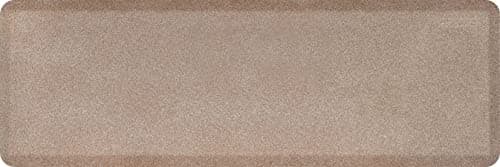
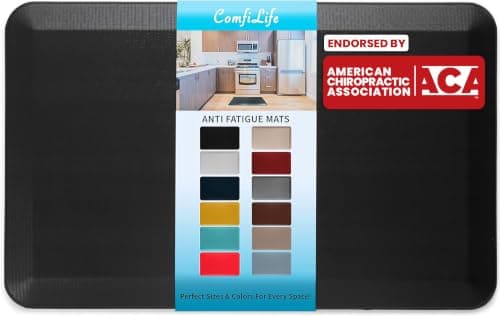
A mat earns its money when the floor is hard and you have already dealt with dose and height. It is not a fix for standing eight hours, it is not a fix for a desk at the wrong height, and it is not a treatment for heel pain that is already established.
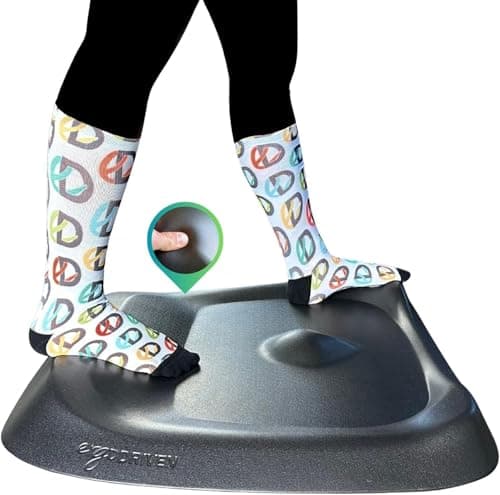
What it does do is supply compliance the floor does not have, and — in the case of a sculpted mat — provide terrain that produces small, continuous changes in foot position. For static aching, that second property does more than thickness. For a genuinely hard floor, thickness matters and the details are in mats for concrete floors. If you want to know whether you need one at all, that argument is at do you need an anti-fatigue mat.
What we would spend money on, in what order
Nothing, then a mat, then footwear, then a perch. The nothing is genuinely first — most people who write about painful feet at a standing desk have been standing for two-hour blocks on a tile floor in socks within a fortnight of buying the desk, and three free changes fix it. If the floor is hard and the pain persists after those, a good mat is the single best twenty minutes of shopping you can do. A leaning stool comes last, as the third position that takes the load off entirely without going back to a chair — standing desk stools covers those.
When to stop self-treating
Sharp heel pain first thing in the morning, numbness or tingling, swelling that does not settle overnight, or pain that persists after several weeks of doing everything above — those are reasons to see someone, not reasons to buy a thicker mat. This page is general information and not medical advice.