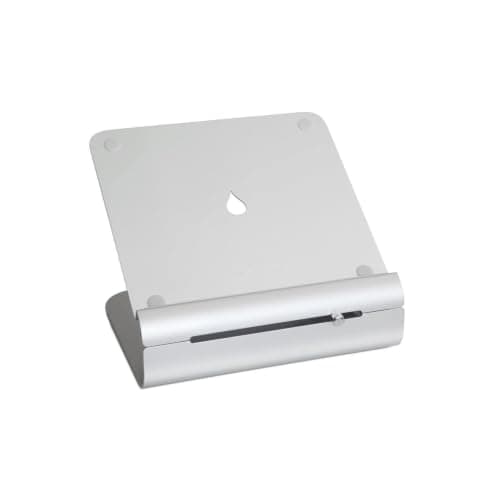
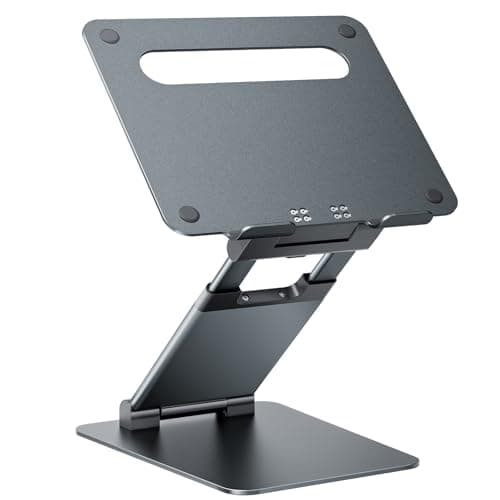
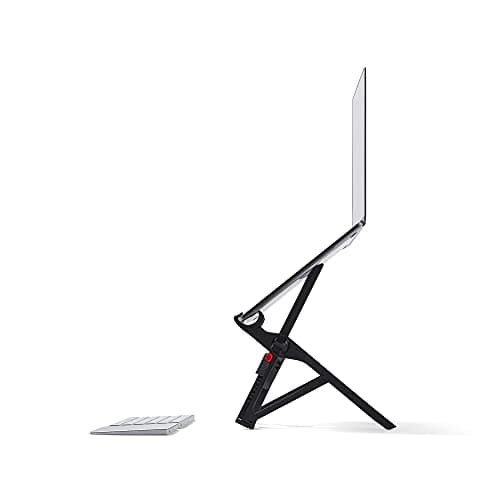
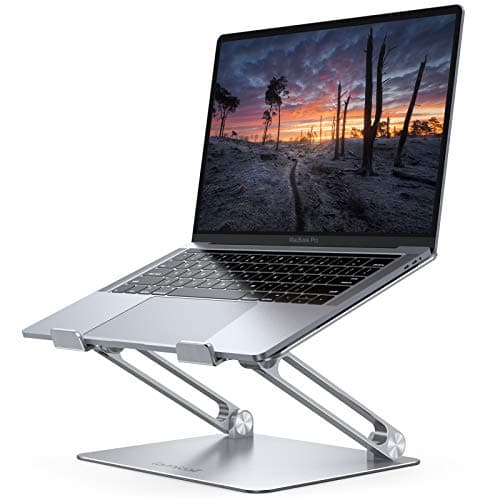
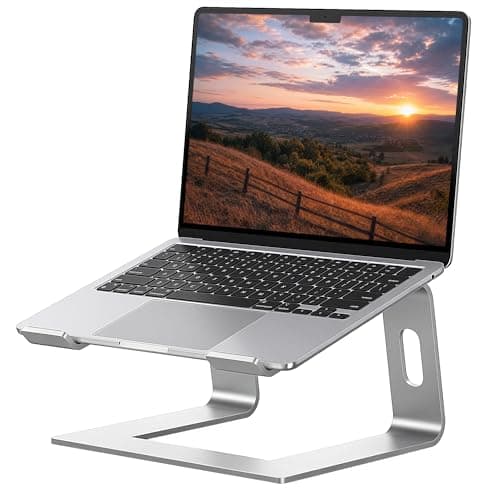
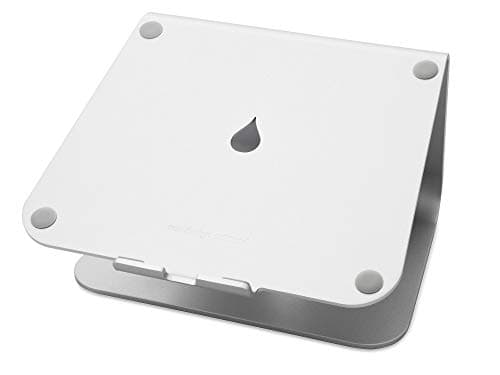
Buy the Rain Design mStand for a fixed desk setup and the iLevel2 if you need the height to adjust. Both are single-piece aluminum, which means nothing to sag and nothing to off-gas. But the stand is only half the purchase: raising a laptop without adding a separate keyboard raises your hands with the screen and solves nothing.
The laptop problem, stated properly
A laptop bolts the screen to the keyboard. Put the keyboard where your hands should be and the screen is roughly a foot below where your eyes should be; put the screen at eye level and your hands are at chest height. There is no position that serves both, which is why laptop-only work reliably produces forward head posture — the head drifting forward and down, with the neck and upper back holding it there for eight hours.
OSHA's workstation guidance and Mayo Clinic's desk setup advice both put the top of the screen at or slightly below eye level, at roughly arm's length. A laptop on a desk is nowhere near that, and no amount of sitting up straight fixes a geometric problem.
The fix is to separate the two halves: stand raises the screen, external keyboard and mouse restore the hands. Together that is the single highest-value ergonomic change most laptop users can make, and it costs less than a chair.
How high does it actually need to go?
This is the specification listings hide, and it is the one that decides whether a stand works for you. Most fixed stands raise a laptop about five to seven inches. For a person of average height seated at a standard desk that lands close to right; for a tall person it is not close at all.
- Sit properly first, chair set for your elbows, feet flat or on a footrest.
- Look straight ahead, then measure the gap between your eye line and the top of the laptop screen where it sits now.
- That is the rise you need. If it is more than about seven inches, buy an adjustable stand — the iLevel2, the Nulaxy telescoping model or the Roost.
- If you use the same laptop sitting and standing, the stand has to adjust. Standing changes your eye height by more than any fixed riser accounts for.
Aluminum, plastic and the materials angle
This is one of the few categories where the material question is genuinely easy. A solid aluminum stand has no foam, no laminate, no composite core and no adhesive — it is an inert object, and there is nothing to break in, nothing to off-gas and nothing to compress. On a site that spends most of its time explaining what is ina product, it is worth saying when the answer is "metal".
The Roost is the exception and it is a reasonable one: glass-filled nylon, an engineering plastic, chosen because aluminum cannot fold to that size. It is still a solid molded part with no emissions pathway of consequence. The stands to be skeptical of are the ones with foam pads and fabric-wrapped surfaces, and none of those made this list.
A laptop riser is the one case where a fixed stand genuinely beats an articulating arm, because a laptop's screen and keyboard are attached and no arm can separate them. If you are raising an external monitor rather than a laptop, the calculation is different and we run it in monitor arm vs monitor stand.
Stand plus what?
Budget for three things, not one:
- A separate keyboard. Without it the stand is pointless. A split or sculpted board is better again — our ergonomic keyboard roundup covers the options.
- A separate mouse. A trackpad at chest height is worse than a trackpad on a desk. A vertical mouse is the usual upgrade here, and our ergonomic mouse picks explain why.
- Somewhere for the keyboard to go. On a shallow desk, the stand plus a keyboard eats the depth you need for a comfortable viewing distance. A keyboard tray buys that depth back.
And the honest alternative: if the laptop lives on one desk permanently, an external monitor on a monitor arm is a better setup than any stand — a proper screen at a proper height, with the laptop closed or used as a second display. The stands on this page are for people who need the laptop screen itself.