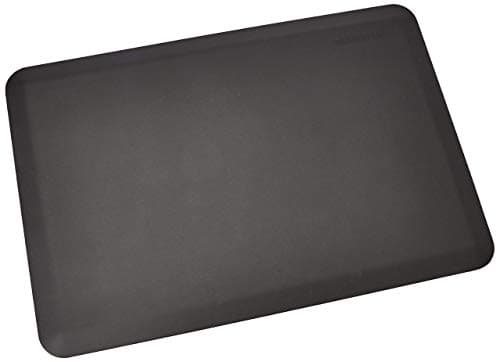
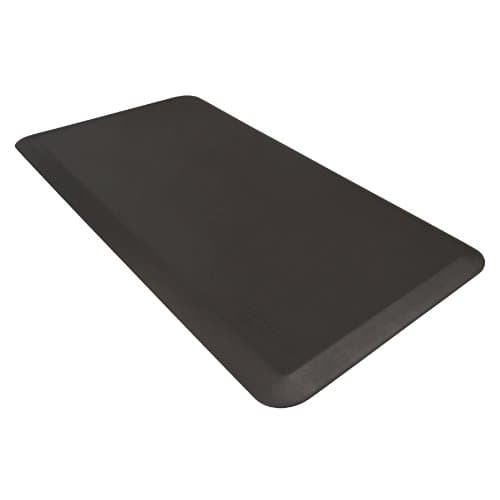
Buy a WellnessMats if what you want is to know what you are standing on. WellnessMats states its mats are 100% polyurethane and free of formaldehyde, heavy metals, PVC, BPA, latex, plasticizers and phthalates, that they are odor-free and will not off-gas the way rubber, vinyl and biodegradable foam mats do, and that they pass CFR 1630/1631 surface-flammability testing. That is a specific, checkable, falsifiable statement, and it is the strongest material disclosure in this category by a wide margin. It also costs two to five times what a good budget mat costs, and it is firmer than most people expect.
Why a named exclusion list beats the word "non-toxic"
"Non-toxic" is not a defined term. No body issues it, nobody has to substantiate it, and it appears on mats whose manufacturers have never disclosed a single ingredient. It is the weakest claim in the category and it is also the most common one.
A named exclusion list is the opposite kind of statement. It names specific substances, which means it can be wrong, which means someone can be held to it. That is what makes it worth something. Our PFAS and PVC explainer ranks mat claims in descending order of usefulness and this construction sits at the top of that ranking — specifically because it is falsifiable.
One boundary worth drawing clearly, because it is where reviews of this mat usually overreach: a manufacturer disclosure is not a third-party certificate. WellnessMats is telling you what it puts in the product; GREENGUARD would be UL Solutions telling you what comes out of it in a chamber test. Those are different levels of evidence, and we cover the difference in what GREENGUARD actually certifies. The mat category has essentially no GREENGUARD entries at all, which makes the disclosure the best available evidence rather than the best possible evidence.
What single-piece construction actually buys you
Most mats are a foam core with a separate surface layer bonded on top. That bond is the failure point: it delaminates, bubbles, or the core compresses under the heel positions you use most and develops a dead spot. Once a mat has a dead spot, it is finished, and most budget mats reach that point somewhere between year one and year three.
A single-piece polyurethane mat has no bond line to fail. It also cannot separate at a cut edge, which is where cheap mats start peeling. That is the mechanism behind the 20-year residential warranty — it is not marketing bravado, it is a claim the construction supports.
The corollary is a real cost: you cannot buy a thin one. The construction that makes it last makes it substantial, and a WellnessMats is heavier and more of a permanent installation than a rolled foam mat you can shove in a cupboard.
The firmness, which is the main complaint
This mat supports; it does not sink. People who have used a plush gel or memory-foam mat frequently describe their first day on a WellnessMats as disappointing, and it is worth understanding why the firmness is deliberate rather than a defect.
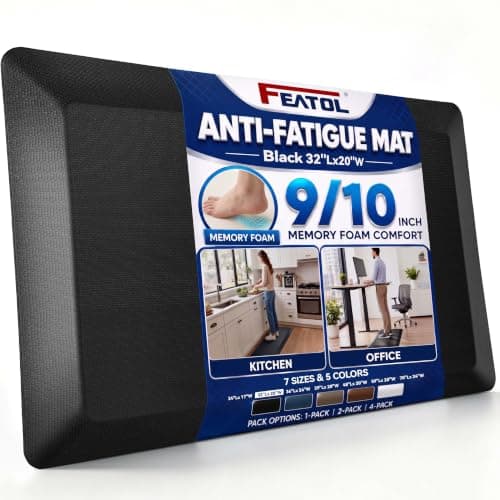
A soft mat feels wonderful for ten minutes and then your foot has sunk into a hole, your ankle is working to stabilize, and after an hour you are more tired than you would have been on the floor. Firm PU foam that returns energy is the construction every professional standing-workstation mat uses, and it is what the top of our main mat roundup consistently rewards. If you genuinely want plush, the FEATOL is nearly an inch thick and costs a fraction of this — and will not last a fifth as long.
Where it stops short, honestly
- No third-party certificate.Everything above is the manufacturer's own disclosure plus a flammability standard. There is no chamber-tested indoor-air certification. GelPro's Eco-Pro line does carry a third-party mark — for slip resistance rather than emissions — which is the trade we lay out in WellnessMats vs GelPro.
- It is flat. No terrain, no prompts to move. If your problem is stiffness from standing still rather than a hard floor, the Topo comparison is the page you want, and a balance board is the cheaper fix.
- The price is the price. There is no budget WellnessMats. The smaller 36×24 Original is the cheapest way in and it is still several times a mainstream foam mat. If the mat is a nice-to-have rather than something you will stand on daily for a decade, the maths does not work — a good $50 PU mat replaced twice still costs less.
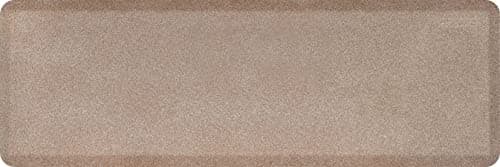
- Sizes and finishes come and go. WellnessMats sells across several collections and individual sizes drop in and out of stock on Amazon — the Granite SKU we previously tracked had no live offer when we checked this page. Buy from the listing that is actually available; the material position is identical across the range.
- Color and finish options are limited compared with the mass-market brands, and the surface texture is a matter of taste.
Who should buy it
Buy it if you stand at a desk most working days, on a hard floor, and you would rather buy one thing that lasts than three things that do not — and if the material question is the one you actually care about. That is a specific buyer, and for that buyer this is the clearest purchase in the category.
Do not buy it if you stand occasionally, if you want something soft, or if you are still working out whether a standing desk suits you at all. In those cases start cheap, read our non-toxic mat rankings for the mid-price options, and upgrade when the habit sticks.