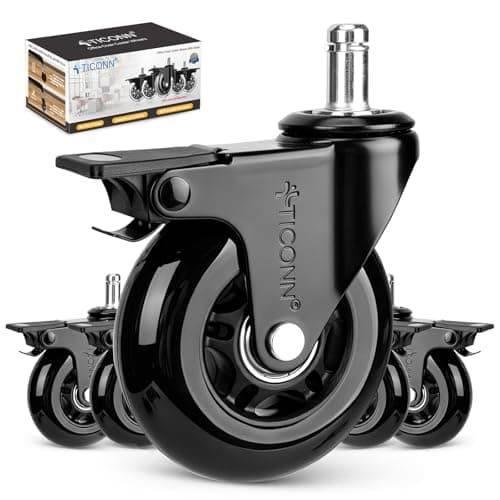
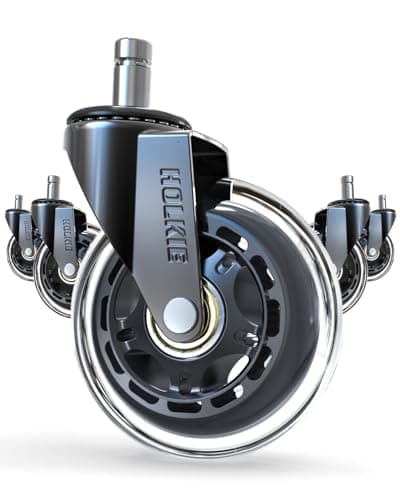
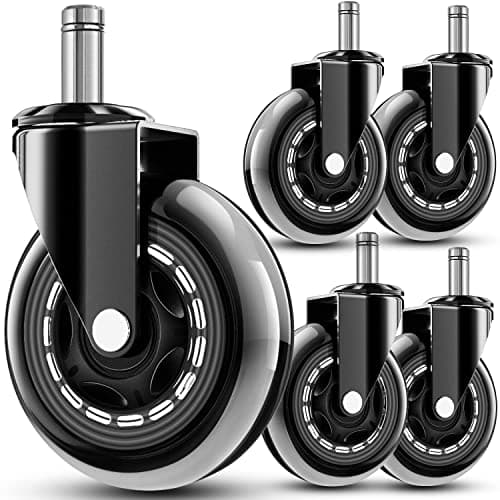
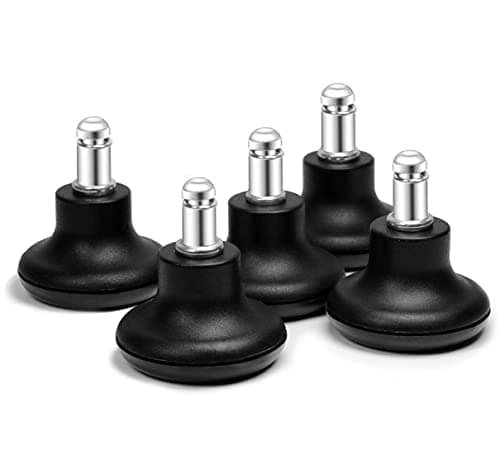
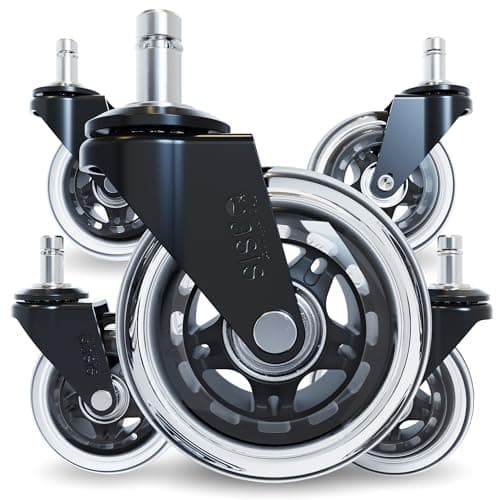
For a hardwood, LVP or tile floor, buy a soft-tread rollerblade-style caster — The Office Oasis set is the default. If you want a written load figure, the TICONN set states 650 lb on its own listing. If the chair will not stay where you put it, or the carpet is thick, stop rolling: five bell glides cost about fifteen dollars and end the problem. Before you buy any of them, do the five-second fit check below, because a caster that does not fit your chair's socket is a caster you are returning.
Why the stock casters are the problem
Nearly every task chair ships with small, hard wheels. The caster trade is direct about what hard treads do: CasterHQ's wheel-materials guide ranks soft urethane first for floor protection — it "conforms to floor; best floor protection available" — describes polyurethane as non-marking and quiet, calls solid rubber "excellent non-marking", and says glass-filled nylon "marks and damages finished floors", recommending it only for unfinished concrete or industrial floors. Nylon's compensation is load: it carries the most weight per wheel of the common polymers, which is exactly why a furniture maker reaches for it. A hard tread is also the usual source of a chirp on a finished floor, which is one of the cases in why your office chair squeaks — worth reading first if noise rather than floor damage is what sent you here.
The working rule the guide supports is that the tread should be softer than the floor. A soft wheel deforms around grit and spreads the load; a hard wheel concentrates it at a point and carries debris across the finish like a stylus. That is also why the same wheel behaves differently on carpet: on pile, a harder, larger wheel rolls more easily, which is why a chair that glides beautifully on hardwood with soft casters can feel heavy on thick carpet.
Durability is not the issue people assume it is. The caster is one of the components ANSI/BIFMA X5.1 tests — the standard's test list for general-purpose office chairs includes caster durability alongside the back-strength, drop, swivel, tilt, stability, arm and leg tests. A chair tested to X5.1 has had its casters cycled. What X5.1 does not do is tell you what the tread will do to your floor.
The fit check: do this before you buy anything
Tip the chair on its side and pull one caster straight out of the base. Most office chairs use a grip-ring stem: a split metal ring near the top of the pin that compresses into a channel in the socket, which is why the caster pulls out with force rather than unscrewing. If yours threads out like a bolt, you have a threaded stem and the snap-in casters on this page will not fit it at all.
Then measure the pin. The dimension the aftermarket treats as the office-chair standard is 7/16 in diameter by 7/8 in long — which is 11 mm by 22 mm, and the reason you see both sets of numbers. One product on this page states that dimension on its own listing; most do not state any dimension at all, which is the honest state of this category. Caliper it if you have one, a ruler if you do not, and treat any "fits 98% of chairs" claim as marketing rather than a specification. Smaller 10 mm stems exist on some older European and US chairs.
What this category will and will not tell you
We went looking for published specifications for every set here and came away with very little. The brand page for our top pick returned a 404 on the path we tried. The 650 lb figure that circulates for it appears in a competitor's comparison table rather than on the maker's own site, so we are not repeating it as a specification — the only load number on this page that we will quote is TICONN's, because TICONN puts it in its own listing title. Two of the five name a tread material in the listing; none publishes a durometer, a bearing spec or a material data sheet.
That is worth saying out loud on a site whose whole filter is documentation. Casters are a category where the documentation does not exist yet, so the ranking here rests on the material class the seller names, the fit information the listing gives you, and what the physics of a soft tread on a finished floor predicts. Nothing here was tested by us. We do not have a lab, and our methodology page says so in those words.
Casters or a mat?
On a hard floor, casters first. A $20 tread change addresses the contact patch where the damage actually happens, costs a fraction of a good mat, takes up no floor space and does not raise a materials question of its own — a small rubber or urethane wheel is a far smaller piece of polymer than a 48-by-60-inch sheet of vinyl. If you still want the floor covered after that, our chair mat roundup ranks mats by what they are made of, including the plasticizer-migration mechanism that makes a vinyl mat the wrong choice over LVP.
On carpet it is the other way round. Soft casters do not help on pile; they sink into it. What helps on carpet is a hard rolling surface over the top — a carpet-rated mat — or giving up on rolling and fitting glides.
The case for glides, which nobody makes
Every caster roundup assumes you want to roll better. Sometimes the right fix is the opposite. A chair that drifts on a sloped floor, rolls off its mat, or has to be hauled back to the desk twenty times a day is not a chair with the wrong wheels; it is a chair that should not be on wheels. Bell glides swap the five casters for five fixed feet, keep the seat height almost unchanged, and cost less than a takeout dinner.
They suit three situations in particular: a standing-desk stool or perch that should stay put (see standing-desk stools), a chair on thick carpet where rolling was never really working, and any floor with a slope. They are wrong for anyone who rolls between two monitors as part of their actual workflow — which is a real posture consideration, not a convenience one, and is covered in dual monitor ergonomics.
Installing them: the five-minute version
Lay the chair on its side on something soft. Pull each old caster straight out — the grip ring will resist, and pliers or the claw of a hammer give you leverage if fingers are not enough. Check the socket is clean, then push the new stem in until the ring seats with a click. Do all five, stand the chair up, and roll it before you sit: a caster that is not fully seated will drop out under load. Keep the old set. If the new wheels are wrong for the floor, you want the option to go back.
Choosing casters in four checks
1. Stem type, then stem size
Grip-ring or threaded first — they are not interchangeable. Then 7/16 in by 7/8 in (11 mm by 22 mm) unless your chair says otherwise. Measure; do not trust a percentage claim.
2. Match the tread to the floor, not to the marketing
Finished hard floor: soft urethane or rubber. Unfinished concrete or a garage workshop: hard nylon is fine and will outlast everything. Carpet: tread hardness matters less than wheel diameter, and nothing beats a hard rolling surface laid over the pile.
3. Wheel diameter is the quiet upgrade
Three-inch wheels clear thresholds, cable edges and carpet transitions that two-inch wheels stop dead against. Larger wheels also distribute the same weight over a longer contact patch. Check your seat height afterwards — bigger casters raise the chair slightly, which can matter if you are already at the top of your height range (our height calculator covers the numbers).
4. Buy five, not four
Office chair bases are five-star; a mixed set of four new and one old is a wobble you will feel within a week. Every set on this page is a set of five for that reason.