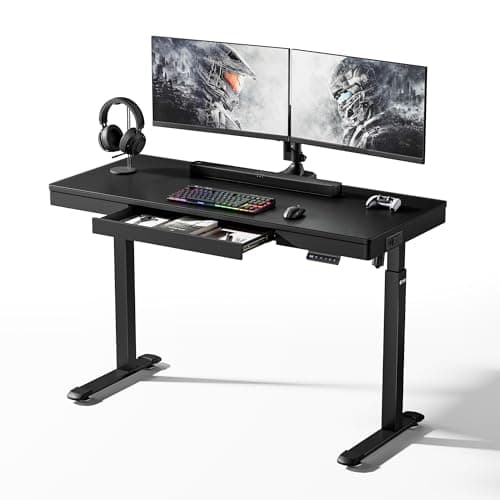
If you are buying a Eureka, buy the frosted glass one. Eureka publishes no emissions certificate for any desk it makes, so the usual way this site resolves a desk — look the model up in a registry — is closed. A tempered glass top closes the question a different way: there is no particleboard core, no adhesive resin and no laminate in the surface, so there is nothing in it to off-gas. That is a materials answer rather than a paperwork one, and on this brand it is the only kind of answer available.
The rest of this review is about why that is the recommendation, because Eureka is a genuinely unusual case. Most undocumented desk brands are undocumented because they are not paying attention. Eureka is paying enormous attention — it just points it outward.
What Eureka Ergonomic actually is
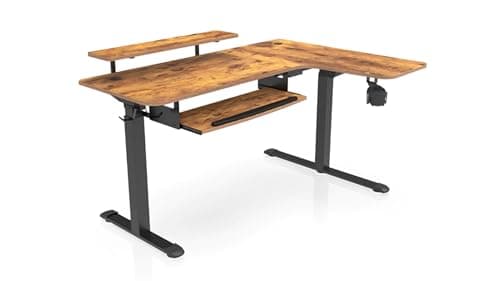
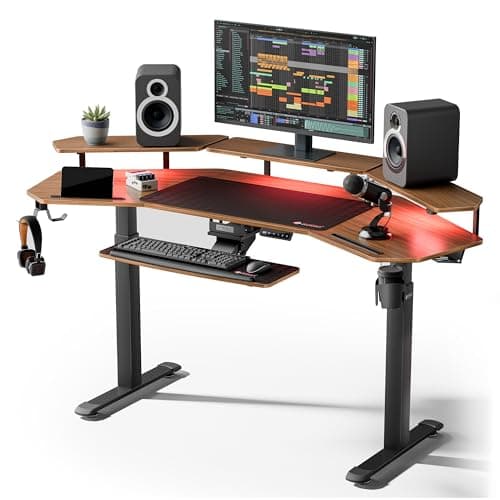
Eureka is a design-led sit-stand brand: L-shaped corner desks, wing-shaped studio and gaming workstations, executive desks with integrated drawer banks, glass and stone tops, and a long tail of accessories. It sits above the marketplace budget cohort on price and well below the contract brands, and the thing it competes on is shape. If you want a 61-inch corner desk with the keyboard tray and monitor shelf already attached, or a 72-inch studio top with a cable slot cut into it, Eureka makes one and most of the brands we rank do not.
That matters for how you read this page. Like the FEZIBO review, a "Eureka review" is a brand review rather than a model review — there is no single flagship, there is a catalog of layouts.
The library, and what it does not say
Here is the part that makes Eureka worth writing about. The brand runs one of the most thorough certification-education libraries in this industry. There are Eureka explainers on what BIFMA certification is, on the specific X5.5 durability tests, on desk load standards, on BIFMA versus GREENGUARD, on GREENGUARD versus GREENGUARD Gold, on desktop materials for LEED and WELL credits, and on how to read a standing desk warranty. They are accurate. Several of them are clearer than what the certifying bodies publish themselves.
In its own eco-friendly standing desk guide, Eureka tells the reader to "prioritize products with UL GREENGUARD Gold Certification". The same guide then recommends four Eureka products. None of them is stated to carry one.
We went looking for the certificate that would resolve that, and did not find it. Across Eureka's product pages and its blog there is no GREENGUARD certificate, no GREENGUARD Gold certificate, no third-party BIFMA certification mark for any desk, and no certificate number anywhere to enter into a registry. Its BIFMA-versus-GREENGUARD explainer references the BIFMA Compliant product registry and UL's SPOT database by name — and links to no Eureka entry in either. You can run both searches yourself in about a minute, and you should; that is the whole method this site is built on, and it is set out in our GREENGUARD explainer.
We want to be fair about what that does and does not mean. It does not mean the desks are unsafe, and it does not mean Eureka is being dishonest — writing a good explainer about a standard is not a claim to hold it. The overwhelming majority of desks sold in this country carry no emissions certificate at all. What it means is narrower and more useful: on the one question this site exists to answer, the brand that explains the answer best has not published one for itself.
What Eureka does publish about its own desks
Two things, and both are worth having.
Real specification numbers.Unlike FEZIBO, Eureka does put specs on its own domain. The Ark X Executive page, to take the model that matches the executive desk ranked below, publishes a 29.9 to 48.4 inch height range, a 220 lb capacity, dual motors on 2-stage legs, and anti-collision with a named Hall sensor. Those are checkable figures on the maker's own site rather than marketplace copy, which is a meaningfully higher standard than the budget cohort manages.
Two things in that list are worth pausing on. 2-stage legs are one segment short of the 3-stage legs on a FlexiSpot E6 or an UPLIFT V3, which is the single biggest contributor to how steady a desk feels at full standing height — see why standing desks wobble. And a 29.9 inch minimum is high: a conventional seated desk is about 29 inches, so this barely descends below a normal desk. If you are shorter than average, run your own number through our standing desk height calculator before you buy — a desk that will not come down far enough is as bad ergonomically as one that will not go up.
A warranty schedule, published in full. Which brings us to the number that should actually decide this purchase.
The warranty, read properly
Eureka's published warranty is presented as five years. Read the schedule and it splits three ways for desks:
- Frames — the wood or metal framework, mechanism and hardware — get 5 years.
- Electronic parts— and Eureka's own list here is the control panel, the standing desk legs and the USB hub — get 1 year.
- Other parts — handles, fasteners, legs — get 1 year.
The Ark X product page states the same split more bluntly: "1 year for electric modules, and 5 Years for other components except for desktop and electric modules". So the desktop is outside the warranty entirely, and the powered column — the part that contains the motors and the part that actually fails on an electric standing desk — is covered for twelve months. The coverage is also non-transferable and given only to the original retail purchaser.
Set that against the field this site tracks. UPLIFT gives 15 years covering desktop, frame, motors and electronics. Branch gives 10 years. FEZIBO — a substantially cheaper brand — gives two years on motors and electronics and five on the rest. Eureka's one year on electronics is the shortest electronics coverage of any desk brand on this site, at prices that run to four figures.
That is not a reason never to buy one. It is a reason to weight the cost-to-own math differently: on a desk where the motors are covered for a year, the sensible purchase is at the cheaper end of the range, not the executive end.
The surface: PVC leather over something unnamed
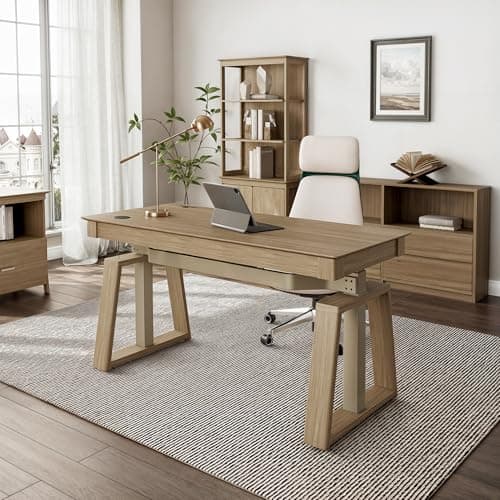
Eureka's executive line is the one that photographs best and the one this site is most cautious about. The Ark X page describes its desktop as "PVC Leather & Pu Paper Laminate" — a wrap of black leather-look PVC and oak-grain paper — and does not name the substrate underneath it. Something is under there, and on a desk at this price it is almost certainly an engineered wood panel, but Eureka does not say which, and its general materials guide discusses MDF and plywood cores as things buyers should look for rather than as things Eureka uses.
For most buyers that is a shrug. For the buyer this site is written for, an unnamed core under a PVC wrap is the least transparent surface in this comparison, and PVC is a material we already treat carefully elsewhere — see PFAS and PVC in anti-fatigue mats. If you want the reasoning behind preferring a named material to an unnamed one, that is MDF versus solid wood.
Why the glass one wins
This is where Eureka's range does something the FEZIBO range could not. When we looked for a FEZIBO with a solid bamboo top — the material argument that would have rescued it — no live Amazon listing came back. Eureka's equivalent is live and cheap.
A tempered glass desktop has no composite core, no urea-formaldehyde adhesive and no laminate layer. The formaldehyde question that dominates desktop shopping does not apply to it, in the same way it does not apply to a bare steel frame. That is not a certificate and we are not going to dress it up as one — it is a construction fact, and construction facts are checkable by looking at the thing. On a brand with no registry entry to offer, a surface that cannot off-gas is worth more than another paragraph of adjectives.
The honest limits: the drawer unit and base are still engineered wood, and the listing's "E1-grade" description is a manufacturer statement with no certifier or certificate number attached — E1 is also a weaker panel class than the E0 that FEZIBO claims. Glass is cold under the wrists and shows everything. And if you clamp a monitor arm to the desk edge, check your arm's clamp range against a glass edge first; our monitor arm picks cover which ones are rated for it.
Where Eureka sits against the desks we rank higher
If certification is genuinely your deciding factor, Eureka is not your brand and no amount of good blog writing changes that. The desks with a document behind them are on the GREENGUARD-certified list, and the per-model picture — including which brands publish nothing — is in the certification matrix.
If what you actually need is a shape nobody else sells, and you have understood that you are buying on photographs plus a one-year electronics warranty, Eureka is a reasonable purchase and the glass top is the version of it that answers the material question. Both of those are defensible positions. What is not defensible is reading Eureka's excellent GREENGUARD explainer and concluding that Eureka desks are GREENGUARD certified.