Buy the Topo if you stand for long blocks and get restless and stiff. Buy the Eco-Pro if you stand in shorter bursts and your feet simply hurt. That is the whole decision: the Topo is a movement device with cushioning, the Eco-Pro is a cushion. Both are good; they are good at different things and the disappointed reviews of each are almost always someone who bought the other one's job.
The design philosophies, side by side
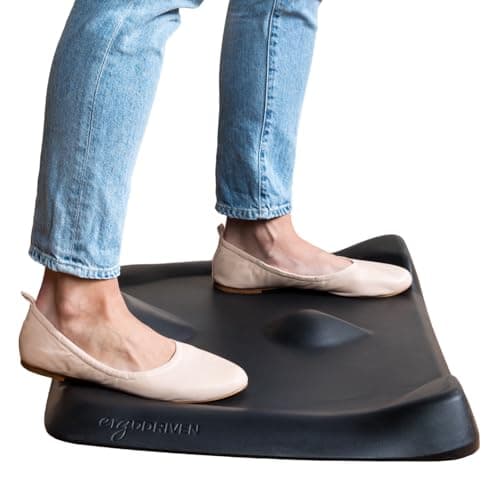
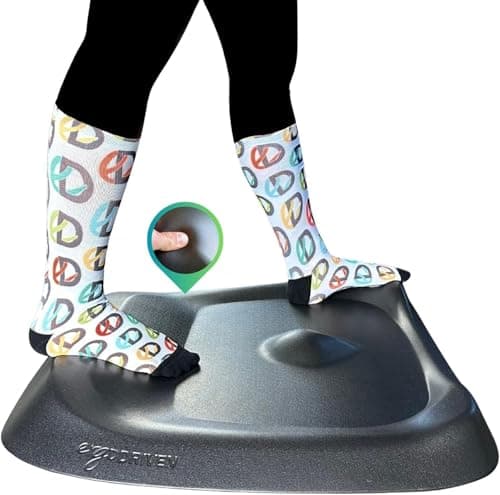
The Topo is deliberately not flat. Ergodriven publishes its dimensions and describes a sculpted surface with raised contours around the edges — calf stretchers, a raised rim, a mound in the middle. The intent is that your feet never settle into one position, because the surface keeps offering somewhere else to put them. It is closer in spirit to a balance board than to a kitchen mat.
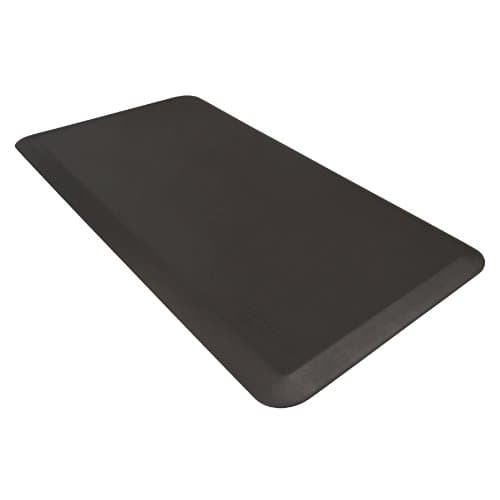
The Eco-Pro is the opposite thesis executed well: a 20-by-48-inch, three-quarter-inch slab of commercial-grade polyurethane with beveled edges and rounded corners. No terrain, no prompts, just a consistently soft surface wherever you happen to put your feet. GelPro sells it as an industrial and commercial floor mat, which is the tradition it comes from — the job there is to make a hard concrete floor survivable for an eight-hour shift.
Materials: both polyurethane, one better documented
Both mats are polyurethane rather than PVC, which is the material distinction that matters most in this category. Soft PVC requires plasticizers — historically phthalates, a family the CPSC restricts in products with close, prolonged contact — while polyurethane needs none. Our PFAS and PVC explainer covers why that is the first thing to check on any mat listing.
Neither carries a third-party emissions certificate, and almost nothing in this category does. Ergodriven states the Topo is PVC-free. GelPro describes the Eco-Pro core as a plant-based polyurethane “Bio-Foam” and says the mat is not made with natural rubber latex, and it is the only mat here with any third-party certification at all — but that certification is a National Floor Safety Institute high-traction rating for the bottom surface, which is a slip-resistance claim and not a statement about what the foam is made of. Do not let the word “certified” on that listing do work it has not earned. If a named exclusion list is what you want, the mat that publishes one is the WellnessMats, and it costs more than both of these.
Practical note that applies to both: unwrap a new mat somewhere ventilated for a couple of days. New polymer products emit most in their first hours, and packaging traps that emission against the surface — the same principle as the 72-hour break-in for a new desktop.
Feel, size and the practical differences
- Underfoot: the Topo is firm. People expecting plush send it back. The Eco-Pro is genuinely soft and forgiving, and people expecting support sometimes find it too soft.
- Footprint:the Eco-Pro is 48 inches wide against the Topo's 29, so it is the better mat if you shuffle sideways, shift between two positions at the desk, or want to roll a chair over it. It is also narrower front-to-back at 20 inches. The Topo has a fixed, desk-shaped footprint and a Mini version for tight setups.
- Edges: both are beveled, which matters more than people expect — a square-edged mat is a trip hazard in a room you walk through in the dark. The Eco-Pro rounds its corners as well, and its base carries the traction certification described above.
- Barefoot: the Topo is designed for it and the terrain is more interesting without shoes. The Eco-Pro is neutral either way.
- Longevity: both hold up. Firm PU that does not bottom out is the common factor in every mat we rank highly, and it is the reason we do not rank cheap gel mats near the top. GelPro puts a five-year warranty behind that claim on the Eco-Pro.
The case for each, in one paragraph
Topo. You stand for ninety minutes or more at a stretch, and what bothers you is stiffness, restlessness and the feeling of being planted. The terrain gives you somewhere to put your feet every few minutes without thinking about it, which is exactly what static standing removes. It is also the better mat for calf tightness, because the raised edges are usable as a stretch.
Eco-Pro. You stand in shorter bursts on a hard floor, and what bothers you is the floor. Concrete, tile, or laminate over concrete — the Eco-Pro is thick, soft and wide enough to make that a non-issue, and it does not ask you to like a sculpted surface.
If the GelPro is the one you are leaning towards, read the brand on its own terms first — there is a one-piece Eco-Pro size with four inches more depth than the 20 by 48 compared here, and it is the better desk shape. That is in our GelPro review.
The third answer: buy neither yet
If you have been standing all day and everything hurts, a mat is treating a symptom. Check the setup first: desk height wrong by two inches produces more discomfort than any mat can fix, and so does standing for four hours straight because the desk is new and you are enthusiastic. Our sit-stand ratio guide and the height calculator cost nothing and fix more than a mat does. Then buy the mat.