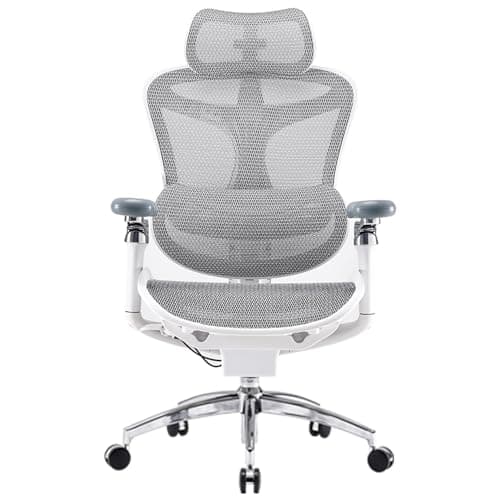
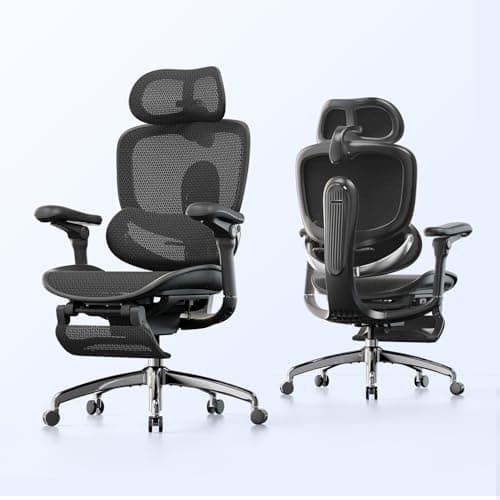
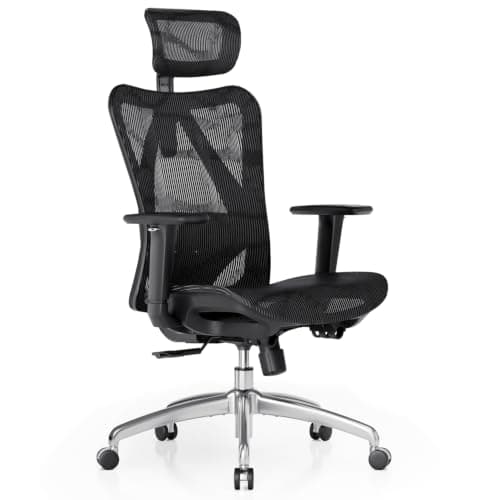
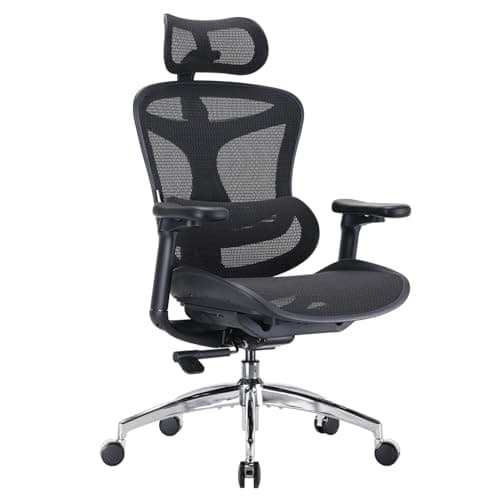
Buy the plain black Doro C300 unless your femur is short, in which case buy the Pro. That is the review in one line, and the reason is the same in both halves: the Doro's real advantage is a mesh seat rather than a foam one, and the only thing the upgrades add that changes how the chair fits a body is seat-depth adjustment. Everything else between the four listings is armrest axes, a footrest and about two hundred dollars.
First, the problem with the name
"Doro C300" is not one chair. On the day we wrote this there were four live listings carrying the name, and the specification that separates them is hidden in the title as a number followed by the letter D:
| Listing | Armrests (per listing) | Seat depth adjusts? | What you are actually paying for |
|---|
| Doro C300, black | "Ultra Soft 3D Armrests" | No | The mesh seat and the lumbar mechanism — the core of the chair |
| Doro C300, grey | "Ultra Soft 3D Armrests" | No | The same chair, usually a few dollars more for the color |
| Doro C300 Pro, grey | "Ultra-Soft 6D Armrests" | Yes — the listing names it | Seat-depth adjustment, plus three more armrest axes |
| Doro C300 Pro V2, jet black | "8D Armrests" | Not stated | A footrest and a 135-degree recline |
There is also a two-pack listing of the base chair, which costs roughly double and is a genuine trap if you click through a search result without reading the quantity. Check what is in the box before you check the price.
One more wrinkle worth knowing before you order, because it is the kind of thing that makes a buyer think they have been shipped the wrong chair: SIHOO's own product page for the Doro C300 describes "4D coordinated armrests" that move "up and down, left, right, forward and backward" with a tilt linkage and "pivot up to 75 degrees", while the live Amazon listing for the black C300 is titled "with Ultra Soft 3D Armrests". We are not going to pretend to know which revision is in which warehouse. Buy on the listing you are actually paying for, read its armrest line, and treat the maker's page as the aspiration rather than the contract.
What SIHOO publishes, and what it does not
This site judges chairs on what their makers will put in writing, because that is the only part a buyer can check. SIHOO publishes more than most chairs in this bracket and less than you need:
- Maximum load: 330 lb. A real number, and higher than the 300 lb that Herman Miller publishes for the Embody at four times the money. Paired with a published max hip width of 20.28 in, which is the figure that actually decides whether a big-and-tall claim is true for you — see big and tall office chairs.
- Seat depth: 18.11 in. One figure, no range, on the base chair. Hold that next to OSHA's own chair guidance, which says a seat should let you sit with your back supported and still keep clearance behind the knee — a fixed 18 in pan cannot do both for a short femur.
- Backrest height: 18.11 to 21.65 in, overall 28 in wide by 28 in deep by 42 to 49 in high, recline to 130 degrees, headrest adjustable in "height, depth, and rotation", and a "self-adaptive lumbar support" that in SIHOO's words "adjusts itself to the contours of your spine".
- No seat-height range. No stature guidance. SIHOO's page gives an overall height for the chair and nothing for the seat, and it offers no body-height range at all beyond "adjustable backrest fits all body types". You cannot size this chair from published data the way you can size an Aeron, which publishes a stature range, a weight rating and a seat-height range for each of three sizes — the comparison we set out in the Herman Miller Aeron review.
- Three-year warranty. Normal for the bracket, and worth doing the division on: a chair at a quarter of the price with a quarter of the warranty is not cheaper per year, it is the same. The twelve-year end of that trade is what you are buying in Aeron vs Embody.
The certification badge is a badge
SIHOO's Doro C300 page says the chair is "Environmentally certified by BIFMA and TUV for quality and safety". That sentence is doing a lot of work for how little it contains, and this is the part of the review that matters most to the reader this site is for.
BIFMA does not issue an environmental certificate for a chair. BIFMA writes standards — ANSI/BIFMA X5.1 is the seating performance standard, and it is about structure, load and cycles, not emissions — and it separately administers the LEVEL sustainability program, which does rate products on materials, energy and health criteria and does publish its certified products. Those are two different things, and "environmentally certified by BIFMA" collapses them into one phrase that belongs to neither. We looked for a SIHOO model in a LEVEL registry on 2026-10-23 and did not find one. The BIFMA explainer sets out what the mark does and does not cover.
TUV is a certifier, not a standard. The claim does not say which TUV house issued anything, to which standard, or under what certificate number. A verifiable certification claim has three parts — the body, the standard and the number — and this one has one and a half.
So: treat the Doro C300 as undocumented on emissions. No GREENGUARD certificate exists for it, and you can confirm that yourself in UL SPOT, the public registry. That is not a scandal — most chairs at most prices are undocumented, and our non-toxic buying guide exists precisely because the certified shortlist is so short. It does mean you should ventilate the room for the first week, which does more than any badge; the protocol is in the first 72 hours.
Why the mesh seat is the actual reason to buy this chair
Strip the model numbers away and the Doro C300 makes one structural claim that very little else in its bracket makes: the seat is mesh, not foam. SIHOO's materials line is "Mesh back and seat, soft PU coated armrests", and the backrest is built on what it calls a flexible triangular frame.
That matters for two reasons this site keeps coming back to. The first is failure mode. The most reliable way a good budget chair goes bad is the seat foam going dead after a couple of years — it is why we rank seat cushions at all, and it is the honest criticism in our own SIHOO M57 review, whose foam pad is the first part of that chair to flatten. A woven seat carries weight in tension; there is nothing in it to take a permanent dish.
The second is materials volume. The largest single piece of polyurethane foam in a normal office chair is the seat pan, and on this chair it is not there. That is a structural answer to the material question rather than a certificate answer, and structure is harder to fake than a badge — the same reasoning that makes a suspension seat the materials pick in mesh vs foam.
The cost is firmness and edge feel. A woven seat over a frame at this price is not an engineered suspension membrane; it is fabric under tension, and at hour six you can feel the frame at the front edge in a way you do not on a chair costing four times as much. People who want to sink into a seat will not like it. That is a preference, not a defect — but it is the thing to know before you buy, because it is the most common reason a mesh seat gets returned.
C300 vs C300 Pro: the only upgrade that changes the fit
The autocomplete suggestion "sihoo doro c300 vs c300 pro" exists because the two listings read almost identically. Here is the difference that matters: the Pro listing names seat-depth adjustment and the base listing does not.
Seat depth is the single most underrated fit variable in a desk chair. If the pan is deeper than your thigh is long, you can either sit back and have the front edge press behind your knees, or sit forward and lose the backrest — which is to say, you can have circulation or lumbar support, but not both. Cornell's seated-posture guidance and OSHA's chair criteria both treat clearance behind the knee as a requirement rather than a comfort preference. On a chair with a fixed 18.11 in pan, anyone much under about 5 ft 4 is making that trade every day, and it is the mechanism behind most of what gets described as "this chair hurts the backs of my thighs".
So the decision rule is a body measurement, not a budget: short femur, buy the Pro; otherwise, buy the base chair and spend the difference on a monitor arm, which will do more for your neck than three extra armrest axes will do for your elbows. If you are shopping specifically because you are short, start at office chairs for short people instead — the Doro Pro is a reasonable answer there, but it is not the only one.
The Pro V2 is a different proposition again. Its differentiator is not the eight-way armrests, it is the footrest and the 135-degree recline — a rest position rather than a work position. If the chair is a desk chair all day, you are paying the top price in the family for a mechanism you will deploy at lunchtime. If the chair is also where you read, it is the one in the family that does both, and the comparison to make is against a dedicated recliner rather than against the other Doros.
Where it sits against the rest of this hub
Against SIHOO's own M57, the Doro is the newer design and the better seat; the M57 is cheaper and has the longer owner record, which matters when you want to know how a chair fails rather than how it arrives. Against the Hbada and Ticova chairs we rank in budget office chairs, the Doro family's edge is the published load and hip-width figures and the mesh seat; their edge is price. Against the documented chairs — the Branch and Steelcase models in GREENGUARD-certified office chairs — the Doro loses the argument this site cares most about, because a badge without a number is not a document.
Which is the honest summary of the whole review. The Doro C300 is a good chair for the money with one real material advantage and one real certification gap, and the version question is settled by your own leg length rather than by the marketing.
Every chair in this family sits inside one price band, which makes the cross-brand question worth asking directly: at this money, what else is available and what does it document? The best office chairs under $500 puts the whole Doro range against the alternatives in the same band, including the one chair there whose maker prints a GREENGUARD Gold line.
If the undocumented certification position is what stops you buying this chair — and it is a reasonable thing to be stopped by — SIHOO alternatives ranks the chairs at the same money that publish something you can check, and is honest that none of them matches the Doro on adjustment.