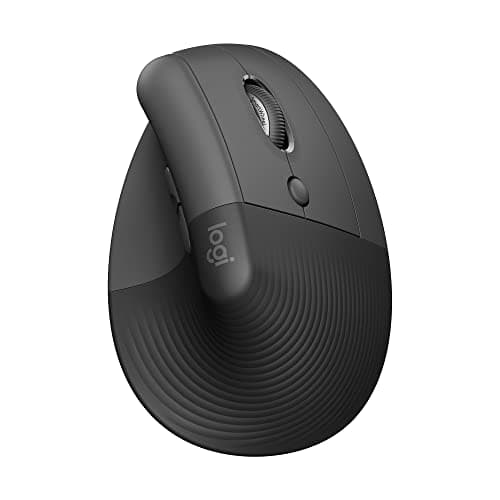
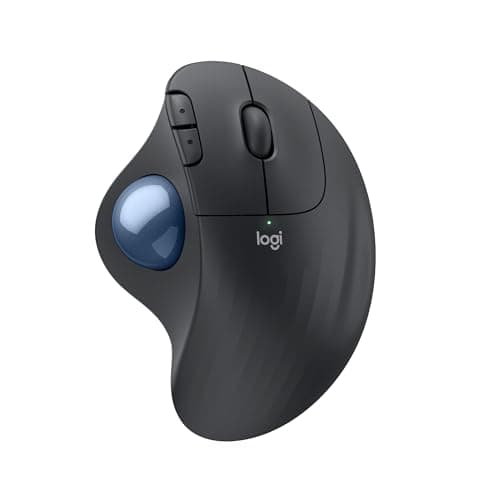
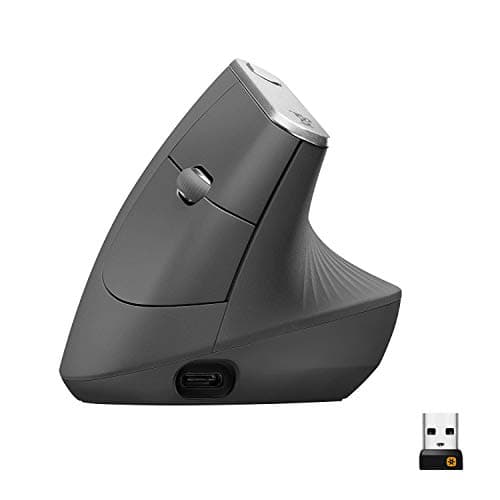
Buy the Logitech MX Vertical. Its 57-degree angle sets your hand in a near-neutral handshake position, and it is built like a full-size mouse rather than a gimmick. If it feels too big, the Logitech Lift is the same idea in a smaller shell; if your desk is cramped or your shoulder aches from reaching for the mouse, the Logitech ERGO M575 trackball keeps your hand still entirely.
One thing worth saying up front: a mouse is not a composite-wood desk or a foam mat, so there is no low-emission certificate to chase here. Every pick is judged on wrist posture, build and how it holds up — not on materials. That honesty matters more on this page than a forced certification angle would.
Why the angle is the whole point
Rest your hand flat on a normal mouse and your forearm has to rotate so the palm faces down. That rotation is called pronation, and holding it for eight hours is what leaves the outside of your wrist and forearm aching. A vertical mouse rotates the grip toward a handshake, cutting the twist and taking pressure off the wrist. The steeper the angle, the more neutral the hand — the MX Vertical and Lift both sit at 57 degrees, aggressive enough to help without feeling unnatural. Getting the rest of your setup neutral matters too; our standing-desk posture guide covers where the hands, elbows and screen should land.
Match the size to your hand
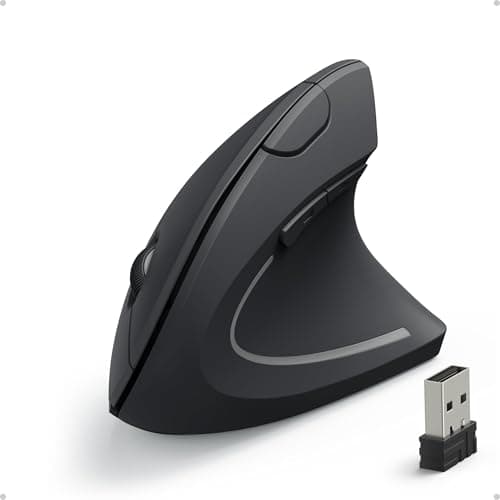
This is the decision most people get wrong. The MX Vertical is a large mouse, and small hands end up gripping the top edge instead of wrapping it, which undoes the comfort. Measure from the base of your palm to the tip of your middle finger: much under 18cm and you want the smaller Lift, which delivers the same angle in a body built for small-to-medium hands. Over that, the MX Vertical fits better. The cheaper Anker Vertical is the low-cost way to find out whether a vertical grip suits you before spending more, and the Delux Seeker is the rechargeable mid-price option with extra buttons.
The trackball is a different answer
A vertical mouse still slides across the desk; a trackball does not move at all. On the ERGO M575 your thumb rolls the ball and your hand stays planted, which suits a small or crowded desk and — more importantly — people whose strain is in the shoulder from repeatedly reaching out for a mouse. The trade is a real first week of relearning and a little less precision for fine design work. If that fits you, it is the most different, and sometimes the most effective, option here.
Where the mouse sits in the bigger fix
A better mouse angle is one piece. A neutral wrist also needs a keyboard that stops your hands from angling outward — see our ergonomic keyboard picks — and a chair whose armrests support the forearm so the wrist floats rather than presses on the desk edge. If wrist or shoulder pain is the reason you are here, fixing the chair and armrest height often does as much as the mouse itself.
How to pick an ergonomic mouse
Measure your hand first
Palm base to middle-finger tip. Under about 18cm points you to the Lift or a smaller vertical; over it, the MX Vertical. A vertical mouse that is the wrong size is worse than a good flat mouse, because you grip it tensely instead of resting on it.
Vertical or trackball
Choose vertical if your ache is in the wrist and forearm from pronation. Choose a trackball if your desk is tiny or your shoulder tires from reaching — the M575 removes the arm movement entirely. Both are ergonomic; they solve different problems.
Ignore the DPI number
Sensor resolution is marketed hard and matters almost none for comfort. Any of these tracks fine. What decides whether your wrist feels better in a month is the angle and the fit, not a spec on the box.
Give it two weeks
A vertical grip feels strange for a few days and a trackball for longer. That adjustment is normal and not a sign the mouse is wrong — your hand is unlearning a posture it held for years. Push through two weeks before judging.
Mind the desk height too
Even the best mouse cannot save a wrist that is reaching up to a too-high surface. If your elbow is not at roughly 90 degrees when your hand is on the mouse, the desk — not the mouse — is the problem. Our height calculator gets that starting point right.
How we picked
We compiled specs from manufacturer manuals, verified every certification claim in the certifying body's own registry (UL SPOT for GREENGUARD, BIFMA, CARB), did the cost-to-own math, and read the aggregated owner reviews, then scored each product against a published rubric. The scores are judgments from documented research — they are not measurements we took, because we do not have a lab and we are not going to pretend we do.