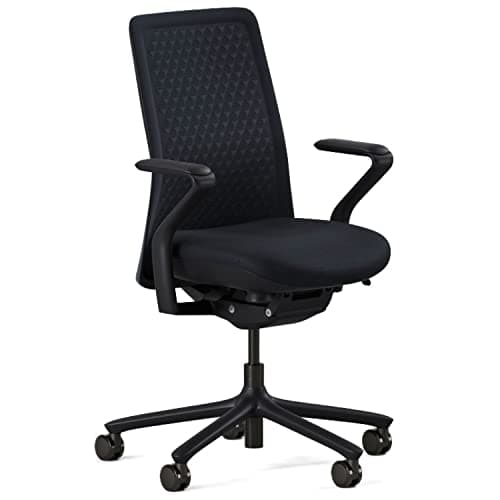
Buy the Branch Ergonomic Chair Pro, and buy a footrest with it. The Pro wins because it is the only chair here that adjusts the two things a smaller frame actually needs — seat depth and the height of the lumbar pad — and the footrest is in the list because no chair fixes the real problem, which is that a chair set correctly for your arms leaves your feet off the floor. If your filter is published paper rather than lever count, the Branch Verve is the only chair on this site whose listing states a stature range at all.
The thing nobody publishes
Search "office chair for a short person" and you will be handed twenty roundups that all name a seat-height range. Go to the listings those roundups link to and try to find the number. On the chairs we rank, Amazon's detail tables mostly do not carry a seat-height floor, the manufacturers mostly do not print one on their own product pages, and the one stature statement we found anywhere is in a product title: Amazon's own title for the Branch Verve says it fits 5 ft to 6 ft.
That is the whole difficulty with this query. It is a dimension question asked of a category that will not publish dimensions. We are not going to invent them — we do not have these chairs and we do not measure anything — so this page does something more useful: it tells you which measurement you need, which adjustments make a chair fit a smaller frame regardless of its lowest setting, and which chairs publish those adjustments.
Measure your popliteal height first
Sit on a hard chair with your feet flat and your knees at a right angle. Measure from the floor to the crease at the back of your knee. That figure — your popliteal height, plus about an inch for a shoe — is the seat height you want, and it is the only number in this purchase that is genuinely yours.
If your figure falls below a chair's lowest setting, your feet dangle. Dangling feet is not a comfort complaint, it is a load problem: the weight of your lower legs hangs off the front edge of the seat and compresses the back of your thighs, and the standard workaround of perching forward to reach the floor abandons the backrest entirely — which is the one part of the chair you paid for. Mayo Clinic's office-ergonomics guide and OSHA's computer-workstation eTool both put feet flat on the floor or on a footrest as a baseline, not a refinement.
Why you cannot just lower the chair
Because your chair height is not set by your legs. It is set by your elbows against the desk: forearms roughly level, shoulders down. Drop the seat two inches to get your feet down and your forearms go below the desk, your shoulders come up, and you have traded a leg problem for a neck and wrist problem. That is the same logic our height calculator runs on, and it is why the sequence for a shorter sitter is: set the chair for your arms, then raise the floor.
A sit-stand desk changes this, because a desk that descends lets the chair come down with it. The figure to look for there is the desk's published minimum height, and it is printed far more often than a seat-height floor is — we worked through which desks genuinely go low in standing desks for short people. If you are buying both at once, buy the desk on its minimum height and the chair on its adjustments.
The two adjustments that actually fit a smaller frame
Seat depth.A seat pan built around a six-foot femur presses into the back of a shorter knee before the backrest reaches the spine. You end up choosing between contact behind the knee and no lumbar contact at all, and neither is acceptable for eight hours. A seat-depth adjustment — sliding the pan forward and back — is what resolves it, and it is the single most valuable feature on this page. "Short torso" and "short thighs" are different problems, and this is the one that answers the second.
Lumbar height.The lumbar curve on a shorter spine sits lower than the pad on a fixed-back chair expects. A pad that slides up and down meets the curve where it is; a molded shape meets it where the designer assumed it would be. This is the one that answers "short torso", and it is why a fixed lumbar rest, however well shaped, is the wrong buy here.
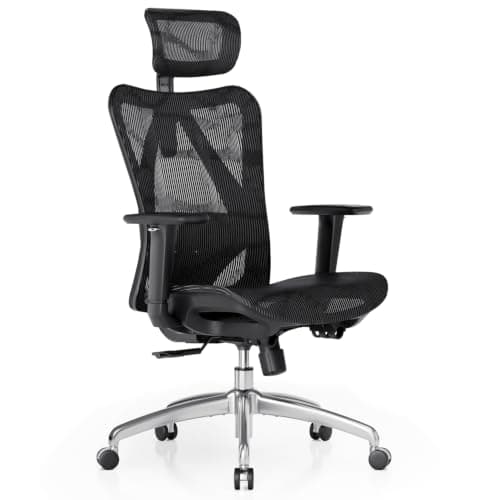
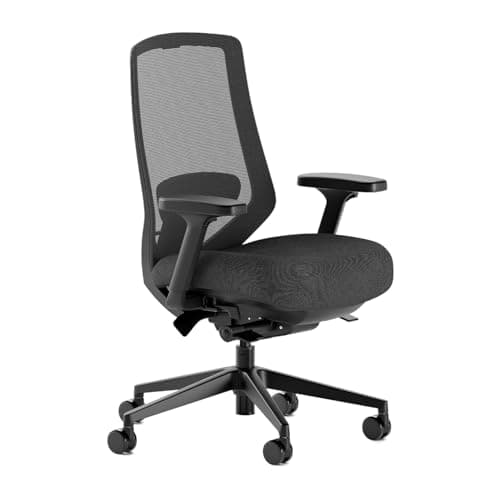
Everything else — tilt tension, armrest width, headrests — is comfort. These two are fit. The Pro publishes both. The Verve publishes adjustable lumbar height and seat depth with far fewer adjustments overall. The SIHOO publishes an adjustable lumbar at a budget price. The Branch Daily, by Branch's own listing, has a fixed lumbar rest and four adjustment points, which is why it is absent here despite being the cheapest chair in that range carrying the GREENGUARD Gold line — we explain that range in the Branch chair review.
What each chair publishes
| Chair | Published stature statement | Lumbar | Adjustment points | Rated capacity |
|---|
| Branch Ergonomic Chair Pro | None published | 2-way adjustable pad (up/down and in/out) | 14 | Branch rates 275 lb |
| Branch Verve | Amazon's title states 5 ft to 6 ft | Adjustable lumbar height | 6 on the Amazon listing | Branch rates 275 lb |
| SIHOO M57 | None published | Adjustable lumbar | Not published as a count | Not published |
| Steelcase Series 1 | None published | Adjustable lumbar | Not published as a count | Steelcase rates 400 lb |
| Branch Daily | None published | Fixed lumbar rest | 4 | Branch rates 225 lb |
Read that as a disclosure table, not a measurement table. Every cell is a line the maker publishes or an absence we are naming; none of it is a figure we took. The Branch rows come from Branch's own per-chair pages, read on 26 September 2026, and the Steelcase capacity from its dated compliance certificate.
The footrest is not an accessory here
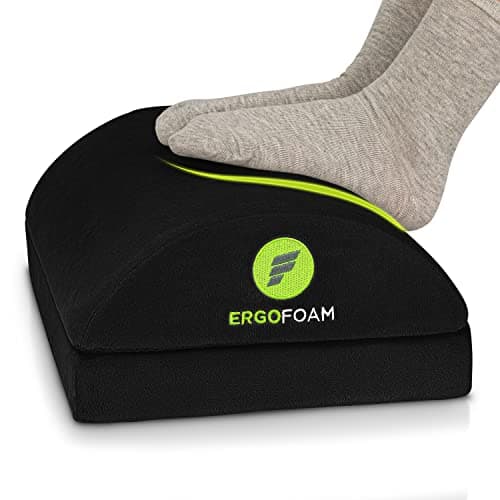
If your popliteal height falls below the chair's lowest setting, a footrest is the part of this purchase that solves the actual problem, and it costs a fraction of the chair. What it buys you is the ability to keep the chair where your arms need it while your feet get a surface at the right height and angle. The ones worth having hold an angle under load rather than squashing flat — we ranked the category in under-desk footrests, and the dense-foam ErgoFoam is the pick repeated here.
One caution on cheap foam: a footrest lives in a warm enclosed space under a desk you breathe over all day, and almost none of them publish a foam certificate of any kind. That is a materials question rather than an ergonomics one, and it is the subject of what CertiPUR-US actually certifies.
Buying a chair at 5 ft 4 and under, in five checks
1. Measure your popliteal height before you shop
Floor to the crease behind the knee, seated, feet flat, plus an inch for a shoe. Write it down. It is the only figure in this decision that is actually about you.
2. Buy seat-depth adjustment, not a smaller chair
A sliding seat pan fixes pressure behind the knee on any frame size. A "petite" chair with a fixed pan does not, and the label is marketing rather than a dimension.
3. Buy adjustable lumbar height if your torso is short
A pad that moves up and down meets your curve; a molded back meets the average. On this page that narrows it to the Pro and the Verve.
4. Set the chair by your elbows, then raise your feet
Forearms level with the desk first. Whatever gap is left under your feet is a footrest problem, not a seat-height problem.
5. Treat any unpublished number as unpublished
If a roundup quotes a seat-height floor for one of these chairs, ask where it came from. We could not find one on the listings or the manufacturer pages, and we will not print a figure we cannot source. Check the live detail table for your exact SKU before you buy, and verify any certification claim at the certifier's own registry yourself.