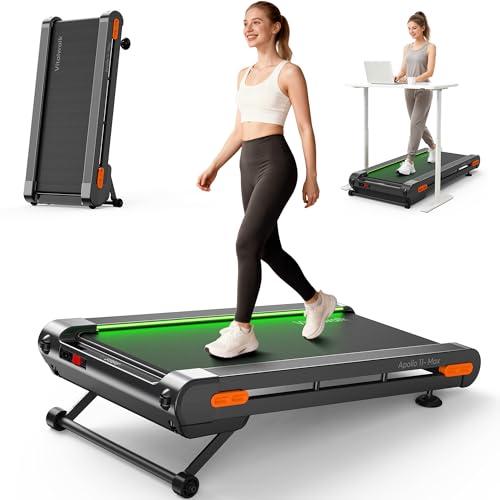
Start here, because it changes how you read every other page on this subject: no walking pad sold on Amazon has a third-party weight certificate. An office chair does — the Steelcase Series 1has a dated ANSI/BIFMA X5.1 compliance certificate signed in January 2024 behind its 400 lb figure, and you can download it. A walking pad's capacity is a sentence in a marketing bullet, written by the seller, checked by nobody. That is why "400 lb" on a $185 pad and "400 lb" on a $600 pad are not the same promise, and it is why we are not going to rank these by whose number is biggest. We ranked them by how much published evidence sits behind the number.
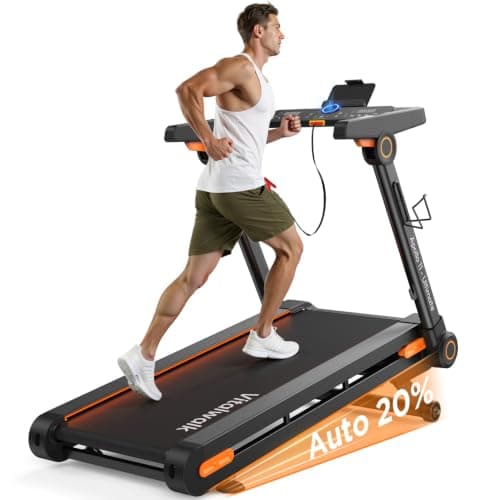
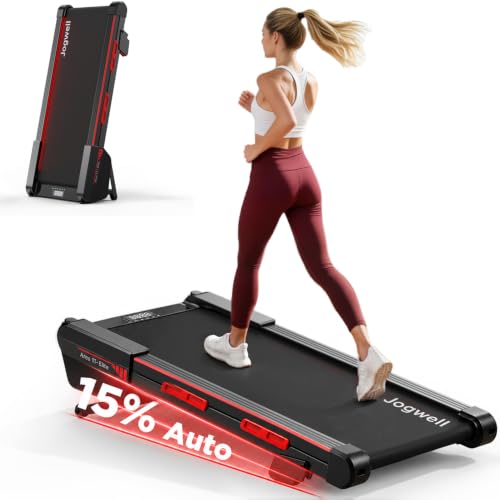
If you want the short answer: the Vitalwalk 400 lb full-deck padmakes the highest claim on this page and is the one that backs it with the most published structure — a 74 lb pad, a named double alloy frame, an 18-inch belt and a warranty split into separate frame and motor terms. If that is more pad than you want to own or store, the Jogwell at 350 lb does the same thing for roughly half the money.
The four criteria, in the order they matter
Every pick below is scored on these and nothing else. We cannot tell you how a pad feels under 240 lb because we have not walked on one, and our methodology page says so in those words. What we can do is read what each seller publishes and check it against itself.
1. Does the pad publish a capacity at all — and only one?
This sounds like a low bar. It is not. Two examples from the same afternoon:
- The WalkingPad P1, a well-known $349 pad, publishes no user weight capacity anywhere— not in the title, not in any of the five feature bullets. It tells you the belt is 16.5 in wide and the frame is aluminum unibody, and then stops. It is not a bad pad; it is an unanswerable one for this question, so it is not ranked here.
- A $184.99 Garvee padpublishes two different numbers on one listing. The title and the first bullet say 400 lbs. The sixth bullet on the same page says "accommodating users up to 350 lbs with confidence". Same listing, same day, 50 lb apart. Its warranty field says 90 days. We are naming it rather than ranking it, because we are not going to earn a commission on a spec we cannot read straight.
2. How much pad is under the claim?
This is the single most useful cross-check available to a buyer, and almost nobody applies it. A walking pad's own published weight is a rough proxy for how much steel, cushioning and motor is in it. Divide the claimed capacity by the pad's mass and you get a ratio that says, roughly, "this machine claims to carry N times its own weight, repeatedly, for hours." Lower is more conservative. From the listings read on 6 November 2026:
- Vitalwalk Apollo 11— 350 lb claimed, 105 lb pad. Ratio about 3.3.
- Vitalwalk 400 lb full-deck— 400 lb claimed, 74 lb pad. Ratio about 5.4.
- Jogwell— 350 lb claimed, 51 lb pad. Ratio about 6.9.
- Cybergoing T10— 300 lb claimed, 36.4 lb pad. Ratio about 8.2.
- Garvee— 400 lb claimed (or 350), 49.16 lb pad. Ratio about 8.1 on the higher claim.
- MERACH W60 and Rayspace — 400 lb and 450 lb claimed, no pad weight published at all, so the ratio cannot be calculated.
This is not a safety test and we are not presenting it as one. It is a consistency check, and it is the reason the $600 pad outranks the $250 pad making a bigger claim.
3. Is the motor figure peak or continuous?
Nearly every pad advertises peak horsepower, which is the figure that tells you least about a machine you intend to run for three hours at a stretch. Two listings on this page publish the continuous rating as well, and the gap is instructive: the MERACH W60 states "a 3.5HP peak brushless motor with 1.25HP continuous output", and the Garvee states "3.5HP peak (0.65 CHP) continuous". Two pads both headline 3.5 HP; one does twice the continuous work of the other. When a listing publishes only the peak, you are looking at the best-case number by construction.
Brushless matters too, and for a boring mechanical reason rather than a marketing one: a brushless motor has no carbon brushes to wear down, so there is one fewer consumable part in a machine that will see hundreds of hours. Four of the five picks here are brushless.
4. Is the frame described, or just adjectived?
"Heavy duty" is not a construction. "Reinforced dual-steel frame" and "double alloy frame and reinforced steel structure" are — they are claims a seller has committed to in writing and that you could hold them to. Two of the picks below describe their frames specifically. One describes it as "heavy duty" in the title and nowhere else. One does not describe it at all; that one has the highest number on the page and is not on the page.
Belt width lives in this criterion too, and it is the thing a larger walker notices in the first ten minutes. The picks here run 15 in, 15.7 in, 17 in and 18 in. At 2 mph on a narrow belt you spend the whole session making small corrections to stay centered; the wider belts are the fix, and they are the reason the full-deck designs cost more.
Why 265 lb is the number to know about
Here is the context that makes this page necessary rather than niche. Three of the pads already on this site — the ones that win our general under-desk treadmill roundup on deck, noise and price — publish capacities of 265 lb, 265 lb and 350 lb. The 265 lb pads are the UREVO and the TREAFLOW, and they are genuinely good pads at $134.99 and $109.97. They are also below where a meaningful share of American adults sit, which means the default recommendation in this entire product category quietly excludes a lot of the people it is sold to.
If you are under about 240 lb, buy one of those and stop reading — you will save three hundred dollars and lose nothing. If you are between 240 and 300 lb, you are inside the stated range but near the top of it, which is exactly where the margin argument starts. Over 300 lb, the 265 lb pads are out and the page below is your shortlist.
The margin argument, stated plainly
Everywhere else on this site we tell you to buy the cheaper thing when the expensive thing is selling you paperwork you will never read. This is the one page where we say the opposite, and it is worth explaining why.
A chair is a static load. A walking pad is a repeated impact: every step is your body weight plus a multiplier, landing on a deck, thousands of times a session. There is no certificate telling you what safety factor a seller built in, no registry to look it up in, and the consequence of being wrong is not a wobbly chair — it is a motor, bearing or deck failure under you while you are moving. So on a walking pad, and specifically if you are near the top of a stated range, buy the margin. Pick the pad whose number is comfortably above your weight rather than the one whose number just clears it.
That is also the honest reason the Cybergoing T10 sits last here rather than being dismissed: its claim is the smallest on the page, and a 300 lb claim from a listing that names Bosch as its motor supplier is a better-evidenced 300 lb than a 450 lb claim from a listing that names nothing. A modest specific number beats a large vague one.
Two things a heavier walker should check that nobody mentions
Deck height eats your desk
The higher-capacity pads are thicker, because the structure has to go somewhere. The picks here range from 6.5 in to 7.9 in of deck, against 4.1 in and 4.3 in on the 265 lb pads. Add shoes and you are standing eight or nine inches higher than your floor, and your desk has to follow. If your desk is already near its maximum height, that is the constraint that decides this purchase — not the capacity figure. Measure your desk's top of travel first; our standing desks for a walking pad page is built entirely around that arithmetic, and the height calculator gives you the target to compare against.
The floor under the pad
A 74 lb or 105 lb pad carrying a heavier walker transmits more into the floor than a 37 lb one, which matters in an apartment and matters on a suspended timber floor. Walking pad noise covers the mass-and-resilience side of that, and a mat under the pad is the cheap first move. Our mats for concrete floors page is the other end of the same problem.
What we are not telling you
We have not walked on any of these pads, we have not loaded a deck, and we have not measured a decibel. Where a seller publishes a figure we quote it and name the document; where a seller publishes nothing we write that it publishes nothing rather than borrowing a number from a sibling model. Three of these listings had stock or deal messages attached on 6 November 2026, so check the price and availability yourself before you commit — the prices on this page come from the Amazon API and carry the date they were pulled.
One more thing, and it is a health note rather than a product note: if you are starting daily walking at a desk after a long sedentary stretch, or you have knee, hip or back pain, start at twenty minutes rather than two hours and build up. Standing desk knee pain covers what going too hard too early does. Nothing on this page is medical advice.
Capacity is one axis through this set and slope is another, and they do not produce the same order. Walking pads with incline re-ranks several of these pads on incline granularity and deck height, and leads with the one pad here that publishes a continuous motor rating rather than only a peak.
How to buy this in six steps
1. Write down your weight, then add 20%
That is your shopping number, and it is the single most important line on this page. At 260 lb you are shopping at 310 lb, which rules out every 265 lb pad and makes the 350 lb picks the entry point. This is not pessimism; it is the margin you would normally get free from a certificate, and here you have to buy it yourself.
2. Measure your desk's maximum height before you choose a pad
Raise your desk as far as it goes and measure to the top. Subtract the pad's deck height (6.5 to 7.9 in on these picks) and the thickness of your shoes. If what is left is below your standing elbow height, no pad on this page will work for you until the desk changes. Doing this step second rather than last is the difference between one purchase and two.
3. Prefer a belt at least 17 inches wide
Width is what a larger walker feels first. The 18 in belts on the two Vitalwalk pads and the 17 in class above them are a different experience from a 15 in belt, and no amount of capacity compensates for a belt you have to concentrate to stay on.
4. Read the motor spec for the word "continuous"
If the listing gives you only peak horsepower, you have the best-case figure. If it gives you continuous output as well — 1.25 HP on the MERACH, 0.65 CHP on the Garvee — you have the number that predicts hour three. Prefer brushless either way; there are no brushes to wear.
5. Check the warranty is split, and check it against itself
The best disclosure in this category is a warranty stated per component: Vitalwalk publishes 5 years on the frame and 2 years on the motor separately, which tells you which part they expect to fail first. The worst is a listing that states two different terms in two places, which the MERACH W60 does — 2 years in Amazon's warranty field, 3 years in its own bullet. And 90 days, which is what the Garvee offers, is not a warranty on a machine that takes repeated impact.
6. Put something under it
A mat under the pad protects your floor, cuts structure-borne noise and stops the pad walking across the room over a week. On carpet, check that the pad's rollers are not sinking into pile — that is a motor-load problem as well as a stability one. See floor protection and standing desks on carpet.
What we would buy, by weight
- Under 240 lb— the UREVO at $134.99 or the TREAFLOW at $109.97. Both publish 265 lb, both are 4 in thick, and you are not the reader this page was written for.
- 240-290 lb— the Jogwell at 350 lb, or the Cybergoing T10 if budget is the binding constraint and you accept that 300 lb is a ceiling.
- 290-330 lb— the Jogwell or the MERACH W60. The Jogwell describes its frame; the MERACH publishes its continuous motor rating. Pick the disclosure you trust more.
- Over 330 lb— the 400 lb Vitalwalk, or the Apollo 11 if deck length matters more to you than the extra 50 lb of claim. Nothing else here has the margin.