Diagnose by motion, not by sound. If it squeaks when you lean back, it is the tilt mechanism or the bolts around it. If it squeaks when you roll, it is the casters or their stems. If it squeaks when you turn in the seat, it is the seat plate fasteners or the cylinder-to-plate joint. If it clicks or groans when you sit down, that is the gas cylinder taking load, and that is the one you cannot lubricate your way out of. Start with a fastener check, because it costs nothing and it is the actual cause more often than anything you can buy.
Step 1: tighten everything, properly
A chair is a stack of steel and plastic parts bolted together, and a squeak is very often two surfaces moving against each other because the fastener that was holding them still has worked loose. Office seating is tested for cyclic durability under the ANSI/BIFMA performance standards for exactly this reason: thousands of load cycles work fasteners loose, and that is normal rather than a defect.
Turn the chair over, find every bolt — seat plate to seat, seat plate to cylinder, back bracket to seat plate, arm brackets, base to cylinder — and check each one. Most of them take the Allen key that came in the box. Snug, not gorilla-tight: over-torquing into a plastic boss strips it, and then you have a worse problem than a squeak. Then sit in it and repeat the motion that made the noise. A large share of squeaks end here.
Step 2: identify the part by the motion
| When it squeaks | Most likely part | What to do |
|---|
| Leaning back or rocking | Tilt mechanism, tension spring housing, back bracket bolts | Tighten the bracket and plate bolts first; lubricate the pivot only if the maker says how |
| Rolling across the floor | Caster bearings, caster stems in their sockets, hair and grit in the wheels | Clean the wheels, check for play in the stem, replace the casters if the bearing is worn |
| Turning or shifting your weight in the seat | Seat plate fasteners, cylinder-to-plate joint | Tighten; check the cylinder is seated and not rocking in the base taper |
| Sitting down or standing up | Gas cylinder under load | Not a lubrication job. If it also sinks, the cylinder is failing |
| Only on a hard floor, as a chirp | Hard caster tread against the floor finish | Soft-tread casters — this is also the fix for marking the floor |
| From the armrests when you lean on them | Arm bracket bolts, plastic arm pad clips | Tighten the bracket; clips are usually a replacement part or nothing |
On lubricants, the honest position: most chair makers do not publish a lubrication specification, and that absence is the reason this advice is usually vague everywhere you read it. If your chair came with maintenance guidance, follow it. If it did not, be conservative — apply as little as possible, exactly at the joint that moves, and never into a gas cylinder or a bearing that is sealed. Flooding a mechanism with oil is how a squeak becomes a squeak that also attracts dust and drips on your floor.
Step 3: the two faults that are not squeaks
Two noises get reported as squeaks and are actually something else, and it is worth separating them because the fix is different.
A chair that groans and also drops. That is the pneumatic cylinder, and the noise is the least of it. A cylinder that has lost its seal is the single most common "broken chair" fault there is, and we gave it its own page: why your chair keeps sinking. Cylinders are a replaceable part on most chairs.
A crack or snap rather than a squeak. A single sharp sound under load is not friction, it is something flexing or failing — a plastic seat pan, a weld, a cracked arm boss. Stop sitting in it hard, turn it over, and look. Durability certification matters here: a chair with a published ANSI/BIFMA rating has been load-cycled to a standard, and a chair with no published rating has been tested by you. That is the reason BIFMA certification is worth paying attention to on a chair you intend to keep.
When the casters are the answer
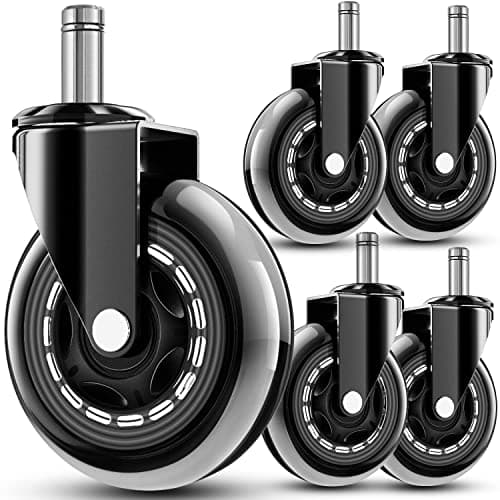
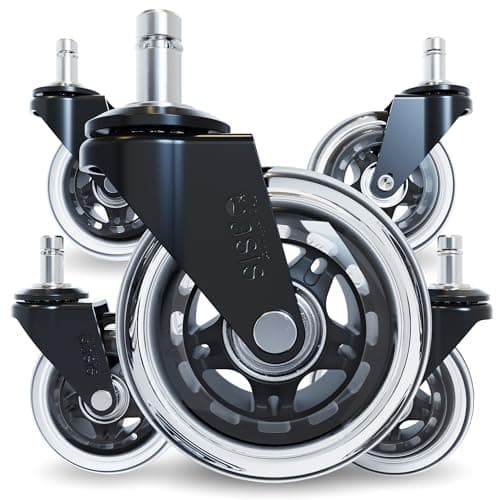
Casters are the one part on this list that is cheap, universally replaceable and genuinely worth replacing rather than nursing. A worn caster bearing squeaks, a hard nylon tread chirps on a finished floor, and both are fixed by a soft-tread replacement set that snaps in with no tools. Caster trade guidance is consistent on the material question: soft urethane treads give the best floor protection, while hard nylon marks finished floors.
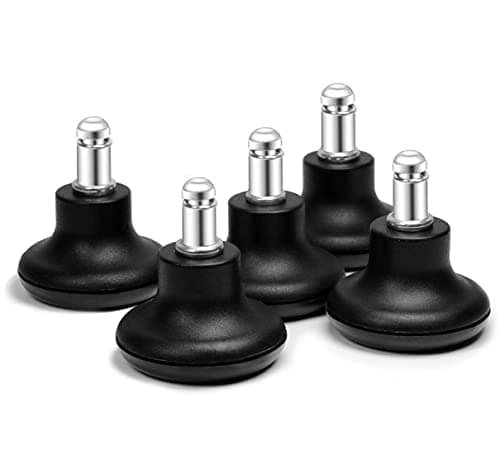
One check before you order, and it is the one that gets skipped: measure the stem. Grip-ring casters push into a socket; threaded casters screw in. They are not interchangeable, and no amount of force converts one into the other. The aftermarket standard is a 7/16 by 7/8 inch grip-ring stem, and the Bell Glides listing below is the only product in our registry whose title states that dimension — which makes it the cheapest way to confirm your chair takes the standard stem before you buy a nicer set.
If the chair wanders rather than squeaks, glides are the underrated answer: five stationary feet instead of five wheels, which is the right call on thick carpet, a sloped floor or a perching stool. The full ranking is at office chair casters, and if your actual complaint is the floor rather than the chair, that is chair mats.