We earn a commission when you buy through our Amazon links, at no extra cost to you. It never affects our rankings, and we say so when the cheaper — or the direct-only — product is the better buy. How this works.
Buy the Steelcase Series 1. It is the one chair here that answers both halves of the question — you can fit it to your back (4D arms, an adjustable lumbar, a seat that slides), and Steelcase publishes the documents that say what it survived and what it is made of, which almost nothing else in its price band does. If you would rather have the largest number of adjustments for the money, the Branch Ergonomic Chair Pro is the alternative — though our Branch Ergonomic Chair review found that Branch publishes its GREENGUARD Gold line on three other chairs in the range and not on the Pro. The Herman Miller Aeron is still the reference standard when budget is no object.
We don't run a lab, so nothing here is a measurement we took. Our read comes from published specs, manufacturer manuals, certification registries and aggregated owner feedback. Where a chair carries no public certification, we say so plainly rather than implying it is clean. Every ASIN on this page was re-checked against Amazon's live catalog on 22 September 2026, and two chairs were replaced because their listings had gone dead or changed into a different product — the honest failure mode of an affiliate roundup nobody maintains.
The five things that actually decide which chair you buy
Chair listings are written to make every model sound like all of the others. These are the five questions that genuinely separate them, in the order they matter for someone who sits for a full workday.
1. Is the lumbar support adjustable?
A fixed lumbar bump either lands on the curve of your spine or it doesn't, and if it doesn't there is nothing you can do about it. Adjustable means the support moves up and down — ideally in and out too — so you place it on your curve rather than hoping the factory guessed your height. This single feature separates a chair you can sit in all day from one that leaves you aching by mid-afternoon.
2. Does the seat fit your legs?
Seat depth is the adjustment people skip and then blame the chair for. If the front edge presses the back of your calves you will slide forward off the lumbar support all day; if the seat is far too shallow your thighs hang unsupported. A sliding seat pan solves it. If the chair has none, seat depth becomes a sizing question you answer before you buy, not after.
3. Do the arms move where your shoulders need them?
Armrests carry the weight of your arms so your neck and shoulders don't have to. Arms that are fixed, or fixed too high, are worse than no arms at all because they hold your shoulders up for eight hours. Height adjustment is the one to insist on; width, depth and pivot are genuine bonuses that mostly matter if you are narrow-shouldered or work at a desk you cannot change.
4. Does anyone publish what it is made of?
Foam, plastics and adhesives can off-gas, and a GREENGUARD Gold or SCS Indoor Advantage Gold certificate is a manufacturer letting a third party cap that in a test chamber. BIFMA is the separate durability and safety question. Most chairs publish neither. That is not proof of harm, but if materials are why you are shopping, a published certificate is the only thing that answers you.
5. What is the warranty, and who is actually selling it to you?
A twelve-year parts-and-labor warranty is a manufacturer telling you what it expects the chair to survive. It is also conditional: Herman Miller, for instance, publishes that products bought from unauthorized resellers are not covered. On a marketplace listing, check who the seller is before you treat the warranty as part of what you are buying.
Lumbar support is the spec that decides everything
The Series 1 and the Branch Pro both let you move the support to your curve — the Series 1 with its LiveBack and adjustable lumbar, the Branch Pro with a padded lumbar pad that travels vertically and adjusts in depth — and the Aeron's PostureFit SL does the same job with two independently flexing pads. The Flash Furniture mid-back gives you the shape of the mesh and nothing to move; the Amazon Basics gives you a static back and hopes it fits your particular spine. If you already have back trouble, start with our chairs for back pain instead.
The adjustability that actually matters
Ignore the count of levers on the box — or rather, read it as a proxy and nothing more. Three adjustments do most of the work: seat height (feet flat, thighs level), seat depth (a few fingers between the seat edge and the back of your knees), and armrest height (shoulders relaxed, elbows near a right angle). Everything past that is refinement. The Series 1 and the Branch Pro cover all three, and the Branch Pro goes furthest of anything here on arms, with five directions of movement. The Flash Furniture chair adjusts arm height only, and the Amazon Basics trades most of it away for price — a fair deal only if you are not in the seat for a full workday. Our Steelcase Series 1 review lists every adjustment range from the published seating guide.
BIFMA and GREENGUARD: what a chair is certified to
Two certifications are worth knowing. BIFMA is the furniture-industry durability and safety standard: it says the chair survived cycle testing, not what it is made of. GREENGUARD, and the stricter GREENGUARD Gold, is about chemical emissions — it caps the VOCs and formaldehyde a chair's foam, plastic and adhesives can off-gas into your air. Steelcase, Herman Miller and Branch each publish one or both, and you can confirm the current certificate for your exact model at the UL SPOT registry before you buy. One exception worth knowing: the Series 1's emissions certificate is SCS Indoor Advantage Gold, which uses the same chamber method but lives in SCS's own registry rather than SPOT — our Steelcase Series 1 review goes through every document it publishes. Most budget chairs publish nothing, which is not proof of harm — it is just an absence of evidence, and we treat it that way. If a certificate is the whole reason you are shopping, our best GREENGUARD-certified office chairs page ranks only the chairs whose makers publish one.
What changes as you spend more
Under about $150 you are buying a seat, not an ergonomic system: a mesh back with a fixed shape, height adjustment and not much else. It is genuinely fine for a few hours a day. From roughly $150 to $300 you start getting arm-height adjustment, a real tilt mechanism and a better seat foam, which is the band where the Flash Furniture chair sits. Around $400 to $600 is where the category changes: adjustable lumbar, multi-directional arms, published certification and warranties measured in years rather than months — both the Series 1 and the Branch Pro live here, and it is the best-value tier for anyone at a desk all day. Past $1,000 you are buying materials science, repairability and resale value: an Aeron you can still get parts for in a decade. Nothing above that band fixes a posture problem that the $400 band didn't already fix, which is why our budget chair roundup exists.
Gaming chairs, executive chairs and the word “ergonomic”
“Ergonomic” is not a regulated term, so the label on a listing tells you nothing. Two categories are worth separating out. A racing-style gaming chair puts a bucket seat and a pair of foam wings around you; it looks supportive and usually has a fixed back shape and a pillow strapped on where an adjustable lumbar should be. An executive chair is generally a tall padded back with a single tilt and fixed arms — comfortable for an hour of meetings, not for a coding day. Neither is disqualified by its shape, but ask both the same questions above: does the lumbar move, do the arms move, does the seat depth change. If the answer is no three times, the word on the box is marketing.
One correction worth carrying into any chair shortlist, because it is repeated almost everywhere: the Herman Miller Aeron is notGREENGUARD certified. Herman Miller's own page names BIFMA Level 3 and SCS Indoor Advantage Gold instead, which is an equivalent emissions certificate from a different certifier — and the chair is still the only one here whose maker publishes a stature range, a weight rating and a seat-height range for every size. Both halves of that are worked through in our Herman Miller Aeron review, which also explains why three live Aeron listings for the same size differ by around a thousand dollars.
Open-box, refurbished, and who is really selling it
High-end chairs attract a big second-hand market, and on a marketplace the condition is often buried in the middle of the title. It is a legitimate way to buy an Aeron for a fraction of the price, with two conditions: know what you are getting (open box, refurbished, or genuinely used), and know that the manufacturer warranty may not follow the chair. Herman Miller publishes that purchases from unauthorized resellers are not covered. We only rank listings that are currently buyable, and we say in the product notes below when the seller is a third party rather than the brand — on this page, the Branch Pro is sold by Branch itself and the Aeron is not.
One group this ranking does not settle on its own: shorter sitters. None of these chairs publishes a seat-height floor you can check, so the adjustments that decide fit on a smaller frame are seat depth and lumbar height rather than the price — which is the whole argument of office chairs for short people. If you are pregnant, the adjustment list changes again and we work through it in office chairs for pregnancy.
Two other framings of this same ranking are worth a look before you buy. If you came here from a gaming-chair search, the honest head-to-head is gaming chair vs office chair — the shapes differ less than the paperwork does. And if the sticker prices above look far apart, divide each one by its published warranty term before you decide: how long office chairs last does that math, and a 12-year chair is often the cheaper chair per year.
A chair is only half the fix
The best posture is the next one. No chair, however well adjusted, is good for you if you sit motionless in it for eight hours — the health case for a sit-stand setup is precisely that it forces you to change position. Pair a good chair with a standing desk and alternate between the two. See our best standing desks and the evidence in sitting versus standing. The chair supports you while you sit; the desk is what gets you out of it.
#ad · Live prices from the Amazon Product API, as of October 22, 2026. Where we have no verified live price, we show none — we would rather leave a gap than print a number that has rotted.
In detail
The picks, in full
01
Buy-it-once ergonomic support with documented certification
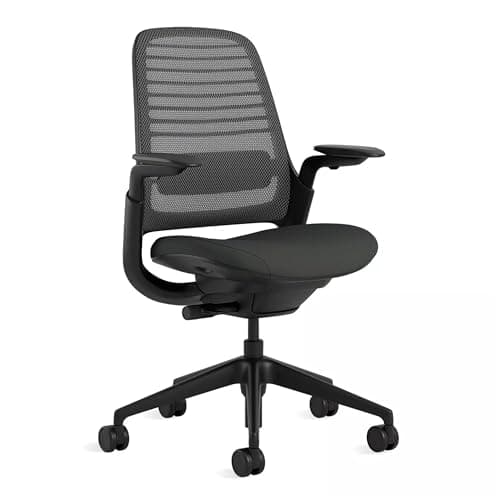
Steelcase publishes more paper for this chair than any other seat we rank: a dated Product Compliance certificate (8 Jan 2024) covering Series 1 seating to ANSI/BIFMA X5.1 and X5.11 at 400 lb, and a cut sheet listing BIFMA LEVEL 3, CAL 117, SCS Indoor Advantage Gold (Furniture) and a published EPD. Read the emissions line carefully: the certificate is SCS Indoor Advantage Gold — the same ANSI/BIFMA M7.1/X7.1 chamber method GREENGUARD uses, issued by a different certifier — so verify it in the SCS Certified Green Products Guide rather than UL SPOT (corrected 2026-09-19; this row previously said 'GREENGUARD / low-emission'). This listing's part number (435A00-…-4ARM-LUM-CC) decodes to 4D arms, adjustable lumbar and carpet casters.
8.4/10
The contract-grade pick: a real ergonomic chair from a manufacturer whose whole business is certified furniture.
Lumbar support
9
Adjustability
8
Materials & certs
10
Build
9
Value
6
Pros
+Genuine ergonomic engineering and a long warranty from a company that stakes its name on it
+Extensive certification and sustainability documentation, not a silent spec sheet
+The flexing back moves with you rather than forcing one posture
Cons
−The most expensive chair here by a wide margin
−Fewer manual adjustments than some cheaper chairs — it relies on its passive support instead
Don't buy this if…
…your budget is tight. The Series 1 is the certified long-term investment; if that's not the priority, the Branch or a good mesh chair gets you most of the way for much less.
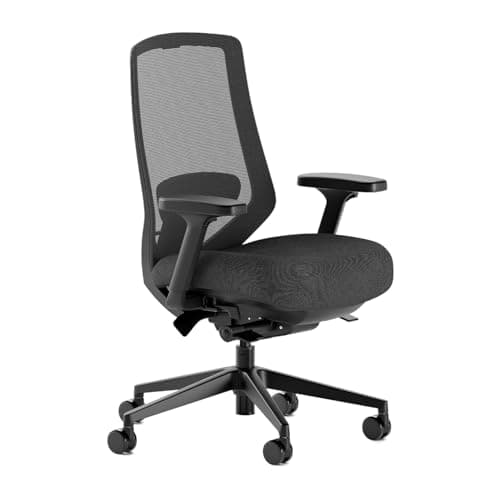
CORRECTED 2026-09-26. Branch's own Ergonomic Chair Pro product page was read directly this time, and its benefits list prints exactly three things that matter here: "Meets BIFMA standard for commercial-grade use; supports 275 lbs", a 7-year warranty, and no emissions line at all. There is NO GREENGUARD wording anywhere on that page, while Branch does print "Certified Greenguard Gold for low VOC emissions" on its Ergonomic Chair, Verve and Daily pages. This row previously carried a GREENGUARD Gold claim taken from a reseller's republished spec sheet; that claim is Branch's resellers', not Branch's, and it is withdrawn. Treat the Pro as BIFMA-claimed and emissions-undocumented: Branch names no BIFMA standard number and publishes no certificate number, and UL SPOT returns nothing to an automated lookup. See /ergonomic-seating/branch-ergonomic-chair-review for the full comparison.
8.0/10
The most adjustment per dollar here: fourteen adjustment points, a two-way lumbar pad and 5D arms, sold on Amazon by Branch itself.
Lumbar support
9
Adjustability
9
Materials & certs
6
Build
8
Value
8
Pros
+Fourteen adjustment points including a lumbar pad that moves up/down and in/out, and arms that move in five directions
+Sold and shipped on Amazon by Branch itself, so the warranty path is the manufacturer rather than a reseller
+Forward seat tilt and tilt tension at this price, which is normally a feature of chairs costing far more
Cons
−The seat is molded high-density foam, not mesh — warmer than a suspension seat over a long day
−Rated to 275 lb, below the 400 lb the Steelcase carries at a comparable price
−Branch prints its GREENGUARD Gold line on three other chairs in the range and not on this one
Don't buy this if…
…you want a chair you set once and forget. Fourteen adjustments only pay off if you actually spend twenty minutes dialing them in.
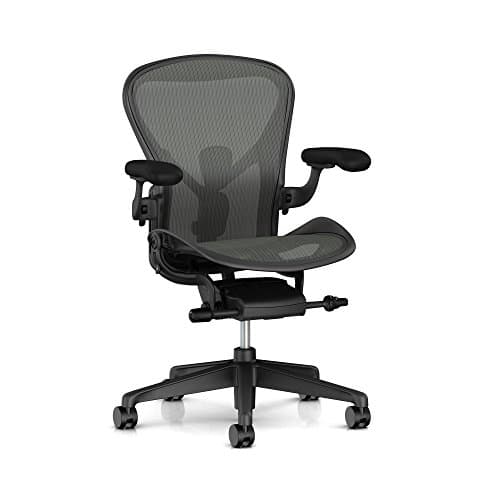
8Z Pellicle meshPostureFit SLSize B: 5 ft 2 to 6 ft, up to 350 lb12-year warranty
Certification & materials
CORRECTED 2026-10-09. Herman Miller's own Aeron store page was read directly and it names "BIFMA Level 3 certified" and "Indoor Advantage Gold certification, SCS Global Services' highest level of indoor air quality performance". It does NOT name GREENGUARD anywhere. This row previously claimed GREENGUARD Gold and told readers to verify it at UL SPOT; that was wrong in exactly the way the Steelcase Series 1 row was wrong before its 2026-09-19 correction, and the claim is withdrawn. The emissions certificate to look for is SCS Indoor Advantage Gold, verified in the SCS Certified Green Products Guide. The same page states the chair is composed of "more than 50% recycled material, including ocean-bound plastic". One caveat specific to buying on Amazon: this listing is fulfilled by a third-party seller, and Herman Miller's published warranty terms exclude products bought from unauthorized resellers, so confirm the seller's authorization if the 12-year cover is part of why you are buying. See /ergonomic-seating/herman-miller-aeron-review.
8.4/10
The reference-standard ergonomic chair — a suspension seat with nothing to compress, PostureFit SL, and a certification record no one else matches.
Lumbar support
9
Adjustability
8
Materials & certs
10
Build
10
Value
5
Pros
+The 8Z Pellicle suspends your weight — no foam to compress, flatten or off-gas, and no heat trap
+Genuinely repairable: parts stay available for years, which is what makes it a decade chair rather than a purchase
+Herman Miller publishes a stature range, a weight capacity and a seat-height range for all three sizes — fit data no other chair maker here provides
Cons
−Costs several times what the rest of this page costs, and that is the whole objection
−Sizing is real — Herman Miller publishes size B for 5 ft 2 to 6 ft and up to 350 lb, and the wrong size undoes the ergonomics
−Sold by a third-party Amazon seller, not Herman Miller, so the 12-year warranty depends on that seller being authorized
Don't buy this if…
…you cannot confirm the size or the seller. A wrong-size Aeron, or one with no warranty behind it, is worse than a right-size cheaper chair.
No emissions certificate is published for this model and the listing makes no BIFMA claim, so we assert neither. Flash Furniture is an established office-furniture brand and tests much of its task seating to ANSI/BIFMA, but we could not find a published certificate for this SKU — that is an absence of evidence, not evidence of a problem, and we treat it that way.
6.4/10
The honest mid-budget mesh chair from a real brand: a ventilated back, height-adjustable arms and a three-paddle control, and nothing it doesn't have.
Lumbar support
6
Adjustability
6
Materials & certs
5
Build
7
Value
8
Pros
+Ventilated curved mesh back and a contoured padded seat, which is the comfort that matters at this price
+Arms adjust in height (listed at 7.75-10.25 in above the seat) rather than being welded in place
+Three-paddle control gives you back height, back angle lock and tilt tension separately
Cons
−The back's lumbar is the shape of the mesh, not an adjustable pad you can move to your curve
−Arms move up and down only — no width, depth or pivot
−No published emissions or BIFMA certificate for this SKU
Don't buy this if…
…you need deep, adjustable lumbar support for an existing back problem — a shaped mesh back supports less of your spine than the Branch or the Steelcase.
The listing states the chair complies with the BIFMA standard and rates it to 275 lb (re-read via the Creators API on 2026-09-22; this row previously said 225 lb and no BIFMA, both of which the live listing contradicts). That BIFMA line is the seller's own claim — there is no certificate number to look up, and no emissions (GREENGUARD) result is published at all. Buy it for price, not for documented materials.
5.8/10
The floor: the cheapest chair here that's still worth owning, and we'll say so plainly.
Lumbar support
5
Adjustability
5
Materials & certs
4
Build
6
Value
9
Pros
+Cheap, and more comfortable than its price suggests
+Simple assembly and a reliable return path
Cons
−Minimal adjustment and shallow lumbar support
−The BIFMA line is a claim on the listing, not a certificate you can verify — and no emissions result is published at all
Don't buy this if…
…you sit for eight hours a day or have back issues. This is a light-use or occasional chair, not a full-workday ergonomic seat — spend more if you're in it all day.
Seat depth is the adjustment people skip and then blame the chair. Sit all the way back against the lumbar, then check the gap behind your knees: you want two or three fingers of clearance between the front edge of the seat and the back of your calf. Too deep and the edge presses your legs and you slide forward off the support; too shallow and your thighs hang unsupported. A chair with a sliding seat pan, like the Series 1 or the Branch Pro, lets you get this right.
Armrests do more than you think
Armrests are not a luxury — they take load off your neck and shoulders. Set them so your shoulders drop and your elbows rest near a right angle without hunching or reaching. Fixed or too-high arms are worse than none, because they push your shoulders up all day. Height-adjustable arms are the feature to insist on; width and depth adjustment are a bonus.
Mesh or foam?
Mesh suspends your weight and breathes, so it runs cooler and there is no foam to compress or off-gas — the Aeron's suspension back is the classic example. Foam is warmer and can feel more cushioned at first, but it softens over the years and, on an uncertified chair, is the part most likely to have an emissions story worth checking. Neither is universally better; if you run hot or care most about emissions, lean mesh. Most chairs here are a hybrid — a mesh back over a foam seat — which is the sensible compromise, and our mesh versus foam comparison works through the trade in full.
Fit the chair to your size, not to the review
Every chair on this page is specified for a range of bodies, and being outside that range undoes the ergonomics faster than any feature list fixes them. The Aeron is sold in three sizes, and size B is specified for roughly 5'3" to 6'6" and 140 to 300 lb — a petite or a very tall sitter should be looking at A or C, not at a review of B. Check two numbers before you buy anything: the seat-height range (can your feet go flat on the floor with your thighs level?) and the weight rating. If you are outside either, see our big and tall chairs instead of forcing a standard-size chair to work.
Set it up in this order
Take twenty minutes with a new chair or you will never feel what you paid for. Seat height first, so your feet are flat and your thighs are level. Then seat depth, to the two-or-three finger gap. Then the lumbar, moved until the support sits in the small of your back rather than above or below it. Then the arms, until your shoulders drop. Then the tilt tension, until leaning back takes gentle effort rather than either resistance or a free fall. Only then judge the chair, and give it a week before you decide.
Reading a certification claim without being fooled
“BIFMA compliant” on a listing is the seller saying the chair was built to a standard; “BIFMA certified” with a certificate you can pull up is a third party saying it. The same gap exists between “low VOC” and a GREENGUARD Gold certificate number. The test is simple and it costs you thirty seconds: can you find the model in the certifier's own registry — UL SPOT for GREENGUARD, the SCS guide for Indoor Advantage, BIFMA's own directory? If you can, the claim is real and current. If you can only find the claim on the box, treat it as a claim. Our certification matrix lists which chair carries which certificate, with where to verify each one.
Then get out of the chair
The most ergonomic thing you can do is stop sitting for a while. Even a perfect chair is a static position, and a body needs movement more than it needs the ideal recline angle. Alternating between a good chair and a standing desk through the day beats optimizing either one on its own.
Side by side
Compare the five on the factors that decide it
The same four questions asked of all five chairs, so you can see where the money goes. Certification is what the maker publishes, not what the listing implies — where nothing is published, the cell says so.
#ad · we may earn a commission · Live prices from the Amazon Product API, as of October 22, 2026. Where we have no verified live price we show none.
How we picked
We do not run a testing lab
We compiled specs from manufacturer manuals, verified every certification claim in the certifying body's own registry (UL SPOT for GREENGUARD, BIFMA, CARB), did the cost-to-own math, and read the aggregated owner reviews, then scored each product against a published rubric. The scores are judgments from documented research — they are not measurements we took, because we do not have a lab and we are not going to pretend we do.
Small things, same day
Desk-day essentials under $40
None of these will change which desk you should buy. They are the cheap, unglamorous parts that decide whether the desk you do buy is pleasant to use on a Tuesday — and, where the material is the whole point of the thing, we have said what it is and what it is not certified to.
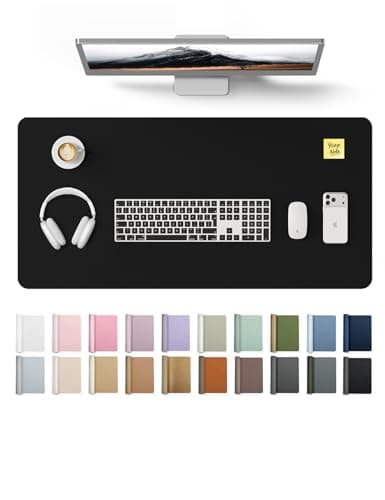
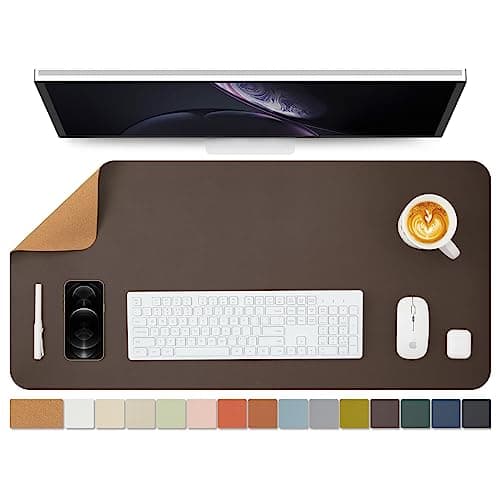
YSAGi PU Leather Desk Pad (31.5 × 15.8 in)
The cheapest way to stop a laminate top getting scratched, and it gives the mouse one consistent surface at both sitting and standing height.
Materials YSAGi lists it as PU — polyurethane, the same polymer we prefer over PVC on the mats side, and for the same reason: no plasticizer question. No emissions certificate is published for it, and at this price we would not expect one.
The natural-material option if a polymer sheet on your desk is exactly the thing you are trying to avoid. Wide enough that keyboard and mouse both sit on it.
Materials Sold as a dual-sided cork mat — cork is bark rather than a polymer sheet, which is the whole reason to pick it here. The seller does not publish what the backing or the second face is made of, and there is no emissions certificate, so treat it as uncertified like the rest of this list.
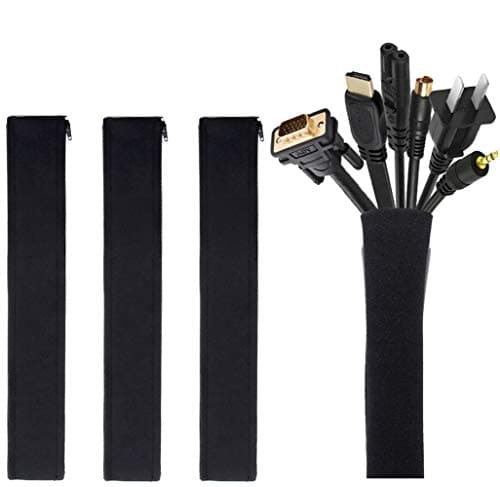
A sit-stand desk drags its entire cable loom up and down twenty times a day. Sleeving the run is the single cheapest thing that stops a cable snagging mid-travel.
Materials No certification is published, and none would mean anything on a cable wrap. This one is on the list for what it prevents, not for what it is made of.
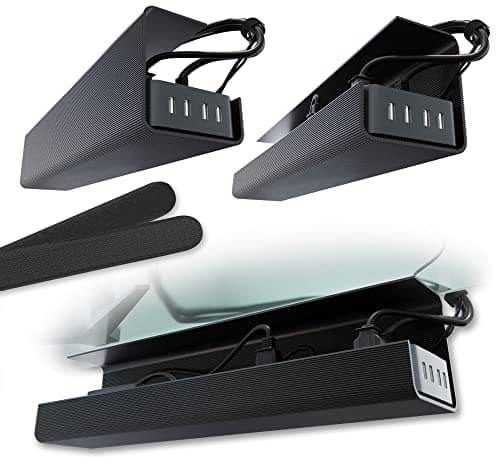
Scanfield No-Screw Under-Desk Cable Tray (17 in, 2-pack)
Gets the power strip and the laptop brick off the floor and onto the underside of the top, so the whole lot travels with the desk instead of tugging at it.
Materials No certification is published and none applies to a tray. The reason it is this one: the no-screw mount means nothing gets drilled into a desktop you may have chosen precisely because it is intact and certified.
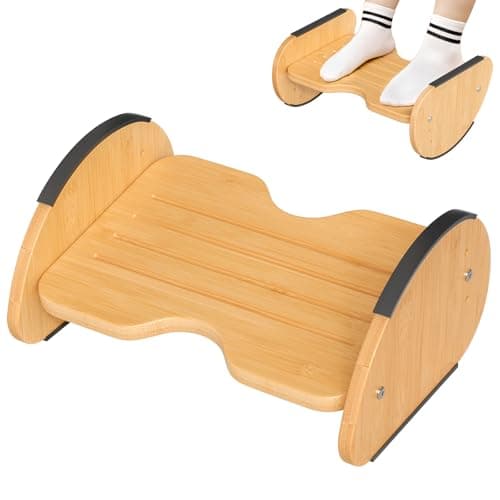
Rock it while you sit, flip it to a fixed angle while you stand. Movement is the entire point of alternating, and this is the cheapest way to add some.
Materials Bamboo. Bamboo panel is normally laminated with an adhesive, and Amazer publishes no formaldehyde or emissions certificate for this model — we are not going to imply it has one.
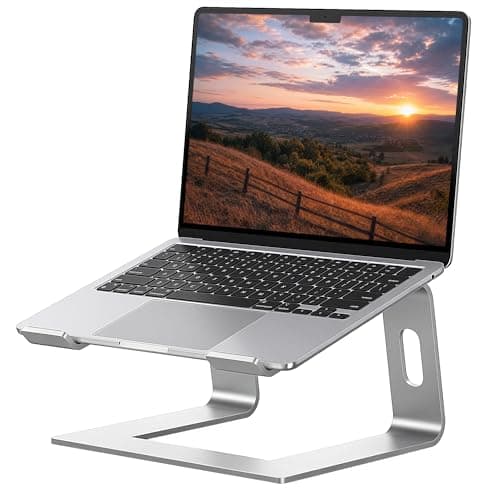
If you work off a laptop, no amount of desk height fixes a screen sitting in your lap. This lifts it toward eye level for under twenty dollars.
Materials Solid aluminum — no composite panel, no adhesive, nothing to off-gas. That is the honest appeal of a metal accessory on a site like this, and it needs no certificate to be true.
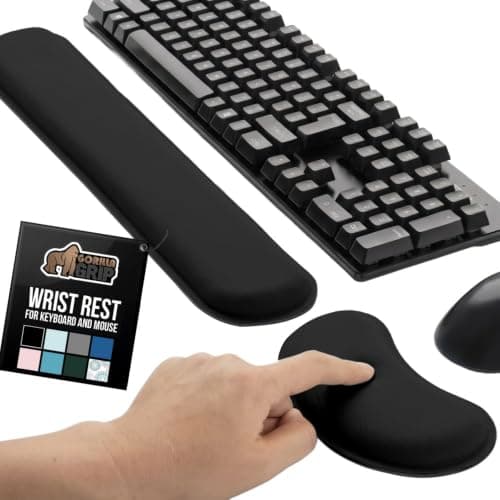
Standing does not fix wrist extension; keeping the wrist neutral does. Two pieces, so the mouse hand gets one as well.
Materials Memory foam under a fabric cover. No emissions or content certificate is published — memory foam is polyurethane foam, and if that is a hard line for you, skip this one rather than talk yourself into it.
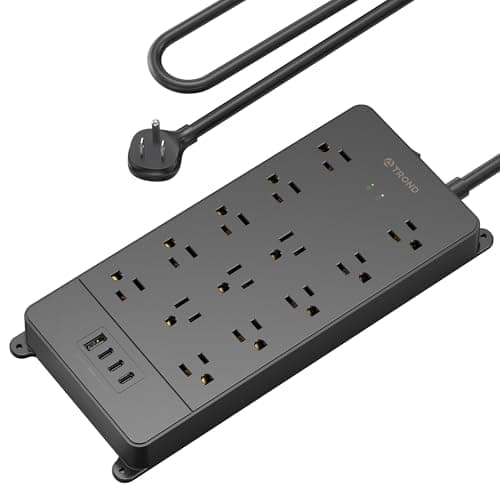
TROND Surge Protector Power Strip (4000 J, ETL Listed)
A powered desk, two monitors and a laptop brick all end up on one strip that travels with the top. Worth thirty dollars for that not to be the cheapest part of the setup.
Materials ETL Listed — a real third-party safety listing from Intertek, and the only genuine certification in this list. You can look it up in Intertek's public directory the same way we tell you to check a GREENGUARD claim at UL SPOT.
The Steelcase Series 1 for most people who sit all day — 4D arms, an adjustable lumbar and the deepest published documentation of any chair in its band, including a dated BIFMA compliance certificate at 400 lb and an SCS Indoor Advantage Gold emissions certificate. The Branch Ergonomic Chair Pro is the alternative if you want the largest number of adjustments for the money, and the Herman Miller Aeron is the reference standard if budget is no object.
How much should you spend on an ergonomic office chair?+
The band where chairs actually become ergonomic rather than just comfortable is roughly $400 to $600: that is where adjustable lumbar, multi-directional arms and published certification start appearing together. Below about $150 you are buying a seat with height adjustment. Above $1,000 you are buying materials, repairability and resale value rather than better posture.
Is an expensive office chair worth it?+
For adjustability, durability and documented low emissions, yes — that is what the money buys, not comfort in the first five minutes. A budget chair can feel fine on day one and leave you aching by month three because you cannot dial it to your spine. If you sit all day, the adjustment range and warranty are the value.
Is an ergonomic chair better than a gaming chair?+
Usually, for desk work. A racing-style gaming chair has a fixed bucket back and a strap-on lumbar pillow where an ergonomic chair has a support you can move to your curve, and its arms often adjust in fewer directions. The shape is not automatically disqualifying — ask the same three questions of either: does the lumbar move, do the arms move, does the seat depth change.
Do office chairs off-gas harmful chemicals?+
Foam, plastics and adhesives can release VOCs and formaldehyde, which is exactly what a GREENGUARD Gold certificate limits. Certified chairs are tested to stay under strict emission thresholds; uncertified chairs simply have not published a result. Ventilate any new chair during its first weeks, and verify certificates at the UL SPOT registry.
Mesh or foam seat: which is better?+
Mesh breathes and has no foam to compress or off-gas, so it stays cooler and ages well; foam can feel plusher at first but softens over time and is the part worth checking for emissions on an uncertified chair. Choose mesh if you run hot or prioritize materials, foam if you want more initial cushioning.
Where should lumbar support sit on your back?+
In the small of your back — the inward curve above your belt line and below your ribs. Sit all the way back in the chair first, then raise or lower the support until it fills that curve without pushing you forward. If it lands on your ribs it will ache within an hour; if it lands on your tailbone it does nothing at all. A support you cannot move is a support that has to be lucky.
Why does a new ergonomic chair feel uncomfortable at first?+
Two reasons, and neither means the chair is wrong. Most chairs arrive with every adjustment at the factory default, which fits almost nobody — spend twenty minutes setting height, depth, lumbar and arms in that order. And a chair that holds you in a neutral posture uses muscles a slumped posture lets you switch off, which feels like work for the first week. If it still hurts after two weeks of correct setup, the chair is the wrong size for you.
What is the best ergonomic office chair for tall or petite people?+
Check two published numbers before the review score: the seat-height range and the weight rating. A chair whose seat will not drop low enough leaves a shorter sitter's feet dangling, and one that will not rise enough forces a tall sitter's knees up. The Aeron is sold in three sizes for exactly this reason, with size B specified for roughly 5'3" to 6'6" and 140 to 300 lb. If you are outside a standard range, see our big and tall chairs.
Are used or open-box office chairs worth it?+
Often yes on the financial maths, with two cautions. Read the condition in the listing title rather than assuming — on premium chairs, “open box” and “refurbished” listings sit right alongside new ones. And check the seller: Herman Miller publishes that products bought from unauthorized resellers are not covered by its warranty, so a second-hand bargain can quietly cost you the twelve-year cover that was half the reason to buy the chair.
Does a good chair fix back pain on its own?+
It helps, but movement matters more than any single posture. The strongest setup is a well-adjusted chair paired with a standing desk so you alternate between sitting and standing through the day. See our chairs for back pain guide for the details.
How long should an ergonomic office chair last?+
The warranty is the manufacturer's own answer to that question, and it is the most honest spec on the page. Steelcase publishes twelve years of multi-shift cover on the Series 1 and Herman Miller publishes twelve years including parts and labor on the Aeron; Branch publishes seven on the Pro. A chair sold with a one-year warranty is being described by its maker as a one-to-three-year chair, whatever the listing says.
We do not run a testing lab, and we do not pretend to. We verify certifications in the certifying body's own registry, compile specs from manufacturer manuals, and cite health claims to recognized authorities — by name, with a link. Where we could not verify something, we say so on the page rather than quietly leaving it out. Read our full method.