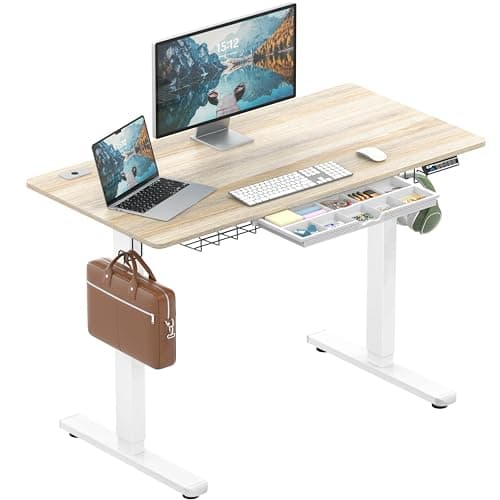
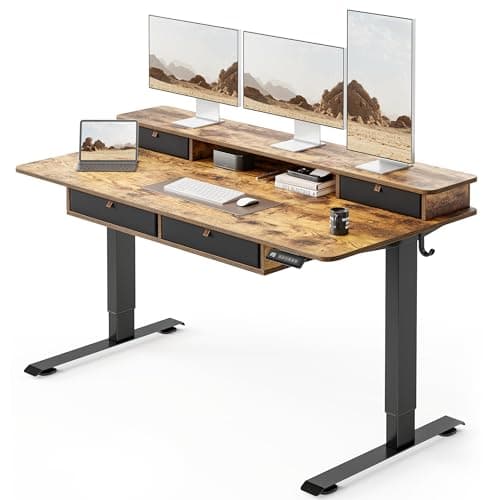
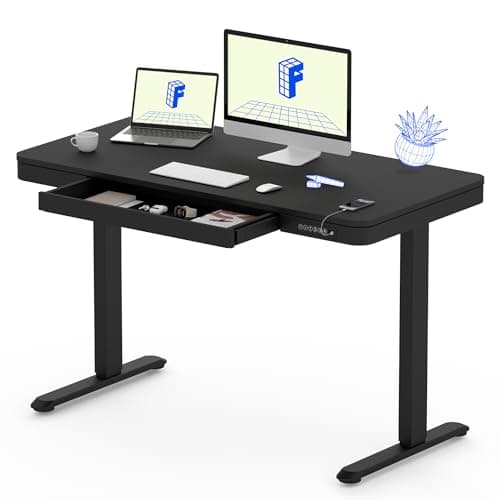
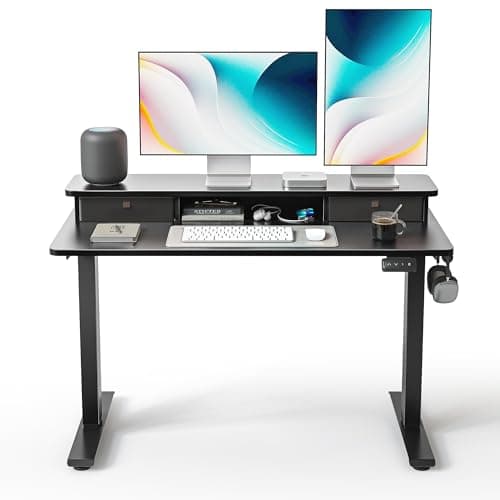
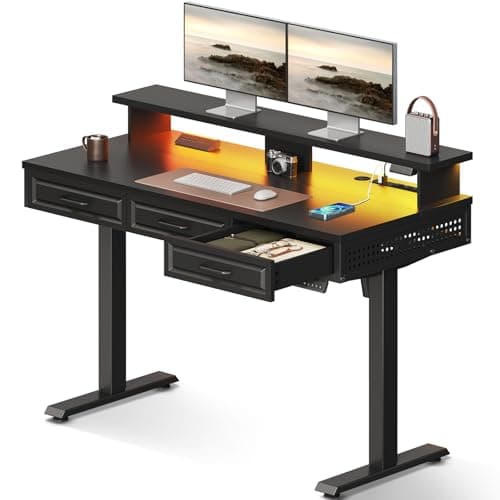
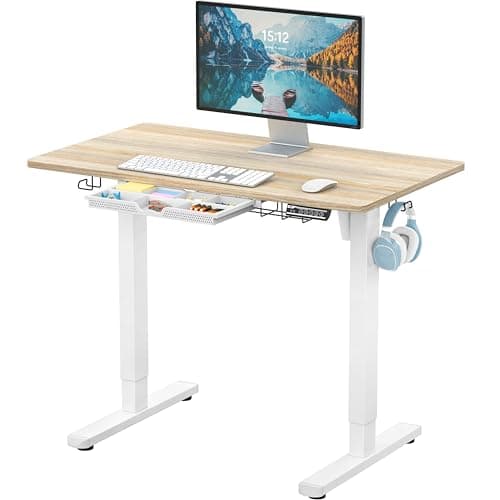
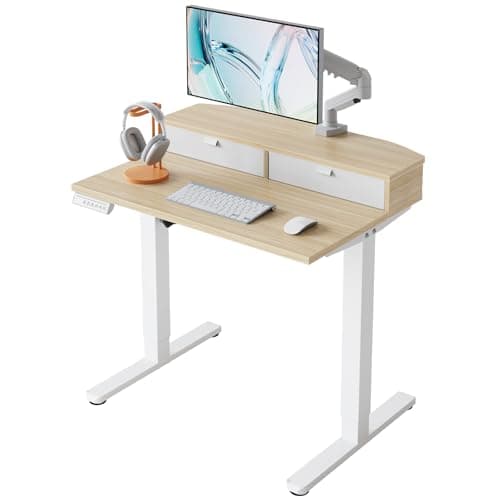
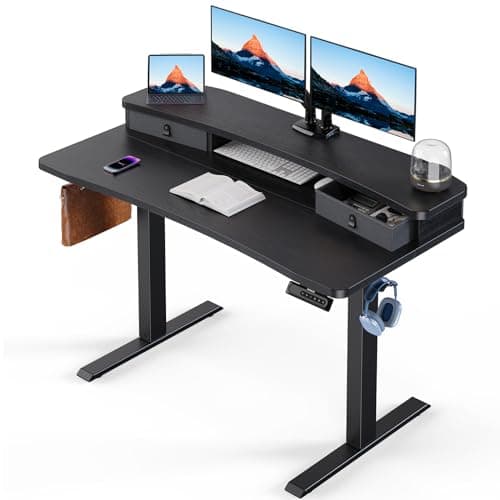
Buy the HUANUO 48×24 with two drawers. It is the best-balanced version of a genuinely compromised idea — two enclosed drawers, a clamp-friendly edge so a monitor arm still fits, and a price low enough that the storage is effectively free. Every desk on this page trades some stability and adds composite wood for that storage, and we are going to be specific about how much.
The compromise nobody spells out
A sit-stand desk is a cantilever. Two legs hold up a top that extends past them in every direction, and the further from a leg you hang weight, the more the whole assembly wants to flex. A drawer bank is a box of weight hung under the top, usually toward one end, and usually loaded with the densest objects in the room — a stapler, batteries, cables, a hard drive.
That is why a desk with drawers wobbles at standing height in a way the same frame without drawers does not, and why the fix in our wobble guide — get weight low, get weight central — is in direct conflict with what a drawer is for. It is not a reason to avoid drawers. It is a reason to know what you are buying and to load the drawer nearest the leg with the heavy things.
The second compromise: more composite, less documentation
A drawer box is five more panels of engineered wood, and drawer construction means more cut edges. Cut edges are where a composite panel emits most freely, because the laminate that partly seals the faces does not cover them. So a desk with three drawers carries meaningfully more exposed composite than a plain top of the same footprint.
None of the desks on this page publishes a CARB Phase 2, TSCA Title VI or GREENGUARD certificate. That is not us failing to find one — it is the state of the category. Storage desks are a value-segment product and value-segment brands do not certify. Two of the picks above are FEZIBOs, and our FEZIBO standing desk review works through exactly what that brand does and does not publish about its panels. If a certificate is your first filter, the honest advice is to buy a certified plain desk or a bare frame with a solid top and put a separate drawer unit next to it. We would rather say that than pretend a certified storage desk exists.
The same logic applies further up the price range, and it gets more expensive there. Eureka's executive drawer desks run into four figures with a surface its own product pages describe only as a PVC-leather-and-paper laminate, without naming the substrate underneath — our Eureka Ergonomic review works through what that wording leaves out. Paying premium money does not buy documentation in this format; it buys finish.
If you buy one anyway — and most people reading this will — the 72-hour break-in method matters more here than on a plain desk, and the drawers should be pulled all the way out and aired separately. They are the parts with the most raw edge.
Built-in drawers versus a rolling pedestal
The alternative deserves a fair hearing, because for a lot of people it is simply better:
- A pedestal does not load the frame. All the weight goes to the floor on its own castors. Your desk stays as stable at standing height as the day you built it.
- It survives the next desk. Built-in drawers are thrown away with the desk; a cabinet outlives three of them.
- You can buy a metal one. Steel filing pedestals exist, cost about the same as the drawer premium on these desks, and have no composite wood in them at all — which is the single cleanest answer to this whole page.
- But it takes floor space, and it does not travel up and down with the desk, so the top drawer is at knee height when you are standing.
The case for built-in drawers is genuinely strong in one situation: a small room where there is no floor beside the desk. If that is you — and it is the same constraint driving our small-space picks — a drawer that rises with the desk is worth the stability penalty.
What to check before you buy
- Is the front edge still clampable? A drawer box under the front lip stops a monitor arm clamping there, and a monitor arm is the highest-value accessory a standing desk takes. The HUANUO explicitly keeps a clamp zone; several rivals do not.
- Does the drawer clear your knees at sitting height? Under-top drawers eat thigh clearance. If you are tall, this is the specification that will annoy you daily — see our tall-user picks for the clearance numbers that matter.
- Fabric sling or rigid box?Fabric adds almost no weight and almost no rigidity; a wood box is real storage and a real load. Both are sold as "drawers".
- Single motor or dual? Storage desks are usually single-motor to hit a price. Adding cantilevered weight to the cheapest lift mechanism is the combination that produces complaints.
Loading a drawer desk so it stays stable
Three rules, in order of how much difference they make:
- Heaviest items in the drawer nearest a leg. The moment arm is what causes flex, and it is a function of distance from the support.
- Keep the drawer contents light in absolute terms. A drawer of paperwork is heavier than most people estimate. Paper is dense; a full letter-size drawer can run to 20 pounds.
- Put the monitor over a leg, not over the drawer. If both the screen mass and the drawer mass sit at the same end, that end is doing all the work.
How we ranked these
Storage capability is scored as its own metric here, alongside the stability, adjustment, materials and value criteria we use across the site. That is deliberate: a desk that wins on storage and loses on stability should show both, rather than averaging into a bland score. Scores are judgments from published specifications, manufacturer manuals and aggregated owner reports, not measurements — we do not run a lab, and our methodology page says so in those words.