Buy the Steelcase Series 1. Long-hours comfort is decided by things that fail slowly — seat foam that keeps its shape, a back that moves with you, arms that take the weight off your shoulders — and contract-grade furniture is designed around exactly that failure curve. Steelcase rates it to 400 lb and warrants it for twelve years. If that is out of reach, the Branch Verve Chair (Galaxy) is the documented mid-price answer and the SIHOO M57 Ergonomic Office Chair is the best adjustability per dollar on the page.
What actually fails at hour six
Chair reviews are written after a week. The problems that define an eight-hour day take longer than that to show up, and there are four of them. They are also the four that separate the field in our best ergonomic office chairs roundup.
- Seat foam compression. Cheap molded foam loses height and rebound within months of daily use, and a seat that has bottomed out tips your pelvis backwards, which flattens the lumbar curve, which is the mechanism behind most desk-related low back pain. Density and thickness are what resist it; neither is on the listing, and warranty length is the best available proxy.
- Arm support. Unsupported arms weigh roughly a tenth of your body mass and hang from your neck and shoulders all day. Height-adjustable arms set at elbow height remove that load. Fixed arms at the wrong height are worse than no arms, because you either shrug or splay.
- Heat. Six hours on a padded seat in a warm room is the reason people fidget, and fidgeting reads as discomfort. Mesh and breathable knit fabrics change this more than any adjustment does, which is why mesh dominates the long-hours category.
- One posture.The chair is not supposed to hold you still. A backrest that reclines and follows you lets you shift position without leaving the desk, and shifting position is the actual goal — NIOSH's ergonomics material and OSHA's workstation guidance both frame the problem as sustained static loading rather than any specific posture.
The adjustment that matters most, and the ones that do not
Rank them: seat height first, because it sets your whole lower body; lumbar depth second, because it decides whether your spine is supported or merely touched; arm height third. Seat depth matters if you are notably tall or short. Everything else — headrests, 4D arm rotation, tension dials nobody ever turns — is a distant fourth.
A headrest is the clearest example of a feature that sells chairs and rarely helps. It is useful if you genuinely recline to read or think, and it is dead weight if you sit upright at a keyboard, because at a working posture your head is forward of the headrest and never touches it. The Ticova High-Back Ergonomic Office Chair is on this list precisely for the people in the first group.
Sitting for long hours is the problem the chair cannot solve
This is a chair page on a sit-stand site, so it would be dishonest not to say it: the best chair in the world is still one posture, and eight hours in one posture is the thing doing the damage. The evidence on prolonged sitting is not about the quality of the seat — it is about the duration of the sit.
So the actual answer to "which chair survives eight hours" is a good chair plus not spending eight hours in it. Alternating between a well-set-up chair and a standing position is the pattern with support behind it, and it is why the Steelcase Series 1 Office Chair and a sit-stand desk beat any chair alone. Our how long to stand guide has the ratios, and standing desk vs ergonomic chair works through which one to buy first if you can only buy one.
Fitting the chair, which is free and skipped by nearly everyone
Most long-hours discomfort in a decent chair is a fitting problem rather than a chair problem, and it takes five minutes to fix.
- Seat height: feet flat, thighs roughly parallel to the floor, knees at or just below hip height. If your feet dangle, the chair is high and you need a footrest — see our footrest picks.
- Seat depth: two to three fingers of gap between the front edge and the back of your knee. Too deep and you slide forward, which undoes the lumbar support entirely.
- Lumbar: the curve should sit in the small of your back, not on your belt line and not between your shoulder blades. If it is not adjustable, a lumbar cushion is the retrofit.
- Arms: set so your shoulders drop and your forearms are level when your hands are on the keyboard. Then set the desk to that height, not the other way around.
The short answer
| # | Product | Best for | Score | Price |
|---|
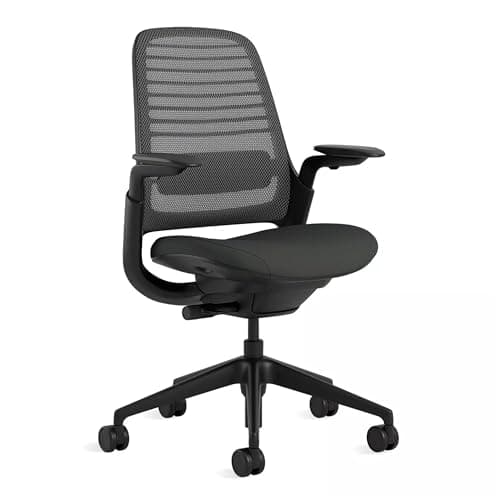
| 01 | | Buy-it-once ergonomic support with documented certification | | $499.00·Amazon |
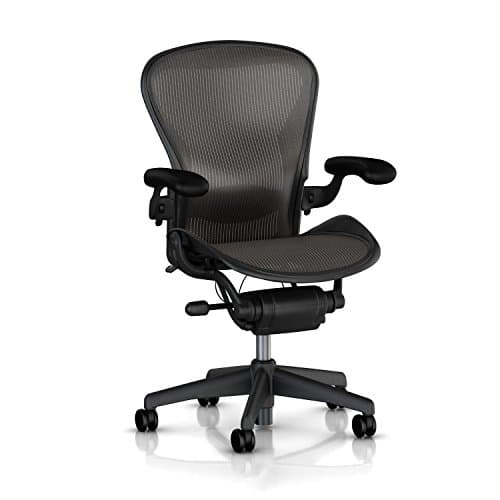
| 02 | | The cheapest honest route into an Aeron | | $699.00·Amazon |
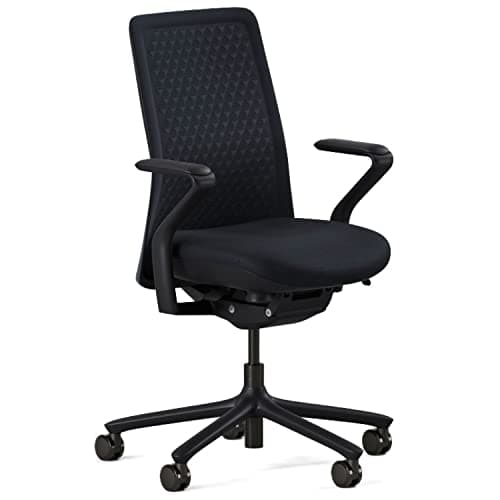
| 03 | Branch Verve Chair (Galaxy)The Branch chair that carries the emissions line and the 7-year warranty — fewer adjustments than the Pro, more paper. | Buyers whose filter is the published certification, not the lever count | | $599.00·Amazon |
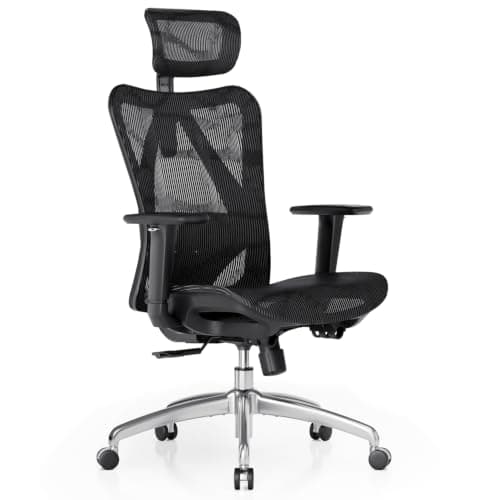
| 04 | | A full-workday chair on a real budget | | $199.99·Amazon |
| 05 | | Recliners and taller sitters | | Check price → |
#ad · Live prices from the Amazon Product API, as of October 21, 2026. Where we have no verified live price, we show none — we would rather leave a gap than print a number that has rotted.
In detail
Buy-it-once ergonomic support with documented certification
LiveBack support4D arms + adjustable lumbarSteelcase rates 400 lb12-year warranty
Certification & materials
Steelcase publishes more paper for this chair than any other seat we rank: a dated Product Compliance certificate (8 Jan 2024) covering Series 1 seating to ANSI/BIFMA X5.1 and X5.11 at 400 lb, and a cut sheet listing BIFMA LEVEL 3, CAL 117, SCS Indoor Advantage Gold (Furniture) and a published EPD. Read the emissions line carefully: the certificate is SCS Indoor Advantage Gold — the same ANSI/BIFMA M7.1/X7.1 chamber method GREENGUARD uses, issued by a different certifier — so verify it in the SCS Certified Green Products Guide rather than UL SPOT (corrected 2026-09-19; this row previously said 'GREENGUARD / low-emission'). This listing's part number (435A00-…-4ARM-LUM-CC) decodes to 4D arms, adjustable lumbar and carpet casters.
The contract-grade pick: a real ergonomic chair from a manufacturer whose whole business is certified furniture.
- Lumbar support
- 9
- Adjustability
- 8
- Materials & certs
- 10
- Build
- 9
- Value
- 6
Pros
- +Genuine ergonomic engineering and a long warranty from a company that stakes its name on it
- +Extensive certification and sustainability documentation, not a silent spec sheet
- +The flexing back moves with you rather than forcing one posture
Cons
- −The most expensive chair here by a wide margin
- −Fewer manual adjustments than some cheaper chairs — it relies on its passive support instead
Don't buy this if…
…your budget is tight. The Series 1 is the certified long-term investment; if that's not the priority, the Branch or a good mesh chair gets you most of the way for much less.
The cheapest honest route into an Aeron
Pellicle suspension meshAdjustable lumbar padFully adjustable armsOpen Box listing
Certification & materials
CORRECTED 2026-10-09: Herman Miller's own Aeron store page names "BIFMA Level 3 certified" and "Indoor Advantage Gold certification, SCS Global Services' highest level of indoor air quality performance" — it does NOT name GREENGUARD, and this row's previous GREENGUARD Gold claim is withdrawn (same error class as the Steelcase Series 1 row, corrected 2026-09-19). Verify Indoor Advantage Gold in the SCS Certified Green Products Guide. That is a statement about the chair as manufactured, which an open-box unit still is. What it is NOT a statement about is this listing: it is an "Open Box Model" sold by a third-party reseller, the bullets claim "12 Year Warranty and 30 day money back" from that seller rather than from Herman Miller, and Herman Miller's own warranty terms exclude products bought from unauthorized resellers. Confirm the configuration, the condition and who actually stands behind the cover before you buy. If you want a new chair with the remastered 8Z Pellicle and PostureFit SL, that is the Size B listing on our best-office-chair page.
The reference-standard ergonomic chair at its lowest entry price — because this listing is an open-box unit from a reseller, not a new chair from Herman Miller.
- Lumbar support
- 9
- Adjustability
- 8
- Materials & certs
- 10
- Build
- 9
- Value
- 7
Pros
- +The mesh suspends your weight without foam to compress or off-gas, and Herman Miller cites BIFMA Level 3 and SCS Indoor Advantage Gold for the chair
- +Genuinely repairable — parts are available years later, so it's a decade-plus chair
- +The most studied ergonomic chair in existence, and open-box is the cheapest way into one
Cons
- −An "Open Box Model" from a reseller, not a new chair — condition, cosmetics and remaining service life are whatever that seller says they are
- −The 12-year cover quoted on the listing is the seller's, and Herman Miller excludes unauthorized resellers from its own warranty
- −Still expensive next to everything else here, and sizing matters (A/B/C) — the wrong size undoes the ergonomics
Don't buy this if…
…you want a warranty you can take to Herman Miller, or you can't confirm the right size for your body. An open-box chair with no manufacturer cover behind it, or a wrong-size Aeron, is worse than a right-size cheaper chair bought new.
Buyers whose filter is the published certification, not the lever count
3D knit backAdjustable lumbar heightBranch rates 275 lb7-year warranty
Certification & materials
Branch's own Verve product page prints, in its benefits list, "Certified Greenguard Gold for low VOC emissions" and "Meets the BIFMA standard for commercial-grade use" alongside a 275 lb capacity — the same three lines it prints on the Ergonomic Chair and does NOT print on the Ergonomic Chair Pro (read 2026-09-26). Both are manufacturer statements: Branch publishes no certificate number and names no BIFMA standard number, and UL SPOT returns nothing to an automated lookup, so verify the live GREENGUARD Gold certificate for Branch at UL SPOT before you buy. The Amazon listing itself repeats neither claim.
The Branch chair that carries the emissions line and the 7-year warranty — fewer adjustments than the Pro, more paper.
- Lumbar support
- 8
- Adjustability
- 6
- Materials & certs
- 8
- Build
- 8
- Value
- 6
Pros
- +One of only three Branch chairs whose own product page carries the GREENGUARD Gold line
- +Height-adjustable lumbar rest plus seat depth — the two adjustments that actually change how a back is supported
- +Sold and shipped on Amazon by Branch itself, and Branch's warranty page names Amazon as an authorized third party
Cons
- −Six adjustment points on the Amazon listing against the Pro's fourteen, at a higher price
- −Amazon's own title says it fits 5 ft to 6 ft — a narrower stature range than the Pro with its optional tall cylinder
- −Stock was thin at resolve time ("Only 9 left"), and Branch publishes no certificate number for the GREENGUARD claim
Don't buy this if…
…you want to dial a chair in adjustment by adjustment. The Verve is a shape you fit into, not a rig you configure — the Pro is the one with fourteen controls.
A full-workday chair on a real budget
Adjustable lumbar3D armrestsMesh backTilt lock
Certification & materials
SIHOO does not publish a GREENGUARD certificate for this model. Some SIHOO chairs are marketed as BIFMA-tested; verify the claim for your exact SKU with the seller rather than trusting a listing badge, and treat emissions as undocumented.
The best real ergonomics per dollar here — adjustable lumbar and 3D arms at a price the flagships cannot touch.
- Lumbar support
- 8
- Adjustability
- 8
- Materials & certs
- 5
- Build
- 7
- Value
- 9
Pros
- +Adjustable lumbar plus three-way armrests is a genuinely ergonomic feature set at this price
- +Mesh back stays cool through a long day
- +Large enough owner base that failure modes and fixes are well documented
Cons
- −No emissions certificate, and BIFMA claims need checking per SKU
- −Foam seat pad is the first part to flatten
Don't buy this if…
…documented certification is the reason you are shopping. The Branch and Steelcase chairs publish what this one does not.
Recliners and taller sitters
Adjustable lumbarAdjustable headrest3D armrestsHigh back
Certification & materials
No GREENGUARD certificate published for this model, and no third-party emissions documentation. Verify any BIFMA claim with the seller for your SKU.
The high-back budget pick — a headrest and a moving lumbar pad, which matters if you recline to think.
- Lumbar support
- 8
- Adjustability
- 8
- Materials & certs
- 5
- Build
- 7
- Value
- 8
Pros
- +The high back and headrest support your neck when you lean back, which mid-back chairs cannot
- +Lumbar pad adjusts up and down, not just in and out — the adjustment that usually gets cut at this price
Cons
- −A tall back dominates a small room visually
- −No published emissions or durability certification
Don't buy this if…
…you sit upright all day. A headrest you never touch is just height, and a mid-back chair costs less.
How to buy a chair for a full working day
1. Read the warranty as a foam-durability spec
Nobody publishes seat foam density. Warranty length is the closest honest proxy you have: a twelve-year warranty is a manufacturer betting the seat will not collapse, and a one-year warranty is a manufacturer declining that bet.
2. Take mesh unless you specifically want cushioning
Over eight hours, heat management beats padding. Mesh also cannot bottom out, which removes the most common long-term failure in this category.
3. Insist on adjustable arm height
This is the single adjustment most correlated with whether a chair is comfortable at hour six, and it is the one most often missing on chairs that otherwise look well equipped.
4. Check the seat width and depth against your body
Chairs are built to a mid-range and the tails suffer. If you are under 5'4" or over 6'2", seat depth and back height are the specs that will decide comfort, not the feature list.
5. Budget for the desk too
A chair set correctly under a desk that is too high puts you back where you started, with raised shoulders and extended wrists. Set the chair to your body, then the desk to your elbows. Our height calculator gives you both numbers.
How we picked
We compiled specs from manufacturer manuals, verified every certification claim in the certifying body's own registry (UL SPOT for GREENGUARD, BIFMA, CARB), did the cost-to-own math, and read the aggregated owner reviews, then scored each product against a published rubric. The scores are judgments from documented research — they are not measurements we took, because we do not have a lab and we are not going to pretend we do.
Small things, same day
None of these will change which desk you should buy. They are the cheap, unglamorous parts that decide whether the desk you do buy is pleasant to use on a Tuesday — and, where the material is the whole point of the thing, we have said what it is and what it is not certified to.
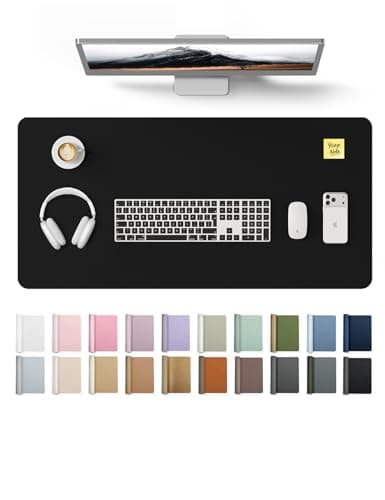
YSAGi PU Leather Desk Pad (31.5 × 15.8 in)
The cheapest way to stop a laminate top getting scratched, and it gives the mouse one consistent surface at both sitting and standing height.
Materials YSAGi lists it as PU — polyurethane, the same polymer we prefer over PVC on the mats side, and for the same reason: no plasticizer question. No emissions certificate is published for it, and at this price we would not expect one.
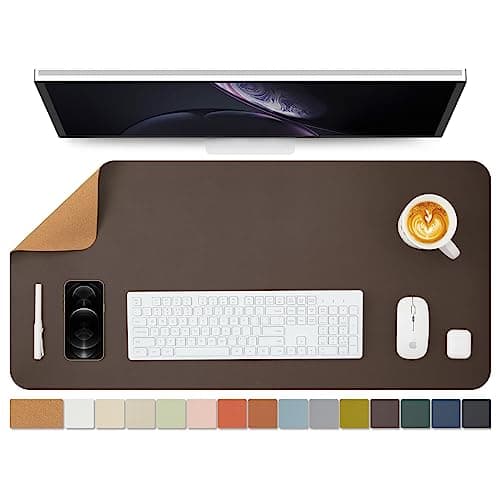
Cork Desk Mat, dual-sided (36 × 17 in)
The natural-material option if a polymer sheet on your desk is exactly the thing you are trying to avoid. Wide enough that keyboard and mouse both sit on it.
Materials Sold as a dual-sided cork mat — cork is bark rather than a polymer sheet, which is the whole reason to pick it here. The seller does not publish what the backing or the second face is made of, and there is no emissions certificate, so treat it as uncertified like the rest of this list.
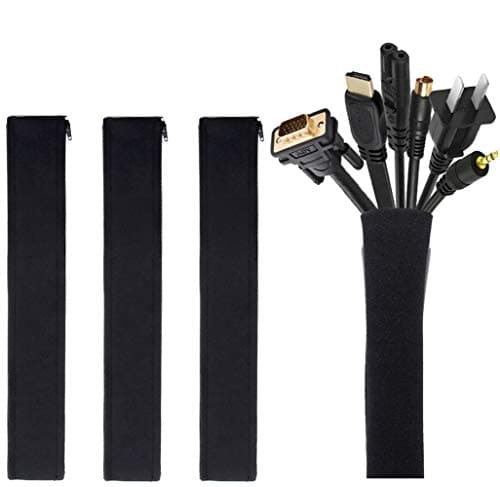
JOTO Cable Management Sleeve (4-pack, 19-20 in)
A sit-stand desk drags its entire cable loom up and down twenty times a day. Sleeving the run is the single cheapest thing that stops a cable snagging mid-travel.
Materials No certification is published, and none would mean anything on a cable wrap. This one is on the list for what it prevents, not for what it is made of.
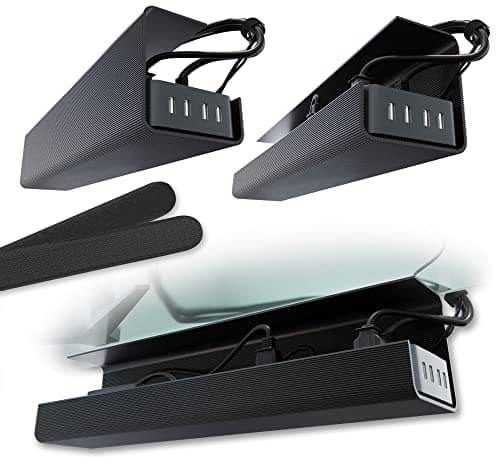
Scanfield No-Screw Under-Desk Cable Tray (17 in, 2-pack)
Gets the power strip and the laptop brick off the floor and onto the underside of the top, so the whole lot travels with the desk instead of tugging at it.
Materials No certification is published and none applies to a tray. The reason it is this one: the no-screw mount means nothing gets drilled into a desktop you may have chosen precisely because it is intact and certified.
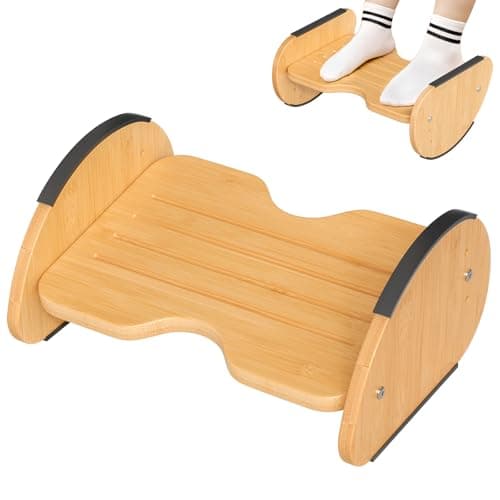
Amazer Bamboo 2-in-1 Reversible Rocking Footrest
Rock it while you sit, flip it to a fixed angle while you stand. Movement is the entire point of alternating, and this is the cheapest way to add some.
Materials Bamboo. Bamboo panel is normally laminated with an adhesive, and Amazer publishes no formaldehyde or emissions certificate for this model — we are not going to imply it has one.
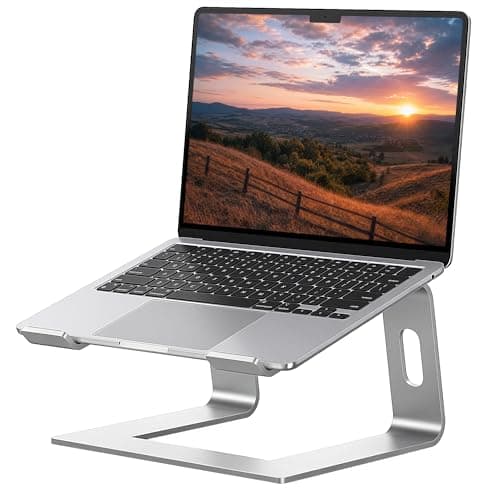
SOUNDANCE Aluminum Laptop Stand (10-15.6 in)
If you work off a laptop, no amount of desk height fixes a screen sitting in your lap. This lifts it toward eye level for under twenty dollars.
Materials Solid aluminum — no composite panel, no adhesive, nothing to off-gas. That is the honest appeal of a metal accessory on a site like this, and it needs no certificate to be true.
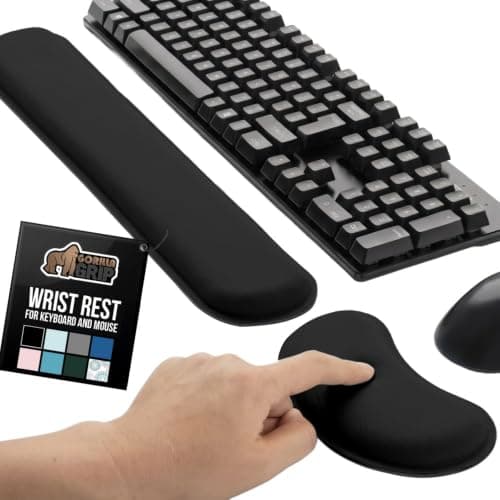
Gorilla Grip Memory Foam Wrist Rest (keyboard + mouse, 2-piece)
Standing does not fix wrist extension; keeping the wrist neutral does. Two pieces, so the mouse hand gets one as well.
Materials Memory foam under a fabric cover. No emissions or content certificate is published — memory foam is polyurethane foam, and if that is a hard line for you, skip this one rather than talk yourself into it.
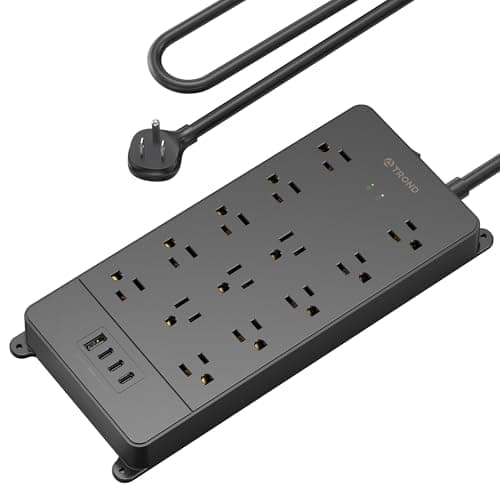
TROND Surge Protector Power Strip (4000 J, ETL Listed)
A powered desk, two monitors and a laptop brick all end up on one strip that travels with the top. Worth thirty dollars for that not to be the cheapest part of the setup.
Materials ETL Listed — a real third-party safety listing from Intertek, and the only genuine certification in this list. You can look it up in Intertek's public directory the same way we tell you to check a GREENGUARD claim at UL SPOT.
Questions
What is the best office chair for sitting long hours?+
A contract-grade chair with adjustable lumbar, adjustable arm height and a long warranty — the Steelcase Series 1 is our pick. The warranty matters because the thing that fails over years is the seat, and warranty length is the closest proxy for foam durability you can actually read.
Is mesh or foam better for long hours?+
Mesh, for most people. It cannot bottom out the way molded foam does, and it manages heat far better over a full day. Foam feels more comfortable in the first five minutes, which is why showroom impressions mislead.
Do I need a headrest for long hours?+
Only if you genuinely recline. At an upright working posture your head sits forward of the headrest and never touches it. If you lean back to read or take calls, a headrest is worthwhile — that is who the Ticova is for.
Can a good chair prevent back pain from long hours?+
It reduces the load, it does not remove it. Sustained sitting is the underlying problem, and the fix with the most support behind it is alternating positions rather than perfecting one. See
standing desks and back pain.
Is an expensive chair worth it if I sit eight hours a day?+
At that dose, usually yes — but spend it on adjustability and durability rather than on brand. A $200 chair with adjustable lumbar and arm height that fits you beats a $900 chair that does not, and the cheapest real upgrade to a chair you already own is a lumbar cushion.
Receipts
We do not run a testing lab, and we do not pretend to. We verify certifications in the certifying body's own registry, compile specs from manufacturer manuals, and cite health claims to recognized authorities — by name, with a link. Where we could not verify something, we say so on the page rather than quietly leaving it out. Read our full method.