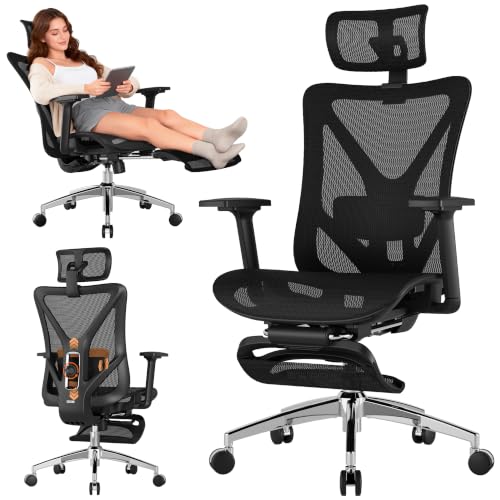
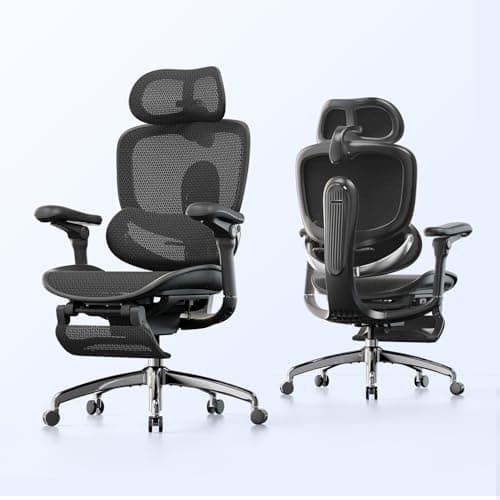
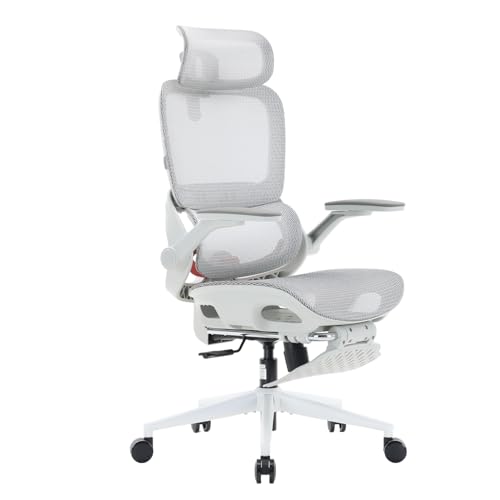
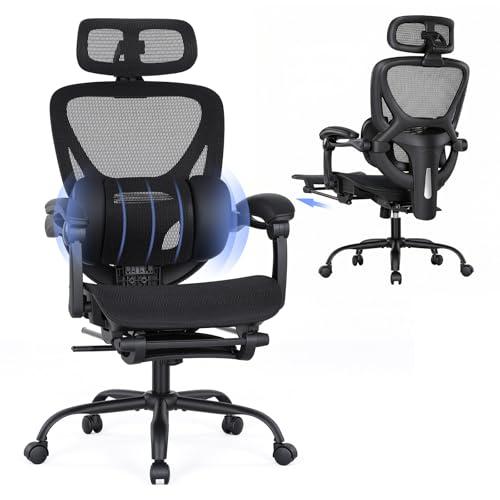
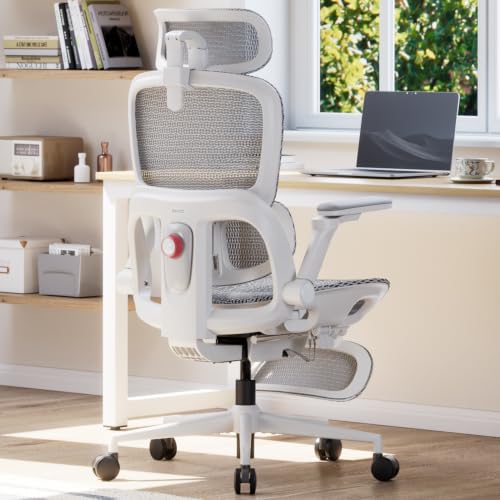
Buy the SIHOO B300 Pro. It is the only chair in this group whose footrest is bolted to a chair worth owning without it — the lumbar block adjusts in height and slides forward on its own, the backrest itself raises and lowers, and the seat depth moves, which is three adjustments the rest of this group either drops or fakes. If the fit question is what worries you, buy the GABRYLLY instead: it is the only chair here whose maker states who it fits, in feet and inches, and the only one that publishes how far the footrest actually extends. The Doro C300 Pro V2 is the premium pick and earns it on recline depth rather than on adjustment. The budget pick is the MALOL, which is a real footrest chair for roughly half the money and publishes no standards claim whatsoever — a trade we spell out below rather than bury. Every chair on this page carries a live price read from the Amazon Creators API and stamped with the date it was read. Nothing here is typed in, and nothing here was tested in a lab, because we do not run one. What we do instead is read what each maker publishes and tell you where it stops.
One thing to settle before the ranking, because it decides whether you should buy any of these chairs at all. A built-in footrest is not an ergonomic feature in the sense that lumbar support is one. OSHA's workstation guidance asks for feet flat and thighs roughly parallel to the floor while you work; a footrest that extends out in front of the chair does the opposite of that, because using it means reclining out of your working posture. It is a break mechanism. That is a genuinely useful thing to own — it is the difference between standing up and walking away from a task and resting without leaving the room — but it is not the thing that will stop your back hurting at 4pm. The thing that stops your back hurting at 4pm is the lumbar adjustment, the seat depth and the armrest height, and that is the axis this page ranks on.
How we ranked these five
Chairs in this category are sold on the mechanism, which means the listings talk about the footrest and go quiet about everything else. So the criteria here are deliberately the unglamorous ones, in this order.
1. What adjusts when the footrest is stowed. You will have the footrest out for perhaps twenty minutes a day. You will be sitting in the chair for eight hours. Every adjustment that fits the chair to your body — lumbar height, lumbar depth, backrest height, seat depth, armrest axes — matters roughly twenty-four times more than the footrest does, and that ratio is why the ranking looks the way it does.
2. Whether the maker publishes a number you can check.This is a category where nobody publishes a third-party certificate. Every chair here makes some version of the same "tested to meet BIFMA and SGS standards" claim with no certificate number attached, or makes no claim at all. So the tiebreaker becomes any specific, checkable figure: a user height range, a footrest extension length, a gas-cylinder class, a lumbar travel measured in inches. Two chairs here publish several. One publishes none.
3. Whether the recline locks. A footrest and a free-swinging tilt are a bad pair: you put your legs up, the backrest moves under you, and you spend the break balancing instead of resting. Three of the five chairs here lock the backrest at named angles. That is worth more than a bigger recline number.
4. Base diameter and stated capacity. A reclining chair with a loaded footrest moves its center of gravity forward and up at the same time. The spec that stops that from becoming a tipping story is the base, and only one listing in this group states its diameter.
5. Price, last. Not because it does not matter but because the spread here is narrow in absolute terms and wide in what it buys. Read the comparison table before you decide the cheapest one is fine.
What the footrest is actually for
There is a real, modest physiological case for putting your legs up, and it is worth stating accurately rather than overselling it. Prolonged immobility in a seated position is what CDC flags as the circulation risk — its travel guidance is about long-haul flights, but the mechanism is the same at a desk: hours without moving the legs. Elevating the legs and changing posture interrupts that. NIOSH makes the complementary argument from the other direction, that standing all day is its own hazard and the goal is alternation rather than any single perfect position.
So the honest version is: a footrest gives you one more posture to rotate into without leaving your desk, and more postures is the thing the evidence actually supports. What it does not do is treat anything. If you have swelling, pain or a diagnosed circulatory condition, the chair is not the intervention and we are not going to pretend otherwise.
There is also a second, less obvious use that several of these listings hint at and none state plainly: a footrest chair is the chair people buy when they sit cross-legged. "Office chair with footrest cross legged" is the single most common autocomplete continuation of the category. If that is you, the spec you need is not the footrest at all — it is a wide seat pan and flip-up armrests, and we rank that properly on chairs for cross-legged sitting.
Who each chair is for
The SIHOO B300 Pro is for someone buying one chair. It is the only pick here where the footrest is a feature of a properly adjustable task chair rather than the reason the chair exists. The lumbar system moves in two axes independently and the backrest height moves too, which together mean the lumbar curve can be placed where your lower back actually is. Seat depth adjusts. Armrests move on six axes and flip up. If you want one chair for the workday and the break inside it, this is the one, and it is not the most expensive chair on the page.
The GABRYLLY is for someone who wants the fit stated. Its listing says the chair is designed for users between 5 ft 3 in and 6 ft tall. That sentence is rarer than it should be and more useful than any other sentence on any listing in this group — it is the maker telling you, before you spend money, whether the chair is for your body. It also publishes the footrest extension (18.1 in of steel), the lumbar travel in inches in both axes and the base diameter. Four specific numbers, where most of this category offers adjectives.
The Doro C300 Pro V2 is for the deep recline. It is the premium pick and the most expensive chair here by a wide margin, and the reason to buy it is the 135-degree recline plus footrest combination that makes a genuine rest position rather than a lean. Eight-way armrests are the most adjustable in this group. What it does not give you, relative to the B300 Pro, is a lumbar block you can move independently — which is why it sits third and not first. We review the family in detail in our SIHOO Doro C300 review.
The B100 Pro is for the footrest buyer who wants one safety spec. It is the cheaper SIHOO: same mesh, same retractable footrest, three locked recline angles, and the only listing in this group that names its gas-cylinder class. A Class 4 cylinder is the top of the four-class scale, and a failed gas cylinder is the one way a cheap office chair hurts someone. What you give up is the adjustable lumbar and the seat depth.
The MALOL is the budget pick, with an asterisk. It is a genuine retractable footrest, a 130-degree recline and a five-position lumbar block for roughly half the price of the mid-picks. It is also the only chair here whose listing makes no standards claim at all — not an unnumbered BIFMA line, not a badge, nothing. We are not going to read safety into an absence, so it ranks last. For a guest desk or a second room that is a perfectly rational trade; for the chair you sit in every day it is not.
What none of these chairs publish
This is the part of the category a buyer-first page has to say out loud, because it applies to all five picks equally.
No third-party certificate, anywhere.Four of the five listings say some version of "tested to meet BIFMA and SGS standards". None of them gives a certificate number, a test-report reference or a registry entry, and we could not find one for any of these models. ANSI/BIFMA X5.1 is a real standard with real test protocols behind it, and a chair that genuinely held a certificate would have a document to point at. Treat every one of these claims as a manufacturer statement. If a verifiable certificate is your buying test, the only honest route is to spend up to a maker that publishes one and verify it yourself at UL SPOT — which is what our GREENGUARD-certified chairs page is for.
No low-emission documentation for the mesh, foam or plastics. Not one of these five publishes a GREENGUARD, OEKO-TEX or SCS certificate for any component. A new chair in a closed room will off-gas for its first days regardless of price; the difference between a documented chair and an undocumented one is that with the documented chair you know what it is emitting. See off-gassing in the first 72 hours for the ventilation routine that applies to any of them.
No published cycle testing on the footrest mechanism itself. This is the one that matters most for this specific category and nobody addresses it. A deployable footrest adds a moving load path to a chair, and none of these makers publishes a cycle count, a load rating or a separate warranty term for it. The warranties on offer are three years (B300 Pro, GABRYLLY), thirty-six months (B100 Pro) and unstated (MALOL). Footrest mechanisms are a known long-term failure point across the category, so buy on the assumption that the mechanism is the part that will go first.
When a separate footrest is the better buy
Here is the buyer-first version of this page, and it is not the answer the category wants us to give: for a lot of people the right purchase is a good task chair plus a separate under-desk footrest, not a chair with one built in.
The two products do different jobs. A built-in footrest extends forward and up and is for resting when you stop working. An under-desk footrest sits flat on the floor, is for working, and is the correct fix for the specific and very common problem of a chair whose seat is too high for your legs because it was set by your desk height instead of your body. If your feet dangle, or if you tuck them under the chair all day, that is the problem to solve first and a reclining footrest will not solve it. Our under-desk footrest ranking covers that side, and the cheapest pick there costs a fraction of the gap between the budget and mid picks on this page.
Buy a chair with a built-in footrest when the chair is also where you read, watch things or take twenty minutes horizontal — in other words when the chair has a second job. Buy a task chair plus a flat footrest when the chair only has one job and it is work. Both are legitimate; only one of them is being advertised to you.
How to buy a footrest chair without buying a bad chair
1. Price the footrest separately in your head
Decide what the mechanism is worth to you as a line item — the realistic figure in this group is a modest two-figure sum — and then judge the rest of the chair on what is left. A footrest chair that costs the same as a good task chair has spent part of its budget on the mechanism, and the money came out of something. Usually it came out of the lumbar adjustment.
2. Count the adjustments, then ask which ones move independently
"4D lumbar" and "adaptive lumbar" are not the same claim. Adaptive means the panel flexes as you move — it has no controls. Adjustable means you set it. Ask specifically whether the lumbar moves in height, whether it moves forward and back, and whether the backrest itself raises. Three yeses is the B300 Pro. One yes is most of this category.
3. Check the recline locks at named angles
A locked 135 degrees is a rest position. An unlocked 135 degrees is a balance exercise with your feet off the ground. Look for the angles written as numbers in the listing — 110/125/135 or 90/110/135 — rather than "up to 135 degrees", which usually means a tension knob and a free tilt.
4. Measure your own height against the listing, if it gives one
Only one chair here states a user height range, and if you are outside it, believe it. Everyone else: the two measurements that decide a chair are your popliteal height (back of knee to floor, sitting, shoes on) and your femur length (back of knee to back of buttock). Compare them against the seat-height range and seat depth. Mayo Clinic's guide is the plain-language version of this and it takes two minutes with a tape measure.
5. Look at the base diameter and the stated capacity together
A stated 300 lb capacity on a 27.5 in base is a different claim from a stated 300 lb capacity on a base whose diameter nobody mentions — especially on a chair designed to put weight out in front of itself. If the listing does not publish a base diameter, treat the capacity figure as describing the seat and not the stability.
6. Buy where the return is free, and sit in it for a week
No certificate exists for any chair on this page, which means your own week in it is the only test data that will ever apply to your body. Use it: put the footrest out on day one, then check on day six whether you have used it since. A surprising number of people find out they bought a mechanism they do not want — and that is a much cheaper discovery inside a return window.