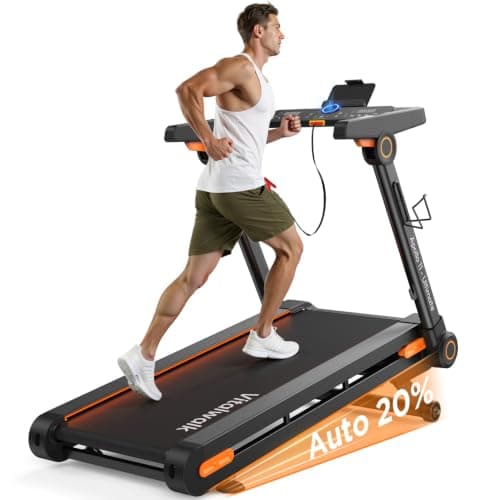
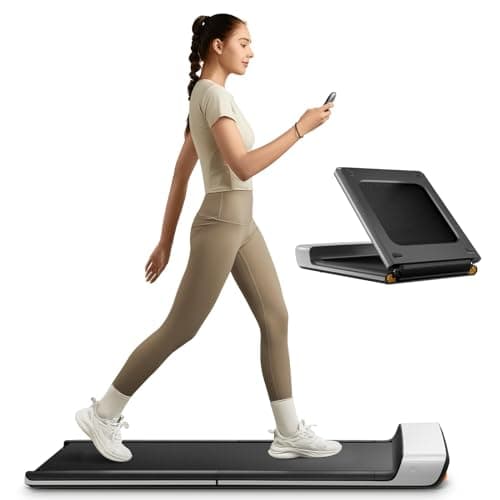
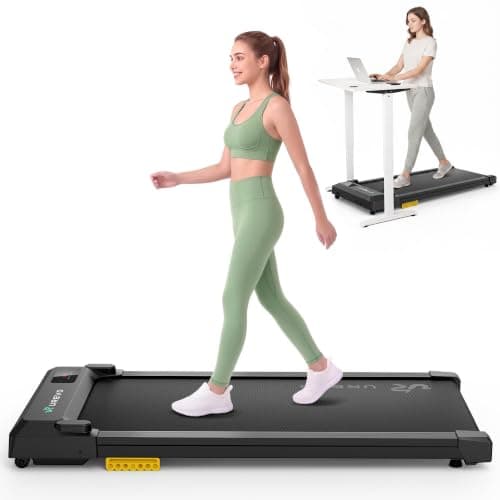
If the complaint is coming from the apartment below you, the motor is not your problem. Two different noises leave a walking pad: airborne noise, which is the motor and the belt and which a closed door mostly handles, and structure-borne noise, which is your heel striking a deck that is bolted to a frame that is sitting on a floor joist. The second one is what travels through a building, and the only levers that move it are deck cushioning, mass under the pad and how you walk. For most apartments, the practical buy is a pad with a cushioned deck — the UREVO is the one we rank for that at a sane price. If you walk for hours every day, a brushless motor is the mechanical argument for the airborne half, and the Vitalwalk is the pad here that has one.
First, nobody in this category publishes a number
We went looking for a decibel figure and there is not one worth comparing. Walking pad listings say "whisper quiet", "ultra quiet" and "silent motor", and almost none of them state a measured sound level — the Vitalwalk is explicit about calling itself whisper quiet while publishing no decibel figure, which is the category norm rather than an outlier. Where a figure does appear, it is a marketing number with no stated measurement distance, no load on the belt and no standard behind it, which makes it uncomparable.
For context on what a decibel figure would even mean: NIOSH's recommended exposure limit is 85 dBA averaged over an eight-hour workday, and it puts vacuums and lawn mowers in that range. It also publishes the exchange rate — every 3 dBA increase halves the safe exposure time. A walking pad at desk speed is nowhere near that territory as a health question. The problem is not loudness, it is transmission.
The two noises, and which one gets you a complaint
Airborne: the motor, the belt and the rollers
This is the sound you hear in the room. It is a low whine plus belt friction, it rises with speed, and it is the noise that matters for your own calls. Two things reduce it: a motor with fewer wearing parts, and keeping the speed down.
A brushless motor is the one specification in this category with a real mechanical argument behind it. A brushed motor has carbon brushes in sliding contact; they wear, and a worn motor gets louder as well as weaker. A brushless motor has none, which is why it is the spec worth paying for if you are running hours a day rather than twenty minutes. That is a durability argument that happens to also be a noise argument, and it is why the Vitalwalk's 3.5 HP brushless motor is in the picks below.
Structure-borne: your feet, the deck and the joists
This is the one that generates the knock on the ceiling. Every heel strike puts an impulse into the deck, the deck passes it to its frame, the frame passes it to the floor, and a timber floor is an excellent transmitter of low-frequency impact. It does not matter how quiet the motor is. The person below is not hearing your pad; they are hearing you walk.
This is also why the common advice — put a rug under it — half works. A thin rug does very little for impact transmission. What helps, in rough order of effect:
- Deck cushioning in the pad itself. A cushioned deck absorbs part of the impulse before it reaches the frame. This is the single thing to buy for, and it is the reason the UREVO is the pick rather than the cheapest pad.
- Mass and resilience under the pad. A dense mat — a thick polyurethane mat or a purpose-made equipment mat — does more than a rug because it adds both damping and mass. Do not expect a transformation; expect a reduction.
- Walking slower, in softer shoes. Free, and bigger than most hardware changes. Desk-pace walking is a shuffle rather than a stride, and that is lower impact by nature. We cover the footwear question on standing desk shoes.
- Where in the room it sits. Near a load-bearing wall transmits less into a joist span than dead center of a floor, which is where the deflection is greatest.
- When you use it. The most effective noise intervention in a shared building is not walking at 7 am. This is unglamorous and it is true.
What to look for in the listing, and what to ignore
| Specification | Does it change what your neighbor hears? | Why |
|---|
| Cushioned or shock-absorbing deck | Yes — the biggest single lever | Absorbs part of the heel impulse before it reaches the frame and the floor |
| Brushless motor | Airborne only | No carbon brushes to wear, so it does not get louder with age |
| Pad weight | Yes, indirectly | Mass damps vibration; a 105 lb pad moves less than a 55 lb one |
| "Whisper quiet" / "silent" | No | No measurement distance, no load, no standard. Uncomparable between listings |
| Folding hinge | No, and it is a wear point | A hinge is a moving part under load — useful for storage, not for noise |
| Top speed | Only if you use it | Noise rises with belt speed; desk walking lives at the bottom of the range |
One more honest point about the trade you are making. A long deck is better to walk on — a short deck at 2 mph is genuinely unpleasant if you are tall — but a long deck is also a bigger, heavier object that is harder to store and harder to move away from the middle of the room. If the pad has to disappear between sessions, the folding option below is the one that does that, with the hinge as the acknowledged cost.
If you have already bought one
The order to try things in
1. Ask what they are actually hearing
A hum is airborne and a thump is structural. They have completely different fixes, and guessing wastes money.
2. Put something dense and resilient under it
Mass plus damping. A thick mat, not a thin rug.
3. Move it toward a wall
Away from mid-span, where floor deflection is greatest.
4. Slow down and change your shoes
The free intervention, and usually the most effective one.
5. Shift the hours
Most building noise complaints are about timing rather than volume.
6. Then reconsider the pad
If the deck has no cushioning at all, no amount of flooring underneath it will fix the impulse at source. That is when a pad with a cushioned deck is the purchase that actually solves it.