Skip to content
Riser & Rail

02 — Anti-Fatigue Mats

The Best Anti-Fatigue Mats for Concrete Floors

A concrete slab returns none of the energy you put into it. On that floor the mat is not a comfort upgrade — it is the only compliant surface in the room.

By Stephen V.Updated How we research
#ad

We earn a commission when you buy through our Amazon links, at no extra cost to you. It never affects our rankings, and we say so when the cheaper — or the direct-only — product is the better buy. How this works.

Buy the NewLife by GelPro Eco-Pro. Three-quarters of an inch of commercial-grade polyurethane is the right amount of give for a floor that has none of its own, consistent softness across the whole surface is what a concrete slab specifically demands, and it is the only mat here whose base carries a third-party high-traction certification — which on sealed or epoxy-coated concrete is the specification that stops a mat travelling under you. If the material question comes first, the WellnessMats Granite Collection Anti-Fatigue Floor Mat is the one whose maker will tell you exactly what is in it.

Why concrete is a different problem

Every floor has some compliance — the amount it deflects and returns when you load it. Carpet over underlay has a lot. Engineered wood over joists has a little. A concrete slab has effectively none: it does not deform, so every step you take is decelerated entirely by your heel, your knee and the small muscles of your foot.

That is why a garage, a basement or a ground-floor slab feels punishing in a way a first-floor room does not, even with the same shoes and the same number of hours. And it is why the same mat that is plenty on a wooden floor can feel thin on concrete. The mat has to supply the entire compliance budget rather than topping up what the floor already gives you.

NIOSH's material on prolonged standing at work makes the same point from the occupational side: the hard-flooring industries — retail, manufacturing, commercial kitchens — are where anti-fatigue matting became standard practice, and they are hard-flooring industries. A home office on a slab is the same physics at a smaller scale.

The three specs that decide a concrete mat

  1. Thickness, with a floor of about three-quarters of an inch. Half-inch mats are fine over wood. On concrete they compress fully under your heel and you are effectively standing on the slab again. Three-quarters is the number to look for, and more is not automatically better — past about an inch, mats get unstable to stand on and become a trip hazard at the edge.
  2. Recovery, not softness. The mat has to come back up after each step. A mat that stays compressed feels wonderful for ten minutes and does nothing for hour three, because a permanently flattened mat is just a thin floor. Dense polyurethane recovers; cheap open-cell foam does not, and that difference is what you are paying for between a $40 mat and a $250 one.
  3. Base grip on a sealed surface. Bare concrete has plenty of tooth. Sealed, painted or epoxy-coated concrete — which is what most finished garages and basements have — is genuinely slick, and a smooth-backed mat will travel. A mat that slides while you step onto it is a fall risk, not an inconvenience. That is the whole reason the Gorilla Grip Anti-Fatigue Mat is on this list.

The cold problem nobody mentions

A concrete slab is a large thermal mass in contact with the ground, and it sits at ground temperature year round. In an unheated garage or a basement that means a floor at 55°F under your feet for eight hours, and cold feet stiffen, which changes how you stand, which is its own route to aching arches and calves.

A thick closed-cell polyurethane mat is a reasonable thermal break as a side effect of being a thick polymer slab, and this is a real practical advantage of the plush mats over the thin ones in this specific setting. It is not a claim any manufacturer certifies, and we are not going to put a number on it — but it is the reason people who move a desk into a basement report that a thicker mat helped more than they expected.

Materials, on a floor you are probably standing on in socks

The material-safety question does not go away because the room is a garage. If anything the contact is more direct — basements and garages are where people work barefoot or in socks because the surface is otherwise cold and dusty.

The ranking above puts the Eco-Pro first on performance, and it is worth being clear about what GelPro does and does not publish for it. Its National Floor Safety Institute certification covers the traction of the bottom surface — genuinely useful on a sealed slab, and genuinely not a statement about emissions. On the chemistry, GelPro says only that the core is a plant-based polyurethane and that the mat is not made with natural rubber latex. WellnessMats does publish: 100% polyurethane, free of formaldehyde, heavy metals, PVC, BPA, latex, plasticizers and phthalates, and passing CFR 1630/1631 surface-flammability testing. That is a manufacturer disclosure rather than an indoor-air certificate, and it is still by far the most specific statement any mat brand makes. Ergodriven states the Topo is PVC-free and markets the line as containing no PFAS or PVC.

If you want the reasoning behind why polyurethane is the default here and where PFAS could plausibly hide in a mat at all, that is PFAS and PVC in anti-fatigue mats. The short version: soft PVC needs plasticizers and polyurethane does not, and PFAS chemistry belongs to stain-resistant surface treatments rather than to the foam core.

What the mat cannot fix

Two things, and both are cheap.

Shoes. On concrete, footwear does more than most people expect — a supportive shoe with a cushioned midsole and the mat together is a completely different day from bare feet and the mat. We work through the barefoot question in shoes or barefoot at a standing desk.

Duration. No mat makes eight hours of standing a good idea. If your feet hurt on a slab, the first change is the ratio rather than the mat — see how long to stand and, if the pain is already established, why your feet hurt at a standing desk. Persistent heel pain, particularly first thing in the morning, is the pattern OrthoInfo describes for plantar fasciitis and is worth a clinician rather than another mat.

The short answer

Quick picks

#ProductBest forScorePrice
01
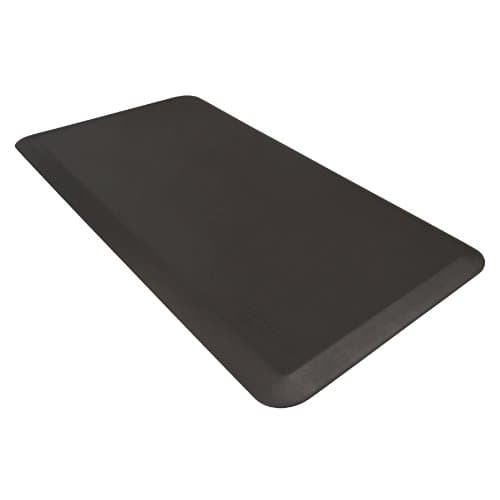
GelPro NewLife by GelPro Eco-Pro Anti-Fatigue Mat (20×48)
NewLife by GelPro Eco-Pro Anti-Fatigue Mat (20×48)

The plush flat pick — a thick, forgiving cushion if you'd rather stand on a soft slab than sculpted terrain.

People who want a soft, flat cushion
8.0
$119.95Amazon
02
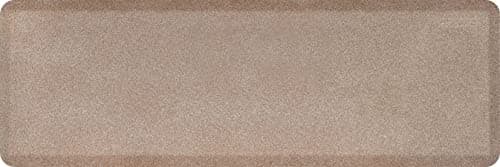
WellnessMats WellnessMats Granite Collection Anti-Fatigue Floor Mat
WellnessMats Granite Collection Anti-Fatigue Floor Mat

The materials answer with a live offer behind it — one solid piece of polyurethane and the most specific ingredient disclosure in the category.

The buyer whose first question is what the foam is made of
8.4
$264.99Amazon
03
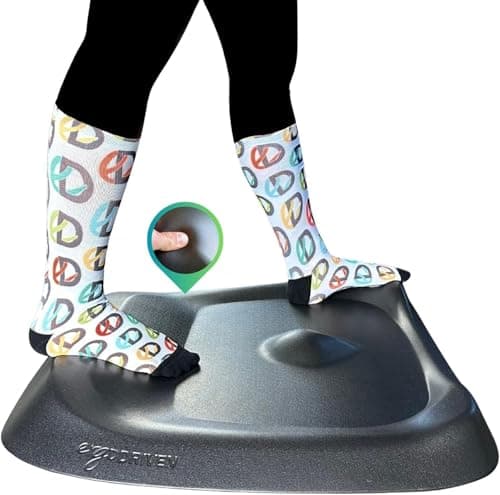
Ergodriven Topo by Ergodriven Standing Desk Mat (full size)
Topo by Ergodriven Standing Desk Mat (full size)

The full-size not-flat mat: sculpted terrain over a real footprint, and the clearest material disclosure in the category.

Standing-desk users who want movement, not just cushion
8.2
$109.00Amazon
04
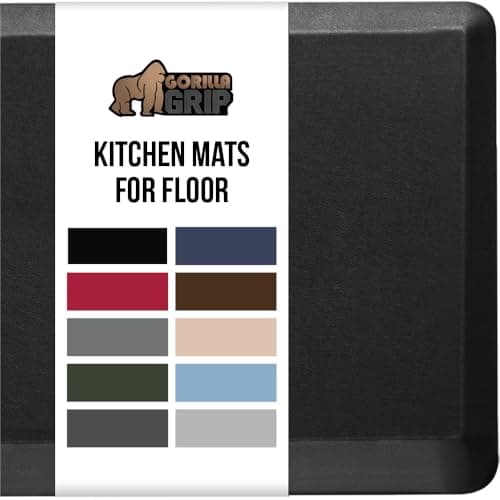
Gorilla Grip Gorilla Grip Anti-Fatigue Mat
Gorilla Grip Anti-Fatigue Mat

The grippiest base here — if your mat slides on a hard floor, this is the fix.

Slippery hard floors
7.2
$42.99Amazon
05
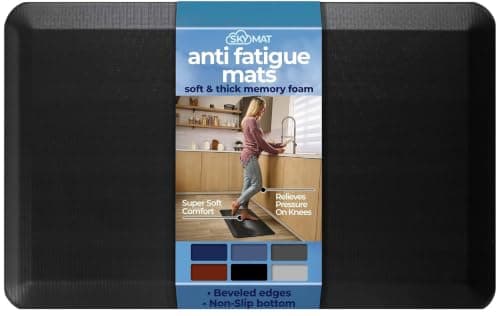
Sky Solutions Sky Solutions Anti-Fatigue Mat (3/4″)
Sky Solutions Anti-Fatigue Mat (3/4″)

The cheapest sensible flat mat here — it does the job, and it doesn't pretend to be more.

The lowest price that still cushions
7.2
$49.99Amazon

#ad · Live prices from the Amazon Product API, as of Sep 6, 2026. Where we have no verified live price, we show none — we would rather leave a gap than print a number that has rotted.

In detail

The picks, in full

01
GelPro NewLife by GelPro Eco-Pro Anti-Fatigue Mat (20×48)

People who want a soft, flat cushion

NewLife by GelPro Eco-Pro Anti-Fatigue Mat (20×48)

3/4 in thick20×48 inPolyurethane Bio-Foam coreNFSI high-traction base

Certification & materials

Polyurethane "Bio-Foam" with plant-based renewable content; GelPro states the mat is not made with natural rubber latex. It publishes no GREENGUARD or third-party emissions certificate, so the chemistry is a manufacturer statement like everyone else's here. What it does publish is a National Floor Safety Institute high-traction certification for the bottom surface — a genuine third-party certification, but of slip resistance, not of what the foam is made of. Do not read it as an emissions claim.

8.0/10

The plush flat pick — a thick, forgiving cushion if you'd rather stand on a soft slab than sculpted terrain.

Cushioning
9
Edge & safety
9
Materials
7
Durability
8
Value
7

Pros

  • Genuinely thick and forgiving underfoot for long standing sessions, and GelPro warrants it for five years against bottoming out
  • Beveled edges and rounded corners reduce the trip hazard a square-edged mat creates
  • The only mat we rank whose non-slip base carries a third-party traction certification, which is the difference between a mat and a fall on a sealed floor

Cons

  • A soft flat mat encourages you to stand still, which is less good for circulation than a mat that makes you move
  • The traction certification is the only third-party document here — the foam chemistry is still GelPro's own word

Don't buy this if…

you want the constant micro-movement of a sculpted mat. Plush and flat is the opposite design philosophy from the Topo.

$119.95View on Amazon

$149.9520% off

Price as of Sep 6, 2026. Prices change — Amazon's is the one that counts.

#ad · we may earn a commission from this link to NewLife by GelPro Eco-Pro Anti-Fatigue Mat (20×48)

02
WellnessMats WellnessMats Granite Collection Anti-Fatigue Floor Mat

The buyer whose first question is what the foam is made of

WellnessMats Granite Collection Anti-Fatigue Floor Mat

100% polyurethaneSingle-piece constructionMade in USA20-year residential warranty

Certification & materials

WellnessMats states its mats are 100% polyurethane made with its own process and are free of formaldehyde, heavy metals, PVC, BPA, latex, plasticizers and phthalates, that they are odor-free and will not off-gas the way rubber, vinyl and biodegradable foam mats do, and that they pass CFR 1630/1631 surface-flammability testing. That is a manufacturer disclosure plus a flammability standard — not an indoor-air certificate like GREENGUARD — and it is still by far the most specific material statement any mat brand publishes.

8.4/10

The materials answer with a live offer behind it — one solid piece of polyurethane and the most specific ingredient disclosure in the category.

Cushioning
8
Edge & safety
8
Materials
10
Durability
10
Value
6

Pros

  • A named exclusion list rather than the word 'non-toxic', which makes the claim checkable
  • Single-piece construction with no bonded surface layer to delaminate or develop a dead spot
  • A 20-year residential warranty, roughly a decade longer than anything else in the category

Cons

  • Two to five times the price of a good budget polyurethane mat
  • Firm rather than plush — buyers expecting a soft cushion are consistently surprised

Don't buy this if…

you want maximum softness underfoot. This mat supports rather than sinks, and a plush foam mat feels completely different.

$264.99View on Amazon

Price as of Sep 6, 2026. Prices change — Amazon's is the one that counts.

#ad · we may earn a commission from this link to WellnessMats Granite Collection Anti-Fatigue Floor Mat

03
Ergodriven Topo by Ergodriven Standing Desk Mat (full size)

Standing-desk users who want movement, not just cushion

Topo by Ergodriven Standing Desk Mat (full size)

Ergodriven lists 29 in wide × 26.25 in deep2.7 in at its highest point0.85 in thick in the neutral areaErgodriven lists 8 lb

Certification & materials

Ergodriven states the Topo is PVC-free, and markets the line as containing no PFAS or PVC. That is a material disclosure, not a third-party certificate — no GREENGUARD or comparable registration is published for it. Polyurethane foam is nonetheless the lower-concern class here, because the plasticizer and chlorine chemistry criticized in vinyl mats belongs to PVC.

8.2/10

The full-size not-flat mat: sculpted terrain over a real footprint, and the clearest material disclosure in the category.

Cushioning
8
Edge & safety
8
Materials
9
Durability
9
Value
7

Pros

  • The calculated terrain gives your feet somewhere to go, which is the actual mechanism behind reduced standing fatigue
  • PVC-free and PFAS-free as stated by the maker — a rare, specific claim in a category full of vague ones
  • Firm foam that holds its shape instead of bottoming out like cheap gel

Cons

  • No third-party certificate backs the material claims — it is the brand's own disclosure
  • Ergodriven notes performance is optimized up to around 240 lb of user weight

Don't buy this if…

you want a flat surface you can roll a chair across. The Topo's whole point is that it is not flat.

$109.00View on Amazon

Price as of Sep 6, 2026. Prices change — Amazon's is the one that counts.

#ad · we may earn a commission from this link to Topo by Ergodriven Standing Desk Mat (full size)

04
Gorilla Grip Gorilla Grip Anti-Fatigue Mat

Slippery hard floors

Gorilla Grip Anti-Fatigue Mat

Thick cushionHigh-grip baseBeveled edgesWipe-clean

Certification & materials

Foam cushion with a textured non-slip base. Gorilla Grip does not publish a third-party emissions certificate; treat material claims as unverified.

7.2/10

The grippiest base here — if your mat slides on a hard floor, this is the fix.

Cushioning
7
Edge & safety
8
Materials
6
Durability
7
Value
8

Pros

  • The base genuinely grips — it won't skate out from under you on tile or laminate
  • Comfortable cushion and easy to wipe down

Cons

  • Marketed more as a kitchen mat than a desk mat — flat, not movement-oriented
  • No published material certification

Don't buy this if…

you're on carpet, where sliding isn't the problem — you'd be paying for grip you don't need.

$42.99View on Amazon

$55.9923% off

Price as of Sep 6, 2026. Prices change — Amazon's is the one that counts.

#ad · we may earn a commission from this link to Gorilla Grip Anti-Fatigue Mat

05
Sky Solutions Sky Solutions Anti-Fatigue Mat (3/4″)

The lowest price that still cushions

Sky Solutions Anti-Fatigue Mat (3/4″)

3/4 in thickPU foamBeveled edgesMultiple sizes

Certification & materials

Polyurethane foam. No third-party emissions certificate published; PU is the lower-concern class than PVC, but any non-toxic claim is unverified.

7.2/10

The cheapest sensible flat mat here — it does the job, and it doesn't pretend to be more.

Cushioning
7
Edge & safety
7
Materials
6
Durability
7
Value
9

Pros

  • The lowest-cost cushion in this list that still has real thickness
  • Comes in several sizes, so you can match your desk footprint

Cons

  • No material certification published
  • Basic flat design; nothing about it encourages movement

Don't buy this if…

you'll stand on it all day and want the best long-term comfort — a denser PU mat like the Topo holds up better under heavy daily use.

$49.99View on Amazon

Price as of Sep 6, 2026. Prices change — Amazon's is the one that counts.

#ad · we may earn a commission from this link to Sky Solutions Anti-Fatigue Mat (3/4″)

How to buy a mat for a hard floor

1. Start at three-quarters of an inch

This is the practical minimum on a slab. Below it you compress through to the floor; far above it you start trading stability for cushion.

2. Buy bigger than your footprint

The most common mat regret on a hard floor is buying one that only covers where you think you stand. You move — a step back to read, a shuffle to reach the drawer — and stepping off the edge onto concrete is exactly what the mat was meant to prevent. Twenty by thirty-two inches is a minimum; a 36-inch-wide mat is better if you have the space.

3. Check the base against your actual floor

Sealed or epoxied concrete needs a genuinely grippy backing. If your mat already slides, a mat with a textured high-grip base fixes it far more reliably than a rug pad underneath.

4. Look at the edge bevel

A thick mat with a square edge on a hard floor is a trip hazard, and on concrete the consequences of tripping are worse. A tapered bevel all the way round is not a luxury feature here.

5. Ventilate it before it goes in a closed basement

Basements and garages are often the least ventilated rooms in a house, which is the worst place to unwrap a new polymer product. Two or three days somewhere airy first — the routine in the first 72 hours — costs nothing.
How we picked

We do not run a testing lab

We compiled specs from manufacturer manuals, verified every certification claim in the certifying body's own registry (UL SPOT for GREENGUARD, BIFMA, CARB), did the cost-to-own math, and read the aggregated owner reviews, then scored each product against a published rubric. The scores are judgments from documented research — they are not measurements we took, because we do not have a lab and we are not going to pretend we do.

Not medical advice

This page is general information, not medical advice, and does not replace a clinician. If you have persistent or severe pain — or a specific condition like a herniated disc or sciatica — talk to a doctor or physical therapist before changing how you work.

Questions

Frequently asked

How thick should an anti-fatigue mat be for a concrete floor?
At least three-quarters of an inch. A concrete slab supplies no compliance of its own, so the mat has to provide all of it, and half-inch mats compress through to the floor under your heel.
Do anti-fatigue mats actually help on concrete?
They are the reason anti-fatigue matting exists — the practice came out of hard-floor workplaces like manufacturing and commercial kitchens. On a slab a mat is doing more work than it does on any other floor.
Will a mat slide on sealed or epoxy concrete?
A smooth-backed one can. Bare concrete grips well; sealed, painted or epoxy-coated concrete is slick, and a mat that travels while you step onto it is a fall risk. Buy one with a textured high-grip base for those floors.
Does a mat help with a cold concrete floor?
A thick closed-cell polyurethane mat is a reasonable thermal break as a side effect of being a thick polymer slab. No manufacturer certifies a figure for this and we will not invent one, but it is a real practical reason to prefer a plush mat in an unheated basement or garage.
Is a rubber gym mat as good as an anti-fatigue mat?
For cushioning, sometimes. For standing all day, no — gym flooring is designed to absorb impact and protect the floor, not to return energy step after step, and it typically has a much stronger odor when new. It also has no beveled edge.

Keep reading

Receipts

Sources

We do not run a testing lab, and we do not pretend to. We verify certifications in the certifying body's own registry, compile specs from manufacturer manuals, and cite health claims to recognized authorities — by name, with a link. Where we could not verify something, we say so on the page rather than quietly leaving it out. Read our full method.