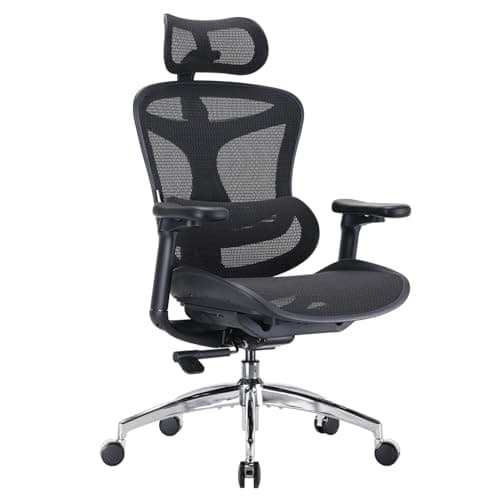
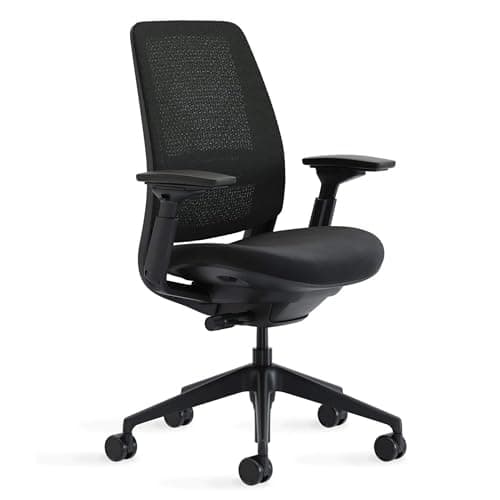
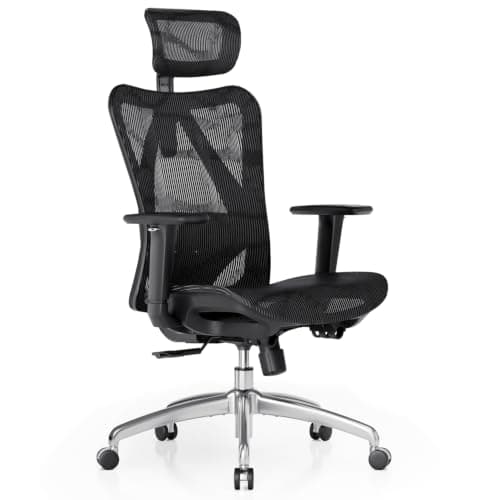
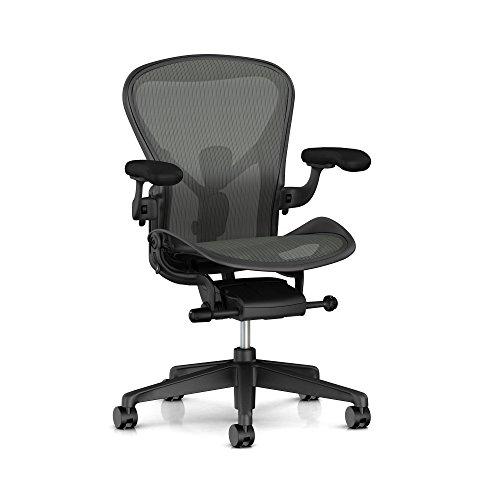
Buy the Herman Miller Aeron, size B, if the budget exists: it is the only chair here whose suspension is described as a zoned textile rather than a panel of mesh, and Herman Miller publishes both a BIFMA Level 3 line and an SCS Indoor Advantage Gold indoor-air certification for it. If it does not, the budget pick is the SIHOO M57 — the cheapest chair on this site with a mesh back and genuinely adjustable lumbar, and the right buy for a full workday on a real budget. In between sits the one chair that changes the question: the SIHOO Doro C300 puts mesh under you as well as behind you, which almost nothing near its price does.
Who each pick is for
- Herman Miller Aeron (size B) — the no-compromise, keep-it-a-decade choice, and the only pick here with a suspension seat instead of foam.
- SIHOO Doro C300 — a full workday with no foam seat pan under you, at a mid-budget price.
- Steelcase Series 2 — taller torsos, and anyone who found a mid-back mesh chair stops at the wrong place on their spine.
- SIHOO M57 (budget pick) — the cheapest chair here that still gives you a mesh back and a lumbar pad you can actually move.
Mesh is not one material, and that is the whole page
"Mesh back" describes a construction, not a spec. A woven polyester panel stretched over a plastic frame and a zoned elastomeric suspension engineered to different tensions in different places are both mesh, and they do not behave alike after six months of eight-hour days. The first one stretches toward the shape of the heaviest thing pressing on it. The second is designed so that the region under your sit bones and the region behind your lumbar curve carry different loads on purpose.
Herman Miller is the only maker in this set that describes its suspension in those terms: the Aeron row in our registry records an 8Z Pellicle, meaning eight tension zones, plus PostureFit SL at the base of the back. Steelcase describes the Series 2 differently — an Air LiveBack with two-way flex, which is a frame-and-back behavior rather than a textile claim. SIHOO describes neither; what the Doro C300 publishes instead is a figure that matters more at its price, which is that the seat is mesh too.
That is why the ranking here is not the same as our general chair ranking, and why it is not a rerun of mesh versus foam, which is the page to read if you have not decided between the two materials yet. This page assumes you have.
The spec almost nobody prints: the seat
Most "mesh chairs" are a mesh back bolted to a foam seat. That is not a criticism — a foam seat with a decent density is a perfectly good seat — but it does mean the two things buyers expect from mesh, airflow and no compression set, only apply to the half of the chair behind you. The part that actually gets hot and the part that actually flattens is the seat.
Two chairs here break that pattern, at opposite ends of the price range. The Aeron has suspension front and back, which is the structural reason it has nothing to flatten. The SIHOO Doro C300 publishes a mesh back and a mesh seat at a mid-budget price, and SIHOO publishes a 330 lb maximum load and a 20.28 in maximum hip width to go with it — real numbers, which is more than most chairs in that bracket offer. Its weakness is also published: a single fixed 18.11 in seat depth with no adjustment, which is a problem if your femur is short and which is exactly what the Doro C300 Pro fixes.
What the makers will and will not put in writing
This site exists for buyers who filter on what a product is made of, so the certificate matters as much as the weave. The honest state of play in this category is lopsided.
Herman Miller's own Aeron page names BIFMA Level 3 and SCS Indoor Advantage Gold. It does not name GREENGUARD anywhere, which is worth knowing because the two are often used interchangeably online and they are different certifiers with different registries — Indoor Advantage Gold is verified in the SCS Certified Green Products Guide, a GREENGUARD certificate at UL SPOT. Steelcase publishes the Series 2 cut sheet listing BIFMA compliance, SCS Indoor Advantage Gold (Furniture) and an Environmental Product Declaration.
SIHOO publishes a badge. Its own product page says the Doro C300 is "environmentally certified by BIFMA and TUV for quality and safety", and that sentence conflates two separate things — BIFMA writes the ANSI/BIFMA X5.1 performance standard and separately runs the LEVEL sustainability program — while naming no certificate number, no standard number and no registry to search. We found no SIHOO model in a LEVEL registry. Treat both SIHOO chairs here as undocumented on emissions and give a new one its first-week off-gassing period in a ventilated room. Our BIFMA explainer is the page that unpicks what the badge does and does not mean.
Where mesh is the wrong answer
Mesh is a thermal and compression solution, not a support solution. If what hurts is your lower back, the deciding feature is the lumbar mechanism and not the textile — read the chairs ranked on lumbar adjustment instead, where two of these four appear in a different order for that reason. If you recline to think and your neck is the complaint, the headrest page is the right ranking. And if the problem is a tailbone or a hard edge rather than heat, a suspension seat is sometimes worse than foam, which is the argument on our tailbone page.
One more honest caveat. A mesh seat has a frame around it, and that frame has a front edge. On a suspension seat the edge is a defined rim rather than a soft taper, and if your thighs are short enough that the rim lands behind your knees you will feel it within an hour. That is a seat-depth question, not a mesh question, and it is why the fixed 18.11 in Doro C300 seat is the single thing to measure before you buy it. Our chairs for short sitters page has the measurement method.
Before you buy
How to read a mesh chair listing
1. Find out whether the seat is mesh
If the listing says "mesh back" and then stops, the seat is foam. That is fine, but it means the airflow and no-compression claims only cover the backrest.
2. Look for a tension description, not a mesh photo
Zoned, multi-zone or a named suspension with a stated number of regions tells you the maker engineered the textile. A close-up photograph of a weave tells you nothing.
3. Check the seat depth figure against your own femur
A single published depth with no adjustment is the most common reason a good mesh chair feels wrong. Two to three fingers of clearance behind the knee is the target.
4. Separate the lumbar mechanism from the mesh
Self-adaptive, adjustable in height, adjustable in depth and "contoured" are four different things. Only the middle two can be fitted to your spine.
5. Read the certification line literally
A named certificate with a named certifier is verifiable. "Certified by BIFMA and TUV" with no number is a badge. Ask which standard and which registry.
6. Then check the warranty length against the price
Twelve years against three is the clearest signal in this category of what the maker expects the suspension to do over time.