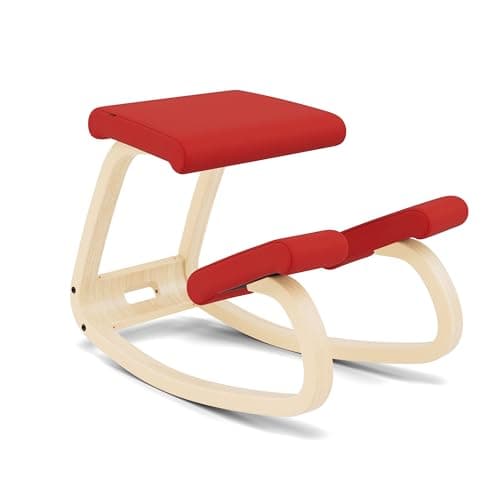
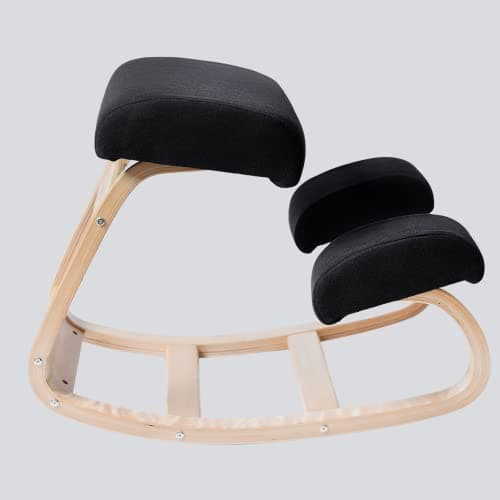
Buy the Sleekform Austin. It rocks, which is the feature that separates a kneeling chair from a padded perch, and it costs about a third of what the Varier original costs while keeping most of the geometry. Buy the Varier Variable Balans if you already know the format suits you and you want the one that will still be here in twenty years. And read the limits section before either — this is a second chair, not a replacement one.
What a kneeling chair actually changes
Sitting in a conventional chair puts your hips at roughly ninety degrees. That angle rolls the pelvis backward, which flattens the lumbar curve, which is the mechanical start of the slouch that every lumbar cushion and adjustable backrest exists to fight.
A kneeling chair opens that angle to somewhere around 110 to 120 degrees by tipping the seat forward and putting part of your weight through the shins. The pelvis rolls forward instead of back, the lumbar curve happens by itself, and there is nothing to slump against. That is the whole mechanism, and it is a real one — it is the same reasoning behind the forward-tilt seat pans on serious task chairs and behind the perching stools that suit a raised desk.
What it is not is a cure. If your back hurts, the ordering matters: fix desk height and screen height first, alternate sitting and standing on a sane schedule, and change position often. Our back pain guide covers the evidence and the order of operations, and OrthoInfo is a better source on low back pain than any furniture listing.
Rocking base or static base — the decision that matters most
There are two kinds of kneeling chair and the listings barely distinguish them.
- Rocking (bentwood runners).The chair moves with you continuously, which keeps the hips and lower back working and stops any one tissue taking load for an hour. This is the original Varier design and it is why the Varier still commands its price. Sleekform's Austin is the well-executed budget version.
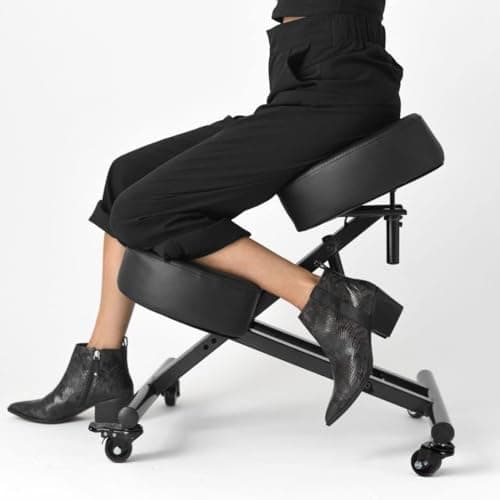
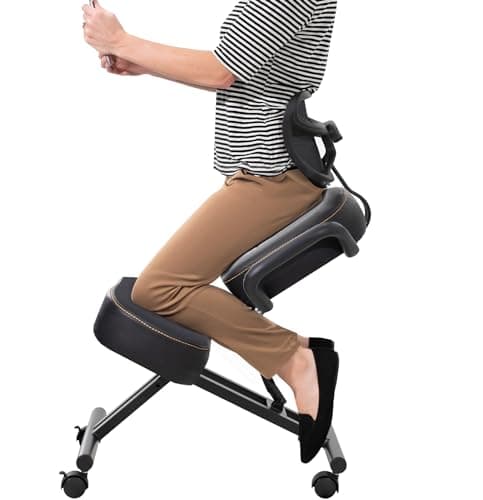
- Static (usually with a gas lift and castors). A fixed perch at an adjustable height. Cheaper, more office-like, and it works with a raised desk — but it gives you the open hip angle without the movement, and movement is half the benefit.
If you can only have one feature, take the rocking base. If your desk is unusually high or you share the chair with someone a different size, take the adjustable one — the Sleekform Alpha adjusts both seat height and seat angle, and seat angle is the control that decides whether your shins or your hips carry the load.
The shin problem, and how to avoid blaming the wrong thing
The most common complaint about kneeling chairs is shin pressure, and the most common cause is a chair being used wrong rather than a bad chair.
- Your weight should be mostly on the seat. The shin pads are for stabilizing, not for supporting. If your shins are taking real load, the seat angle is too steep or you are sitting too far forward.
- Pad thickness is not a luxury. Thin pads are the specific failure of the cheapest models, which is why the Yaheetech here is honestly described as a way to test the format rather than a chair to live with.
- Forty minutes, then move. Nobody sits in a kneeling chair for four hours. The format is designed for blocks, alternated with standing and with a conventional chair.
Who should not buy one
Being direct about this matters more than another paragraph of benefits:
- Anyone with knee problems. The format loads the knees and shins by design. This is the single clearest contraindication and no amount of padding changes it.
- Anyone who needs a chair for a full eight-hour day with no alternative seat. Kneeling chairs are a rotation piece.
- Anyone who gets up frequently. Getting in and out is slower and more deliberate than with a normal chair, and that friction is real if you are on and off calls all day.
- Anyone whose actual problem is an unsupported lower back at a normal desk. That is a job for a proper chair with adjustable lumbar — see our office chair rankings — or for a lumbar cushion on the chair you own.
Materials, briefly
Kneeling chairs are foam pads on a wood or steel frame, and none of the models here publishes a GREENGUARD or BIFMA certificate. The Varier is the exception on construction rather than on paperwork — bentwood and fabric is a materially simpler build than molded foam over particleboard, and Varier publishes an environmental position for its Norwegian manufacturing, though we could not confirm a certificate for this specific model in a public registry, so we are not going to claim one.
Polyurethane foam is polyurethane foam wherever it appears, so the standard habit applies: unwrap a new chair somewhere ventilated and give it a couple of days before it lives in your office. Our off-gassing guide is the same method you would use for a desktop, and it works on seating for the same reason.
Setting up a kneeling chair
- Set the seat height so your hips sit above your knees. That is the whole point of the geometry; if your hips end up level with or below your knees you have rebuilt a normal chair with worse shin support.
- Check the desk height afterwards. A kneeling chair usually sits you higher than a task chair, so your elbow angle changes. If the desk cannot rise to meet you, the chair is the wrong purchase — run the numbers in the height calculator first.
- Start with twenty-minute blocks and build up over two weeks. Sore hip flexors in week one are normal; sore shins are a setup problem.
- Keep your old chair. Rotation is the strategy. A kneeling chair, a normal chair and a standing block is a better day than any single seat.
How we scored these
Posture benefit, adjustability, materials and certifications, build, and value. Posture benefit rewards the rocking designs, because continuous movement is the mechanism the format is actually good at. Scores are judgments from published specifications, manufacturer documentation and aggregated owner reports — not measurements. See our methodology.