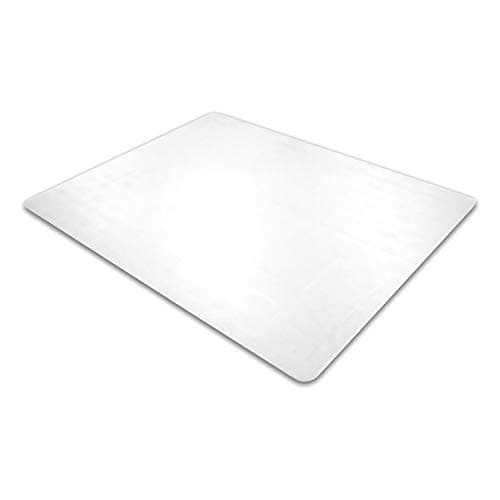
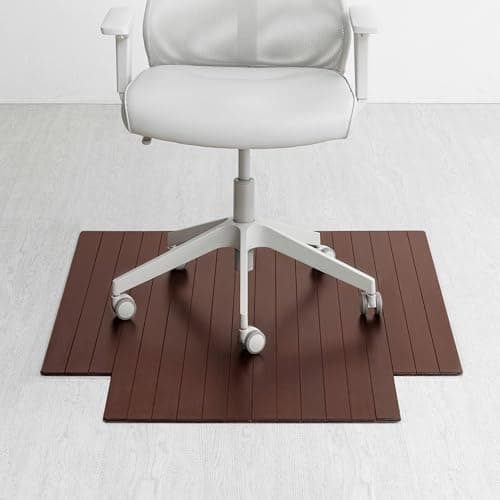
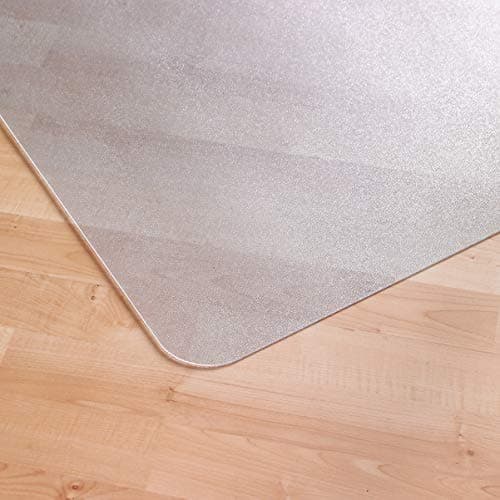
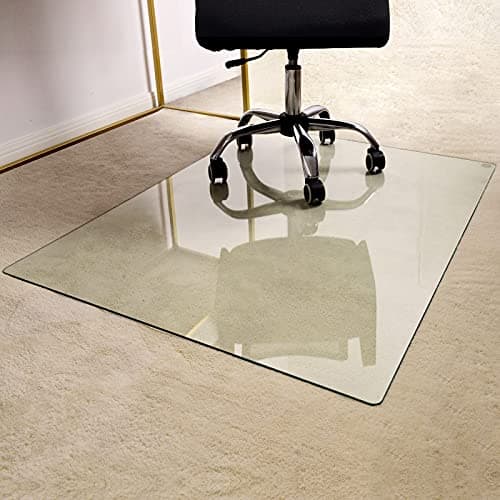
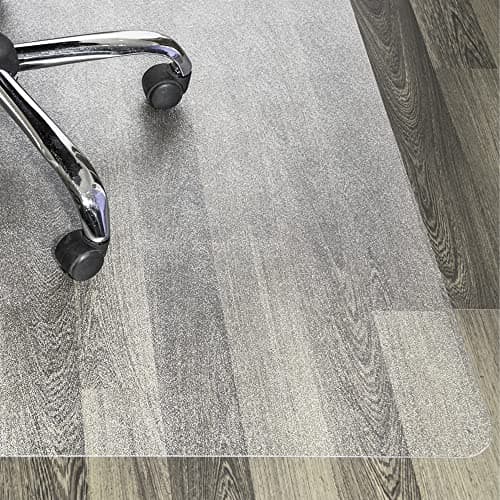
On a hard floor, buy the rigid polycarbonate Floortex Ultimat. On low or medium pile carpet, buy the carpet build of the same mat. If what you want is no polymer in the room at all, the Anji Mountain bamboo mat is the only pick here that answers the materials question by construction, and tempered glass is the only one that answers it completely. Those four sentences cover most desks. The rest of this page is the reasoning, because the chair-mat aisle is sorted by size and clarity and the thing that should sort it is chemistry.
The one failure mode nobody puts on the box
A chair mat is usually the single largest piece of flexible plastic anyone buys for a home office — bigger than the chair upholstery, bigger than the desk edge banding, bigger than every cable sleeve combined. And it spends years pressed flat against your floor under a point load, which is the exact condition that drives one specific, documented process.
Shaw, one of the largest flooring manufacturers in the US, publishes a technical bulletin on it. Its language is worth quoting rather than paraphrasing: plasticizers "are not chemically bound to the polymer so they are able to move freely through a product to the surface", that movement "can be accelerated by the presence of moisture and moisture vapor", and — the line that matters when you are choosing a mat — "there is no known way to stop this phenomenon." The bulletin's own example is a rubber mat on vinyl flooring leaving a stain where it touched, and its recommendation is that materials placed on plasticized vinyl should be chosen to be "stable and resistant to the effects of any plasticizers".
So the real question for a chair mat is not how thick it is. It is whether it contains a plasticizer at all. That single question reorders the entire category, and it is why this list is organized by material rather than by floor type.
The four materials, in the order they answer that question
1. Flexible PVC (vinyl).The default, the cheapest, and the only one with a plasticizer in it by definition — vinyl is flexible becauseit is plasticized. Historically that plasticizer was a phthalate. In office furniture that is unregulated: the US CPSC's phthalate rule covers eight phthalates above 0.1% in children's toys and child care articles, and a chair mat is neither. We go through that scope in detail on phthalates in office furniture.
2. Phthalate-free PVC. A real improvement and a real limit. Substituting the plasticizer removes the phthalate question; it does not remove the plasticizer, and the migration mechanism Shaw describes belongs to plasticizers in general rather than to phthalates specifically. Good mat, wrong mat for a vinyl floor.
3. Rigid polycarbonate.A rigid sheet does not need a plasticizer, so there is nothing in it to migrate. That is the strongest reason to pay for polycarbonate and it is almost never the reason it is sold. The honest counterweight: polycarbonate is a BPA-based polymer. BPA has been on California's Proposition 65 list as known to cause reproductive toxicity (female reproductive endpoint) since May 11 2015, with the developmental endpoint reinstated in December 2020, and we found a retail listing for a polycarbonate chair mat carrying exactly that warning. You are substituting one question for another, not clearing the board.
4. Bamboo and tempered glass.The two that step outside the argument. Bamboo slats on a felt backing contain no plasticizer and no BPA; what they do contain is an adhesive and a surface coating, and the emissions claim attached to them is a class rather than a certificate (more on that below). Tempered glass contains nothing organic at all — no plasticizer, no BPA, no VOC story, nothing that can migrate into a floor. It is also heavy, cold and expensive. There is no free answer in this category; there is only a clear ranking of trade-offs.
Why the top pick is the hard-floor polycarbonate
Because the floors most at risk are the ones most people now have. Luxury vinyl plank and sheet vinyl are plasticized floors, which makes a plasticized mat the single worst pairing available: the mechanism in the Shaw bulletin runs in both directions, and the discoloration it describes does not clean off. A rigid polycarbonate sheet removes the variable. On a hardwood, laminate or tile floor the risk is lower but the reasoning holds, and polycarbonate also keeps its shape — it does not dish under a caster or curl back into the roll it shipped in.
Floortex's own line on the Ultimat range, repeated consistently across retail listings, is that it is free from phthalates and PVC, free of tin, lead and cadmium, and 100% recyclable with 0% post-consumer recycled content. Two caveats we would rather state than bury: floortex.com returned HTTP 404 on the product path we tried on 2026-10-16, so those are the maker's claims as repeated by resellers rather than a document we read at the source; and some listings for the range add "GreenGuard Gold Certified", which we could not verify at UL SPOT and are therefore treating as unverified. The material argument stands on the material. The certificate claim does not stand at all until someone produces a number.
Carpet is a different problem than hardwood
On a hard floor a mat protects the finish. On carpet a mat does something closer to mechanical work: it gives the casters a surface to roll on so they stop plowing fibers, and it stops the chair sinking into pile. That changes the specification in three ways.
- The underside has to grip. Carpet mats have studs, spikes or a gripper texture; hard-floor mats have a smooth back. They are not interchangeable, and a smooth-backed mat on pile will skate.
- Pile height is the spec that matters. Reseller listings for the Ultimat carpet range quote thicknesses of roughly 0.085 to 0.11 in and rate the thicker, lipped builds for pile over half an inch. Buy the low/medium build for low/medium pile; on plush or high pile you need the thicker one, and a thin mat will simply sink with you.
- Size matters more than on a hard floor. Rolling off the edge of a carpet mat is worse than rolling off a hard-floor mat, because the chair drops into pile and stops. 48 × 60 in sounds excessive until the chair stays on it.
On thick carpet specifically, tempered glass is the pick that behaves unlike anything else: it does not flex at all, so the chair rolls as if the carpet were not there. That is also the pick with the most reasons to say no — weight, cost, cold, dust, and an edge you can catch a toe on.
The bamboo mat, and what an "E1" claim actually is
The Anji Mountain mat is the only pick here made of a material rather than a polymer: retail listings describe 100% Moso bamboo in roughly 2-inch slats over a felt backing with non-slip gripper dots, a UV-cured coating, and compliance with the European E1 formaldehyde emissions class. That last part is the kind of claim this site exists to unpack. E1 is an emissions classfor wood-based panels — a threshold a panel is declared to meet — not a third-party certificate with a number you can look up in a registry, and in this case the claim appears on reseller listings rather than on a certificate we could retrieve. It is a real and relevant statement about the panel. It is not the same species of evidence as a GREENGUARD Gold certificate number, and we are not going to pretend it is. The same distinction runs through MDF versus solid wood and formaldehyde in desks.
What the bamboo mat has structurally is the thing no vinyl mat can have: no plasticizer to migrate. If your floor is LVP and you want the plasticizer question gone without buying polycarbonate or glass, this is the pick.
The category's documentation problem, stated plainly
We tried to document every mat we considered and mostly failed, and that failure is useful information. For one of the most popular carpet mats on the market we found a major retailer's listing describing it as 100% polycarbonate, two independent reviews describing it as PET, and a third source calling it heavy-duty PVC — three different polymers for one product, with no material statement from the brand to settle it. We left it off this list for that reason alone. It is probably a perfectly serviceable mat. We just cannot tell you what it is, and on this site that is disqualifying for a recommendation rather than a footnote.
If you are shopping outside this list, that is the test: does anyone tell you what the mat is made of, in writing, on the listing or on the maker's own page? If not, treat it as flexible PVC, because that is what the cheap ones are, and apply the LVP rule accordingly.
Do you need a mat at all?
Two legitimate alternatives, both cheaper. The first is to change the wheels instead of covering the floor — stock chair casters are usually hard, and caster trade guidance is blunt that hard glass-filled nylon "marks and damages finished floors" while soft urethane offers the best floor protection available. On a hardwood floor, soft casters plus no mat is often a better outcome than hard casters plus a mat, and it is the subject of our chair caster roundup. The second is to stop rolling altogether: on thick carpet, fixed glides end the problem for about fifteen dollars.
And if the mat is for an anti-fatigue surface rather than a floor protector, you are in a different category with different physics — that is the anti-fatigue mats hub, where thickness and recovery are the specs and PVC-versus-polyurethane is the same materials argument in a different shape.
How to choose, in five checks
1. Name your floor, then eliminate
LVP or sheet vinyl: rule out every flexible vinyl mat, phthalate-free or not, because vinyl against vinyl is the one pairing with a documented staining mechanism. Hardwood, laminate or tile: rigid polycarbonate, bamboo or glass. Carpet: you need a gripper underside, and the pile height sets the thickness.
2. Measure the pile before you buy a carpet mat
Press a ruler into the carpet beside the desk. Under about a quarter inch is low pile; up to about a half inch is medium; anything more is plush or high, and needs the thick build. A low-pile mat on plush carpet flexes with the pile and does nothing.
3. Size it to the chair's travel, not to the desk
Measure how far you actually roll — back from the desk, across to a printer, over to a second screen. Then add a foot. Most mat complaints are really size complaints: the chair spends half its life with one caster off the edge, which wears a line in the floor exactly where the mat was supposed to help.
4. Ask what it is made of, and accept the answer or walk
Flexible PVC, phthalate-free PVC, polycarbonate, PET, bamboo or glass. If the listing will not say and the maker does not publish it, assume flexible PVC. That is not cynicism; it is what the cheap mats are.
5. If it is new, air it before it lives under you
Any new polymer sheet has a break-in smell. Unroll it in a ventilated room for a day or two before it spends eight hours a day two feet from your face — the mechanics are the same as any other new furniture purchase, and we cover them in the first 72 hours.