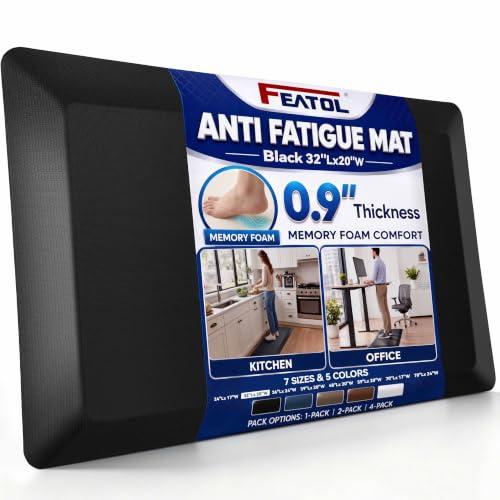
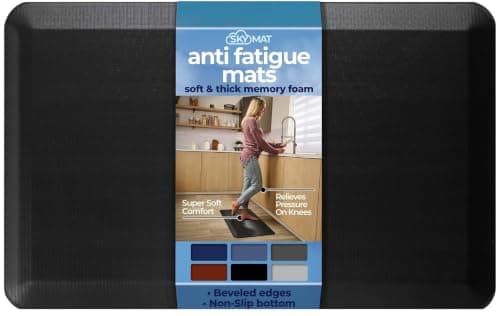
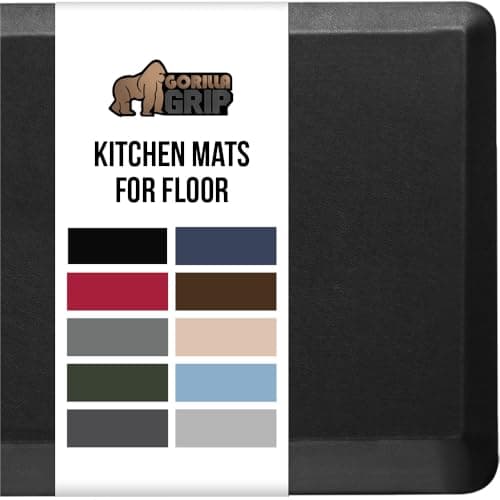
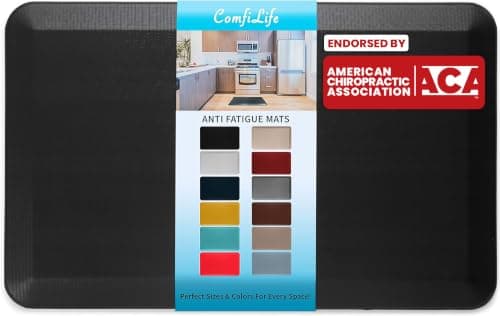
Under fifty dollars, buy the ComfiLife 3/4-inch mat. It is the best-balanced mat in the band: three quarters of an inch of polyurethane foam, beveled edges so you do not trip on it, and a water-resistant surface, which is most of the comfort of the premium cushions for well under half their price. The budget pick is the Gorilla Grip — the cheapest mat here and the one to buy specifically if your current mat slides on a hard floor, because a high-grip base is what it is for. If sore heels rather than balance are the problem, the FEATOL is the thickest cushion in the band at a listed 9/10 of an inch.
All four carried a live price under $50 at the last price check. The figure and the date it was read render beside every pick, because our prices come from the live price layer rather than from this sentence.
Who each pick is for
- ComfiLife 3/4-inch — a good flat mat on a budget, and the default choice in this band.
- FEATOL extra-thick — maximum cushion for the money, when sore heels are the problem you are solving.
- Sky Solutions 3/4-inch — the lowest price that still genuinely cushions, in multiple sizes.
- Gorilla Grip (budget pick) — slippery hard floors: the grippiest base here, and the cheapest mat in the band.
What a mat under $50 is and is not
Every mat in this band is a flat slab of foam with a bevel around it, and that is a perfectly good product. It raises you off a hard floor, it gives your heels something to sink into, and it makes the second hour of standing tolerable. What it does not do is the thing our top-rated mat does: change shape under you.
That distinction is the backbone of this category and the reason our main mat ranking is led by a sculpted mat that sits above this band. The mechanism behind less standing fatigue is micro-movement — small, continuous shifts in ankle and calf position that keep blood moving — and a sculpted surface with raised terrain prompts those shifts whether you think about them or not. A flat mat relies on you to fidget. If you already fidget, a flat mat is enough; if you plant your feet and stare at a screen, a sculpted one does measurably more for you.
NIOSH's own writing on prolonged standing is worth reading alongside this, because it makes the honest point no mat marketing makes: standing all day is its own occupational problem and not the cure for sitting all day. The mat is there to make a mixed day better. If you are standing for hours straight because the desk is stuck up there, the fix is a sit-stand routine, which is what how long should you stand is about.
The four specs that separate mats at this price
Thickness, and the limit on it
Three quarters of an inch is the band standard and the FEATOL is listed at nine tenths. Thicker is softer, which is good for heels and bad for balance — past about an inch a flat mat starts to feel unstable rather than supportive, and it also raises your working height, which quietly shifts your keyboard relative to your elbows. Our page on mat thickness works through the trade-off with the premium mats included.
The edge bevel
All four of these have beveled edges and that is not a cosmetic detail. A square-edged mat at a standing desk is a trip hazard in exactly the spot you step away from twenty times a day, and OSHA's workstation guidance treats floor surfaces and clearances as part of the workstation for that reason. A bevel also stops a chair caster catching the edge if you move between sitting and standing.
The base
This is where the Gorilla Grip earns its place rather than just its price. On a hard floor — laminate, tile, sealed wood — a smooth-backed foam mat slides when you shift weight, and a mat that creeps away from the desk gets kicked aside within a week. A textured high-grip base fixes it. On carpet the problem does not exist, and you would be paying for grip you do not need.
The foam, which nobody documents
Three of these four are polyurethane rather than PVC, and that matters on this site: PU avoids the plasticizer and chlorine chemistry PVC is criticized for, which is why our PVC-free mat ranking exists at all. But — and this is the honest part — not one mat in this band publishes a third-party emissions certificate. ComfiLife, Sky Solutions, Gorilla Grip and FEATOL all describe their materials in marketing language and none of them has a certificate to look up at UL SPOT. FEATOL does not document its foam chemistry beyond marketing language at all.
So treat every "non-toxic" claim in this band as unverified, give a new mat a few days of ventilation before daily use, and if documentation is genuinely your deciding factor, the answer is above the band. That is what PFAS in mats and off-gassing in the first 72 hours are for.
When to spend more, specifically
Three cases, and we would rather name them than let you find out. If you stand for more than a couple of hours at a stretch, a denser PU mat holds up better under that dose than a budget one — the Sky Solutions row says exactly this. If your problem is plantar fasciitis or an existing foot complaint, the surface geometry matters more than the cushion depth, which is the argument on mats for plantar fasciitis. And if you are on a concrete slab — a garage conversion, a basement, a ground-floor studio — the thermal and hardness problem is different again, and mats for concrete floors is the page.
Otherwise: fifty dollars is a genuinely good place to buy a mat, and the premium end of this category is one of the few places on this site where the cheap option is close to the expensive one. Spend the difference on a desk that actually moves instead.
Before you buy
Buying a mat at this price
1. Check your floor first
Hard floor means you need a high-grip base. On carpet, grip is wasted money and thickness is worth more.
2. Measure your standing footprint, not the desk
You want room to shift your feet apart and step back half a pace. Too small a mat means you spend the day stepping off its edge.
3. Insist on a beveled edge
A square edge at a standing desk is a trip hazard in the exact place you step away from all day. All four picks here bevel.
4. Do not buy the thickest one by default
Past about an inch a flat mat trades stability for softness, and it raises your working height relative to your elbows.
5. Treat every material claim as unverified
No mat in this band publishes a third-party emissions certificate. PU is the lower-concern chemistry than PVC, and that is as far as the evidence goes.
6. Ventilate it for a few days
Unbox it somewhere with airflow and leave it before an eight-hour day on it. Cheap foam is the category where this matters most.