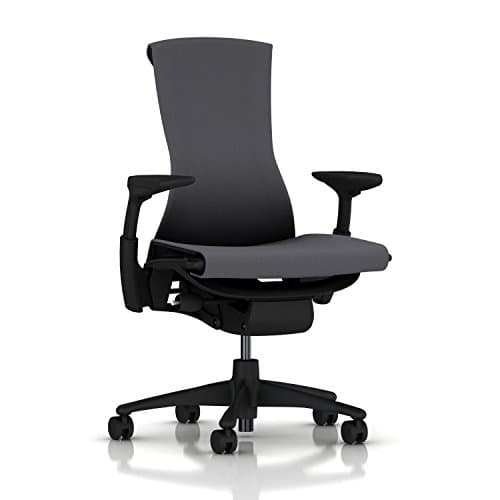
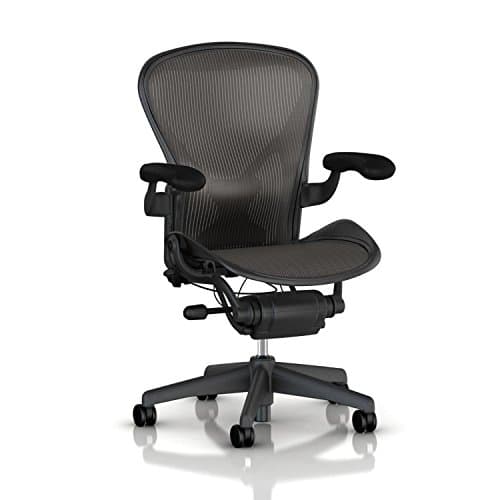
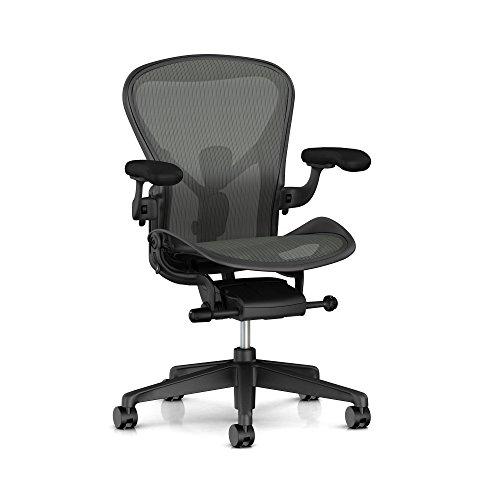
Buy the Aeron if you sit hot, if you want the biggest piece of foam in the room gone, or if you are at either end of the height range and want to be sized from published data. Buy the Embody if your complaint is pressure — a numb seat, a sore sit bone, a thigh that goes dead after two hours — and you want the chair to spread your weight rather than suspend it. What does not decide it is low-emission certification, because Herman Miller publishes the same two documents for both chairs.
The thing almost every comparison gets wrong
Search this pair and you will be told the Aeron is the "certified" one and the Embody is the plush one. The first half is wrong, in both directions. Herman Miller's Embody brochure lists, under Environmental Highlights, exactly two marks: "BIFMA level 3" and "SCS Indoor Advantage Gold". Herman Miller's Aeron store page names the same two — "BIFMA Level 3 certified" and "Indoor Advantage Gold certification, SCS Global Services' highest level of indoor air quality performance".
Two consequences follow, and they are the most useful things on this page.
First, neither chair is GREENGUARD certified. Both hold SCS Indoor Advantage Gold, which is a real emissions certification run through the same ANSI/BIFMA chamber method GREENGUARD uses, issued by SCS Global Services instead of UL. You verify it in the SCS Certified Green Products Guide, not at UL SPOT, where you will search for either chair and find nothing. We had this wrong about the Aeron ourselves until October 2026 and corrected it in the Aeron review; the full explanation of why two certifiers can run the same test is in SCS Indoor Advantage Gold explained.
Second, the emissions question is settled and identical, so stop using it to choose. That is unusual on this site — normally the certificate is the whole decision. Here it cancels, and what is left is a genuine structural argument about what a seat should do.
Published specifications, side by side
Every figure below is from Herman Miller's own store pages and the Embody brochure. We have measured nothing.
| Published figure | Aeron (size B) | Embody |
|---|
| Sizes | Three: A, B, C | One |
| Fit guidance | Stature range per size (B: 5 ft 2 to 6 ft) | "Population Range 2nd-98th Percentile" |
| Weight capacity | 350 lb (size B; A is 300, C is 400) | 300 lb / 136 kg |
| Seat height | 16 - 20.5 in | 16 - 20.5 in standard (15-19 low, 17-22 extended cylinders) |
| Seat depth | Not published as adjustable | 15 - 18 in |
| Seat structure | 8Z Pellicle suspension — no foam | Four support layers over elastic suspension, upholstered |
| Upholstery | None on the seat or back | Medley or Sync, both 100% polyester |
| Back support | Adjustable PostureFit SL (sacral + lumbar pads) | Backfit adjustment; sacral, lumbar and thoracic support standard |
| Recycled content | "More than 50% recycled material, including ocean-bound plastic" | 42% recycled; 95% recyclable at end of life; PVC-free |
| Emissions certificate | SCS Indoor Advantage Gold + BIFMA level 3 | SCS Indoor Advantage Gold + BIFMA level 3 |
| Warranty | 12 years | 12 years |
Sizing versus adjusting — the real fork
These two chairs answer "will it fit me" in opposite ways, and which answer you prefer is most of the decision.
The Aeron is sized. Herman Miller publishes a stature range, a weight rating and a seat-height range for each of A, B and C, which is more fit data than any other chair maker on this site provides. The upside is that you can buy it from published numbers; the downside is that the size letter becomes the specification, and a size B bought by someone who needs a C is a worse chair than a correctly sized cheap one. The seat depth does not adjust.
The Embody is adjusted. It comes in one size, with a published "Population Range 2nd-98th Percentile", a seat depth that moves across a published 15 to 18 in, three cylinder options covering seat heights from 15 to 22 in, and a Backfit adjustment that sets the backrest to your own spinal curve. There is no size letter to get wrong. What there is instead is a chair that has to be set up correctly, and the percentile band is a much weaker statement than a stature range: it tells you the chair is designed for nearly everybody without telling you where in its travel you personally sit.
The practical rule: if you are notably short or notably tall, the Aeron's published sizes serve you better, because you can check the number before you pay — which is the same reasoning behind office chairs for short people and big and tall office chairs. If you are somewhere in the middle, or if two people share the chair, the Embody's adjustable seat depth is worth more than the Aeron's size chart. And note which chair has the higher published capacity: the Aeron in B and C (350 and 400 lb) rates above the Embody's 300 lb.
Suspension versus pressure distribution
This is the structural argument, and the two chairs are honest opposites.
The Aeron removes the seat material. An elastomeric membrane carries your weight in tension. Nothing compresses permanently, nothing traps heat, and the single largest piece of polyurethane foam in a normal office chair is simply absent — which is the materials argument this site cares about, and it is structural rather than documentary. The cost is firmness and a defined front edge; people who want to sink into a chair generally do not get on with it.
The Embody spreads the load instead. Herman Miller's own description is a seat with four support layers over an elastic suspension with support coils that move independently, designed "for airflow", under a 100% polyester cover. It is a padded chair built to even out pressure rather than to eliminate the padding. If your complaint is a numb seat or a sore sit bone, that is the mechanism aimed at your problem — it is the same reason seat cushions exist, executed in the chair instead of on top of it, and the reason the Embody is the one to look at for tailbone pain at this price.
For the materials-first reader, the trade is explicit: the Embody brings back the two things the Aeron removes — a textile cover and padded layers — in exchange for pressure distribution. Herman Miller publishes 42% recycled content, 95% recyclability and a PVC-free construction for it, which is a real disclosure, and it is not the same as not having the material there at all. If that trade matters to you, the wider version of the argument is in mesh vs foam and the certificate side of it in OEKO-TEX explained, which is the certification that would cover a polyester seat cover and which no chair maker here publishes.
What they cost, and the warranty trap
Both chairs carry a 12-year warranty, which is the longest term in this hub and a large part of what the money buys. There is a condition on it that applies to both and to every Herman Miller listing on Amazon: Herman Miller's warranty terms exclude products bought from unauthorized resellers, and these listings are third-party sold. The Embody's list price on Herman Miller's own store is far above its Amazon price, and that gap is not a discount — it is the reseller question. If the twelve years is part of why you are buying, confirm the seller's authorization before you treat it as included.
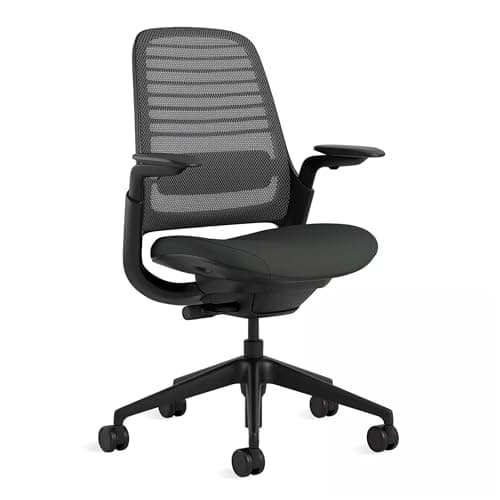
Live prices for every listing on this page are in the cards above and refresh daily; we do not print a number in prose that could be stale by the time you read it. Two structural price notes that do not go out of date: the Classic Aeron listing is the pre-Remastered generation and is consistently the cheapest way into a genuine Aeron, with the generation gap as the whole reason — PostureFit rather than PostureFit SL, the earlier Pellicle rather than the 8Z. And the Steelcase Series 1 is on this page as the reality check: it publishes a dated ANSI/BIFMA compliance certificate, holds the same SCS Indoor Advantage Gold, rates to 400 lb, and costs a fraction of either Herman Miller. If what you want is documented seating rather than a specific chair, start there and read Steelcase Series 1 vs Aeron.
The decision, in four lines
- You sit hot, or you want the foam gone: Aeron. The suspension seat is the only one here with nothing in it to compress or off-gas.
- Your complaint is pressure, numbness or a sore sit bone: Embody. The four layers and the independently moving coils are aimed at exactly that.
- You are at either end of the height range, or over 300 lb: Aeron, on the published size and capacity data.
- Two people share the chair, or your thigh length is the problem: Embody, for the published 15 to 18 in seat-depth adjustment.
And if the budget is the deciding factor rather than the fit, neither answer is on this page: read the best ergonomic office chairs and the SIHOO Doro C300 review, where a mesh seat costs about a tenth of this and the trade-offs are stated just as plainly.
If the answer to this comparison is “the Embody, but not at that price”, that is a separate shortlist and we have built it: Herman Miller Embody alternativesranks the chairs that do part of what the Embody does — a seat that spreads pressure, a back that changes shape — starting with one at well under half the money.