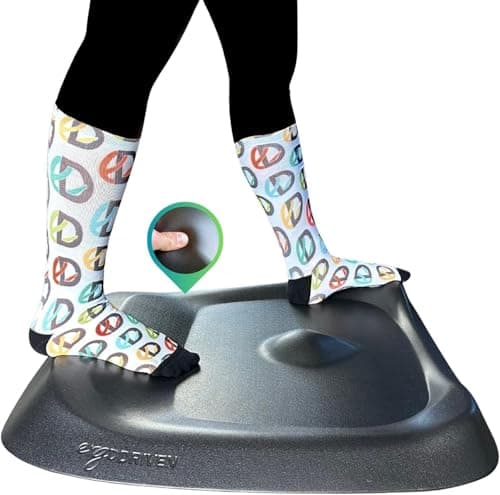
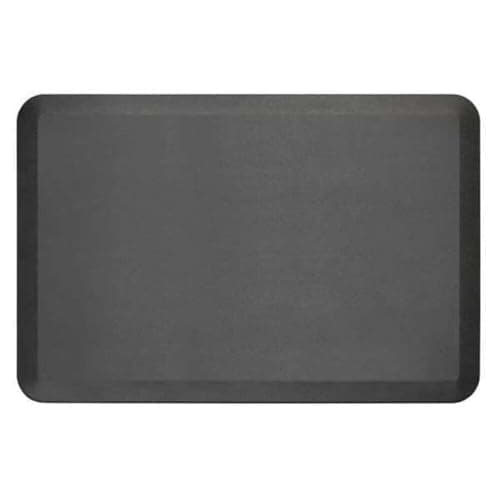
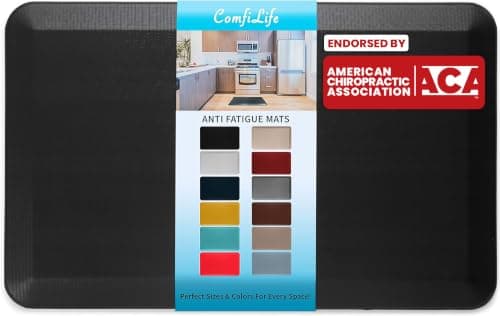
For a genuinely long standing day, buy the WellnessMats Original 36 by 24. Two things make it the pick and neither is softness: 24 inches of depth, which is what keeps your heels on foam when you rock back from the desk, and a single-piece polyurethane construction that will not bottom out or delaminate under the hours. WellnessMats is also the only brand here that publishes an ingredient position — it states 100% polyurethane, free of formaldehyde, heavy metals, PVC, BPA, latex, plasticizers and phthalates, and passing the federal CFR 1630 and 1631 surface-flammability tests — which matters more when you are standing over it eight hours a day than when you are on it for twenty minutes. If you want movement rather than cushion, buy the full-size Topo: its sculpted terrain gives your feet somewhere to go, which is the actual mechanism behind reduced standing fatigue. The budget pick is the ComfiLife three-quarter-inch flat mat. Every price is read from the Amazon Creators API with the date it was read.
First, the honest part, because a page about standing all day has to say it: you should not stand all day.NIOSH is explicit that prolonged standing at work is a hazard in its own right — not a neutral alternative to sitting and not a cure for it — and the research it summarizes links long static standing to leg and foot discomfort, varicose veins and low-back pain. No mat changes that. A mat makes a long upright stretch tolerable; alternating between sitting and standing is what actually fixes the problem, and how long you should stand is the dosage page. If your feet already hurt, why your feet hurt at a standing desk is the diagnostic to read before you buy anything.
With that said: some people genuinely are upright for most of a shift, and a mat chosen for two hours is the wrong mat for eight. This page ranks on duration, which is a different question from our main anti-fatigue mat ranking and reaches a different first pick.
What changes when the standing stretch gets long
Depth stops being a detail and becomes the spec. A 20-inch-deep mat puts your heels on the beveled edge every time you lean back, which is a thing you do constantly over eight hours and barely at all over twenty minutes. Twenty-four inches of depth keeps the whole foot on foam through that movement. It is also the dimension almost no listing leads with, which is why two of the four picks here were chosen on it.
Movement beats cushion. The mechanism behind standing fatigue is static loading: the same muscles holding the same position with no pump action in the calves. Soft foam reduces the pressure but does nothing about the stillness. A sculpted mat works by giving your feet varied surfaces to use, which is why the terrain mat is on this page and why very soft mats are not the answer they look like.
The base matters on hard floors.Over a long day you shift weight laterally hundreds of times, and a mat that creeps on tile or sealed concrete is a trip hazard by hour six. One mat here has a National Floor Safety Institute high-traction certification for its bottom surface — a genuine third-party certification, of slip resistance rather than of emissions, and worth having on a hard floor. Mats for concrete floors is the page if that is your surface.
The material question gets bigger with exposure.Nothing in this category holds a low-emission certificate — not one anti-fatigue mat we have found publishes a GREENGUARD or comparable indoor-air certificate. What differs is disclosure. Polyurethane is the lower-concern class here, because the plasticizer and chlorine chemistry criticized in vinyl mats belongs to PVC; one brand on this page lists what is not in the mat and one simply says “non-toxic”. We take the disclosure and we do not call it a certificate. Non-toxic anti-fatigue mats and PFAS in mats are the longer arguments.
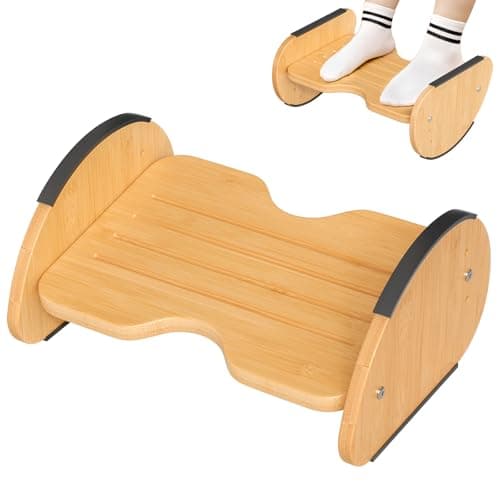
And a mat cannot fix a desk at the wrong height.If your standing height is wrong your shoulders will hurt before your feet do, whatever is under them. OSHA's workstation guidance and our height calculator settle that first; a footrest to prop one foot on is the cheapest thing in this whole category and one of the most effective.
Who each pick is for
- WellnessMats Original 36 by 24— the default for a long day. 24 inches deep, single-piece polyurethane with nothing laminated to delaminate, made in the USA, and the only published ingredient position in the category. Buy it if you stand in one spot for hours.
- Topo by Ergodriven, full size— the movement mat. Ergodriven lists 29 inches wide by 26.25 deep, 2.7 inches at its highest point and 0.85 inches in the neutral area, PVC-free and PFAS-free as stated by the maker. Buy it if the problem is stiffness rather than soreness, and if you will use the terrain rather than stand still on it.
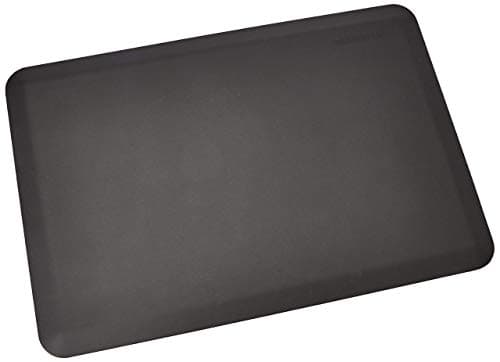
- NewLife by GelPro Eco-Pro, 24 by 36— the hard-floor pick. The same 24 inches of depth, one-piece Bio-Foam with no bond line between materials, and an NFSI high-traction certified base. Buy it for tile, sealed concrete or anywhere a mat might creep.
- ComfiLife three-quarter-inch mat (budget pick)— the cheapest mat here worth standing on, with a comfortable three-quarter-inch cushion and beveled non-slip edges. Buy it if the alternative is a bare floor, and understand that it is flat.
The honest trade in each one
The WellnessMats is small and it is plain.Thirty-six inches of width rewards standing in one spot and punishes wandering — there is no room to shift between two positions along a desk or to roll a chair onto it. This listing is black only, with none of the decorative finishes. And the material statement is manufacturer disclosure, not third-party certification: verify the current wording on WellnessMats' own site before you treat it as settled.
The Topo is not flat, which is the entire point and also the objection.You cannot roll a chair across it, so it is a standing-only surface. Ergodriven also notes that performance is optimized up to around 240 lb of user weight, which is a disclosure we would rather have than not — and it is a limit. No third-party certificate backs its PVC-free and PFAS-free claims; they are the brand's own.
The GelPro is 36 inches wide, which is narrower than the 48-inch version, so a wide sideways step leaves the mat. It is marketed for commercial and industrial use in plain black. And note where its specification lives: GelPro's own site does not present the NewLife / Eco-Pro line at all, so these figures are published through commercial distributors rather than first-party. We treat them as the maker's stated specification confirmed against the listing, and not as a certificate. The NFSI certification covers traction, not emissions.
The ComfiLife is flat and undocumented.It does not encourage movement the way a sculpted mat does, and ComfiLife publishes no third-party material certification, so any “non-toxic” claim attached to it is unverified. It is the budget-comfort pick and it is honest about being that — but on an eight-hour day, flat foam is the pick most likely to leave you shifting from foot to foot by mid-afternoon.
What we would actually do with an eight-hour standing day
Buy depth first, then terrain. If you stand in one position, the WellnessMats 36 by 24 is the mat; if you fidget, the full-size Topo is. Either way, add the two things that do more for a long standing day than any mat upgrade: a footrest to prop one foot on, which breaks the static load in a way no surface can, and a sit-stand rhythm rather than a standing marathon.
Two cases change the answer. On a long desk where you move between two standing positions, the 20 by 48 shape is the right one and what size anti-fatigue mat to buy has the arithmetic. And if a specific pain is driving this rather than general fatigue, treat it as a specific problem: mats for plantar fasciitis and mats for back painrank on the evidence for those rather than on duration. None of that is medical advice — if it hurts in a way that is not getting better, see someone who can examine you.
If your budget is the binding constraint, anti-fatigue mats under $50 is the band page, and it is honest about what the sub-$50 tier gives up: depth and durability, in that order.
Before you buy
How to choose a mat for a long standing day
1. Buy depth before thickness
Twenty-four inches of depth keeps your heels on foam when you rock back. A 20-inch mat puts them on the bevel, which you will feel by hour three and never notice in a twenty-minute trial.
2. Decide whether you stand still or fidget
A still stander wants depth and a firm single-piece surface. A fidget wants terrain. Buying the wrong one of those two is the most common mistake in this category, and it is not a price mistake.
3. On a hard floor, check the base
A mat that creeps on tile or sealed concrete becomes a hazard over a long shift. An NFSI high-traction certification is the only third-party document that exists in this category, and it is about the bottom surface rather than the foam.
4. Expect disclosure, not certification
No anti-fatigue mat we have found carries a low-emission certificate. Prefer a maker that lists what is not in the mat; treat polyurethane as the lower-concern class against PVC; and do not read “non-toxic” on a listing as a tested result.
5. Fix the desk height before you blame your feet
Elbows at roughly a right angle, screen at eye level, weight even. A correct mat under an incorrect desk height just moves the complaint up your body.
6. Budget for a footrest, not a thicker mat
Propping one foot up alternates which leg carries the load, which is the single most effective intervention in a long standing day and costs a fraction of a premium mat.