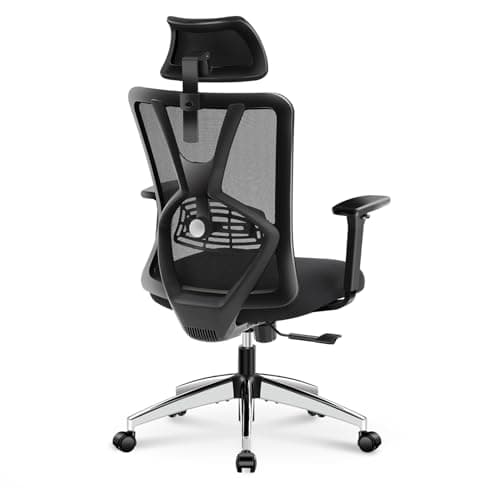
Before you buy anything: if your monitor is below eye level, that is your neck pain, and no chair will fix it. Raise the screen until your eyes are level with a point two to three inches below the top of the casing, about an arm's length away. If the pain persists after a two weeks at the right screen height, then the chair is worth spending on — and the pick is the Ticova High-Back, because it is the only chair in our catalog with an adjustable headrest that moves to meet your head rather than a fixed pad that decides where your head goes.
What a chair can and cannot do for a neck
The AAOS describes the common causes of neck pain as soft-tissue strains and sprains of muscle and ligament, and cervical spondylosis — the wear-and-tear arthritis of the neck. A chair does not treat either. What it can do is change how long your neck muscles are asked to hold your head up without help, and that is a real lever: a head is heavy, and holding it forward of your shoulders for eight hours is the load that turns into a strain.
Here is the part most chair marketing gets backwards. Cornell's ergonomics guidance is explicit that the best seated posture is a reclined 100 to 110 degrees, not the upright 90 degrees that school and posture ads taught everyone. Reclining transfers some of your upper-body weight into the backrest instead of your spine. But it only works if there is something behind your head when you get there — otherwise you recline your torso, leave your head craning forward at the screen, and end up in a worse neck position than when you were upright.
That is the mechanism, and it is the whole argument for a headrest. A headrest is not a luxury for reclining; it is what makes reclining safe for your neck. And the reason so many headrests are useless is that they are fixed — mounted at a height set for an average torso, so for everyone else they either push the head forward or sit behind the shoulders doing nothing.
What to look for, in order
- A headrest that adjusts in height and angle. Both, not one. It has to reach the back of your skull — the occiput — not your upper neck, and it has to tilt to meet a head that is looking slightly down at a screen.
- A backrest that supports 100 to 110 degrees. A recline mechanism that only locks upright, or only flops all the way back, cannot hold the position that actually helps.
- Armrests that adjust for height. Unsupported arms hang from your neck and shoulders — roughly ten per cent of your body weight pulling down on the muscles you are trying to unload. Fixed armrests at the wrong height are worse than none.
- A back tall enough for your torso. A mid-back chair supports your lumbar spine and stops. For neck complaints that is the wrong tool; the support has to reach your shoulder blades before a headrest is even relevant.
Where each pick lands
The Ticova High-Back is first for one reason: it publishes an adjustable headrest and a lumbar pad that moves up and down as well as in and out, on a high back, at a price where those adjustments are normally the first things cut. It is not a certified chair — Ticova publishes no emissions or durability documentation, and we say so in the review below — but on the specific mechanism this page is about, it is the best-equipped chair we rank.
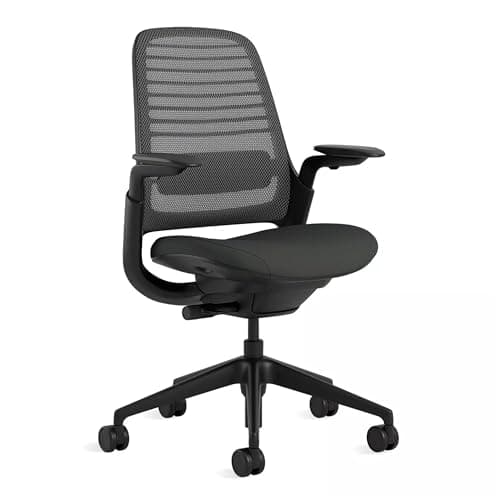
The Steelcase Series 1 has no headrest, and it is second anyway. Its flexing LiveBack moves with you rather than forcing one posture, the arms adjust properly, and it is backed by published compliance testing and a twelve-year warranty. If you want a chair that will be correct for a decade and you can live without a headrest — or intend to sit closer to upright — this is the better long-term purchase.
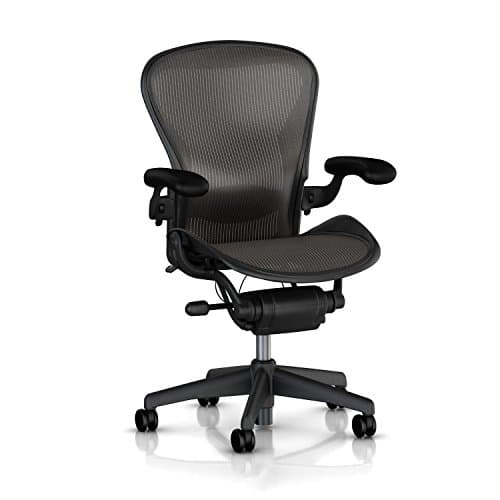
The Herman Miller Aeronalso has no headrest, deliberately, and Herman Miller's position is that the chair is designed around an unsupported-head posture with its PostureFit SL supporting the pelvis and lumbar spine instead. That is a coherent design argument rather than a cost saving, and the Aeron remains the most thoroughly studied seat in existence. Size matters here: Herman Miller's own Size/Fit Reference gives different capacities and fit ranges for A, B and C, and a wrong-size Aeron undoes its own ergonomics.
The purchase that fixes this more often than a chair
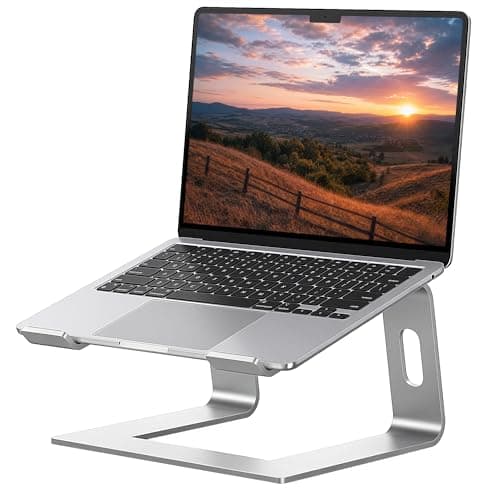
We would rather tell you this than sell you a chair. In our experience of the queries that reach this site, desk neck pain is most often a laptop screen or a low monitor, and the fix is a monitor arm or a laptop stand plus an external keyboard — a fraction of the price of any chair here. Our standing desk neck pain guide works through the free changes in order before it recommends spending anything, and dual monitor ergonomics covers the side-screen twist that produces one-sided neck pain.
If your pain radiates down an arm, or comes with numbness, tingling or weakness, stop troubleshooting furniture. The AAOS lists those among the symptoms that warrant seeing a doctor, and they are not a chair problem.