Buy the Ergodriven Topo Mini. It is the only mat here built for a desk rather than a kitchen, and its sculpted terrain does the one thing a flat cushion cannot: it keeps your feet moving. If you would rather stand on a soft, level surface, the plush Imprint CumulusPRO is the flat pick, and the ComfiLife covers the same idea for a lot less money.
The mat is a movement prompt, not a pillow
The thing that tires your legs is not standing — it is standing still. Holding one posture pools blood and loads the same muscles for hours. A good mat fights that by nudging you into small, constant weight shifts, and a peer-reviewed study of anti-fatigue mats found exactly that link between comfort and how much people shifted their weight while standing. That is why a sculpted surface like the Topo, with contours you instinctively move across, beats a dead-flat slab you can plant on and forget. If you are not sure how much of the day you should even be standing, start with how long to stand before you buy a mat at all.
Foam density and rebound decide whether it lasts
Thickness sells mats; density is what makes them work. A dense polyurethane (PU) foam supports your arch and springs back, so it still cushions after a year of daily standing. Cheap gel and low-density foam feel wonderful in the store, then bottom out — you compress them flat and end up standing on the hard floor through a thin skin. The Topo and the CumulusPRO both use firm PU that holds its shape; the budget flat mats trade a little of that rebound for a much lower price, which is an honest trade if you are not on your feet all day.
A beveled edge is a safety feature, not a trim detail
The single most common mat injury is catching a toe on a square, upstanding edge, or rolling an ankle stepping off one. Every mat we rank here has a beveled, tapered edge that ramps down to the floor for that reason. On a hard floor, also check the base grips: the Gorilla Grip earns its spot precisely because it will not skate out from under you on tile or laminate. A mat that slides is a fall waiting to happen.
PU versus PVC is the materials question that matters
Most anti-fatigue foam is one of two chemistries. Polyurethane (PU) avoids the plasticizers and chlorine chemistry that PVC foam is criticized for; a phthalate-free PU is the lower-concern class for something you breathe over all day. We do not run a lab, so we do not assert a mat is "safe" — we read the material disclosures and tell you what is documented and what is only claimed. If materials are your first filter, the PVC angle gets its own page in our non-toxic, PVC-free ranking, and the wider rules of thumb live in the non-toxic buying guide. A mat is the easy part of a healthy setup; the surface it protects you from standing on all day is the standing desk itself.
The short answer
#ad · Live prices from the Amazon Product API, as of Jul 23, 2026. Where we have no verified live price, we show none — we would rather leave a gap than print a number that has rotted.
In detail
Most standing-desk users
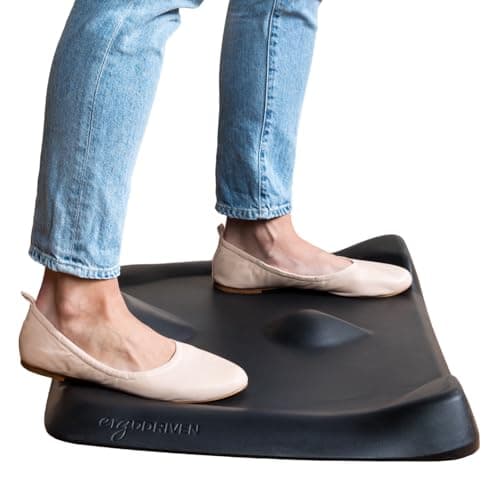
Sculpted terrainPolyurethane foamNot-flat designBeveled edges
Certification & materials
Polyurethane (PU) foam, not PVC — PU avoids the plasticizers and chlorine chemistry PVC is criticized for. Ergodriven markets it as non-toxic; no formal third-party certificate is published, but the PU material is the lower-concern choice for a mat.
The one that's actually designed for a desk — sculpted terrain that keeps your feet moving, not a flat kitchen pad.
- Cushioning
- 8
- Edge & safety
- 8
- Materials
- 9
- Durability
- 8
- Value
- 7
Pros
- +The raised contours prompt small posture changes, which is the actual mechanism behind reduced standing fatigue
- +Firm PU foam holds its shape instead of bottoming out like cheap gel
- +Purpose-built for a desk footprint rather than a kitchen
Cons
- −The sculpted surface is love-it-or-hate-it — some people want a plain flat cushion
- −Costs more than a basic rectangular mat
Don't buy this if…
…you want a large flat surface to shift a chair around on. The Topo's whole point is the terrain, and a flat mat is better for a roll-around setup.
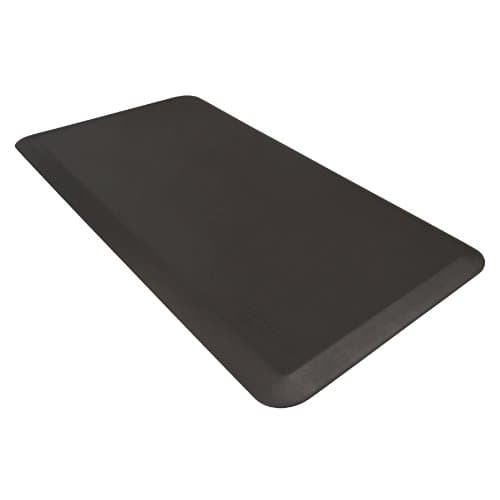
People who want a soft, flat cushion
3/4 in thickInjection-molded foamBeveled edgesNon-slip base
Certification & materials
Polyurethane foam; Imprint states it is phthalate-free. No third-party emissions certificate published, but a phthalate-free PU foam is the lower-concern material class for a mat.
The plush flat pick — a thick, forgiving cushion if you'd rather stand on a soft slab than sculpted terrain.
- Cushioning
- 9
- Edge & safety
- 8
- Materials
- 7
- Durability
- 7
- Value
- 7
Pros
- +Genuinely thick and forgiving underfoot for long standing sessions
- +Beveled edges reduce the trip hazard a square-edged mat creates
Cons
- −A soft flat mat encourages you to stand still, which is less good for circulation than a mat that makes you move
- −The plush foam can feel unstable if you shift weight quickly
Don't buy this if…
…you want the constant micro-movement of a sculpted mat. Plush and flat is the opposite design philosophy from the Topo.
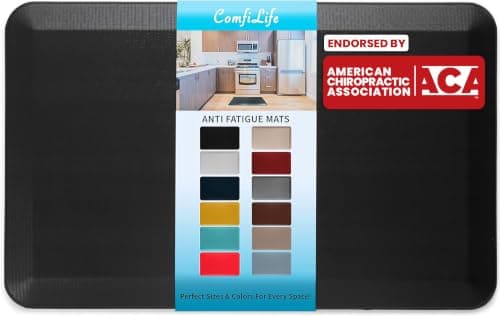
A good flat mat on a budget
3/4 in thickPU foamBeveled edgesWater-resistant
Certification & materials
Polyurethane foam. ComfiLife does not publish a third-party emissions certificate; PU is the lower-concern material versus PVC, but treat 'non-toxic' claims here as unverified.
The value flat mat — most of the comfort of the premium cushions for well under half the price.
- Cushioning
- 8
- Edge & safety
- 8
- Materials
- 6
- Durability
- 7
- Value
- 9
Pros
- +Comfortable 3/4-inch cushion at a genuinely low price
- +Beveled, non-slip edges that stay put
Cons
- −No published material certification, so any non-toxic claim is unverified
- −Flat design, so it doesn't encourage movement the way a sculpted mat does
Don't buy this if…
…you want documented materials or a movement-focused surface. This is the budget-comfort pick, and it's honest about being that.
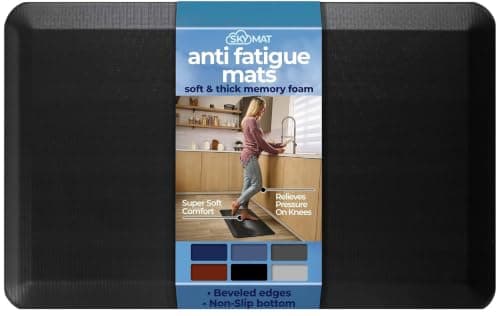
The lowest price that still cushions
3/4 in thickPU foamBeveled edgesMultiple sizes
Certification & materials
Polyurethane foam. No third-party emissions certificate published; PU is the lower-concern class than PVC, but any non-toxic claim is unverified.
The cheapest sensible flat mat here — it does the job, and it doesn't pretend to be more.
- Cushioning
- 7
- Edge & safety
- 7
- Materials
- 6
- Durability
- 7
- Value
- 9
Pros
- +The lowest-cost cushion in this list that still has real thickness
- +Comes in several sizes, so you can match your desk footprint
Cons
- −No material certification published
- −Basic flat design; nothing about it encourages movement
Don't buy this if…
…you'll stand on it all day and want the best long-term comfort — a denser PU mat like the Topo holds up better under heavy daily use.
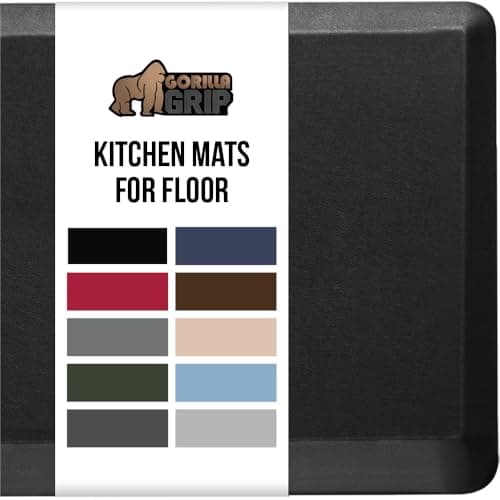
Slippery hard floors
Thick cushionHigh-grip baseBeveled edgesWipe-clean
Certification & materials
Foam cushion with a textured non-slip base. Gorilla Grip does not publish a third-party emissions certificate; treat material claims as unverified.
The grippiest base here — if your mat slides on a hard floor, this is the fix.
- Cushioning
- 7
- Edge & safety
- 8
- Materials
- 6
- Durability
- 7
- Value
- 8
Pros
- +The base genuinely grips — it won't skate out from under you on tile or laminate
- +Comfortable cushion and easy to wipe down
Cons
- −Marketed more as a kitchen mat than a desk mat — flat, not movement-oriented
- −No published material certification
Don't buy this if…
…you're on carpet, where sliding isn't the problem — you'd be paying for grip you don't need.
How to actually choose a mat
Sculpted or flat is the real decision
A sculpted mat (the Topo) has raised contours that keep you subtly moving, which is the point of the whole category. A flat mat (the CumulusPRO, ComfiLife, Sky Solutions) is a plain cushion you stand on. Sculpted is better for a fixed standing spot; flat is better if you roll a chair around or want a large, even surface. Neither is wrong — they are different tools, and the wrong one for your habit is the one you stop using.
Thickness, within reason
Around three-quarters of an inch is the sweet spot: enough give to matter, not so much that you feel unstable or trip on the edge. Thicker is not automatically better — a very soft, tall mat can feel wobbly and actually make you tense your legs more, not less.
Match the base to your floor
On carpet, grip is a non-issue and almost any mat sits still. On tile, laminate or sealed concrete, a slick base slides — that is where a high-grip base like the Gorilla Grip is worth it, and where a smooth-bottomed mat needs a rug pad underneath.
Cleaning is a materials question too
A closed-cell PU mat wipes clean with a damp cloth and does not soak up spills. Open, porous foams hold moisture and get grubby. If your mat lives under a desk with coffee nearby, a wipe-clean surface is the practical choice — just note that a "waterproof" coating is also where a stain-repellent finish could hide, which we get into on the non-toxic page.
How we picked
We compiled specs from manufacturer manuals, verified every certification claim in the certifying body's own registry (UL SPOT for GREENGUARD, BIFMA, CARB), did the cost-to-own math, and read the aggregated owner reviews, then scored each product against a published rubric. The scores are judgments from documented research — they are not measurements we took, because we do not have a lab and we are not going to pretend we do.
Questions
What is the best anti-fatigue mat for a standing desk?+
The Ergodriven Topo Mini for most people. It is purpose-built for a desk footprint, its firm PU foam holds up to daily standing, and its sculpted terrain keeps your feet moving, which is the actual mechanism behind reduced standing fatigue. If you prefer a soft flat surface, the Imprint CumulusPRO is the plush pick.
Do anti-fatigue mats really work?+
The useful ones do, but not by being soft. The benefit comes from encouraging small, continual weight shifts rather than letting you lock into one posture — research on prolonged standing links that movement to lower discomfort. A mat that makes you stand perfectly still is missing the point, which is why we rank a sculpted design first.
How thick should an anti-fatigue mat be?+
About three-quarters of an inch is the practical sweet spot. Thinner mats bottom out under your weight; much thicker ones can feel unstable and turn the tapered edge into a trip hazard. Density matters more than raw thickness — a dense PU foam at 3/4 inch outperforms a soft, tall mat that compresses flat.
Sculpted or flat -- which mat design is better?+
Sculpted (the Topo) if you stand in one fixed spot, because the contours prompt the movement that fights fatigue. Flat (the CumulusPRO, ComfiLife or Sky Solutions) if you want a large even surface or roll a chair around on it. It is a habit decision, not a quality one.
Will an anti-fatigue mat slide on a hard floor?+
A smooth-based mat can slide on tile, laminate or sealed concrete, which is a genuine fall risk. On those floors, choose a high-grip base like the Gorilla Grip, or put a thin rug pad under a mat you already own. On carpet, sliding is not the problem and any beveled mat sits fine.
Receipts
We do not run a testing lab, and we do not pretend to. We verify certifications in the certifying body's own registry, compile specs from manufacturer manuals, and cite health claims to recognized authorities — by name, with a link. Where we could not verify something, we say so on the page rather than quietly leaving it out. Read our full method.