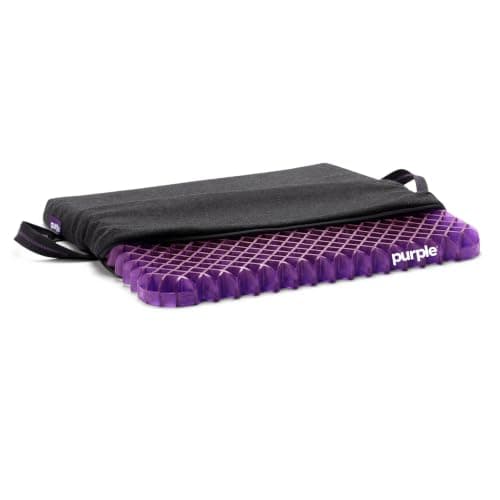
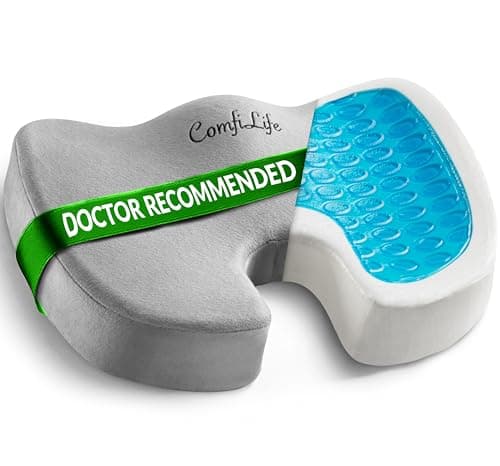
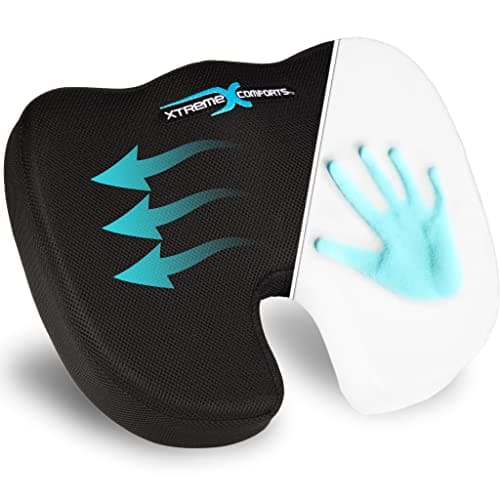
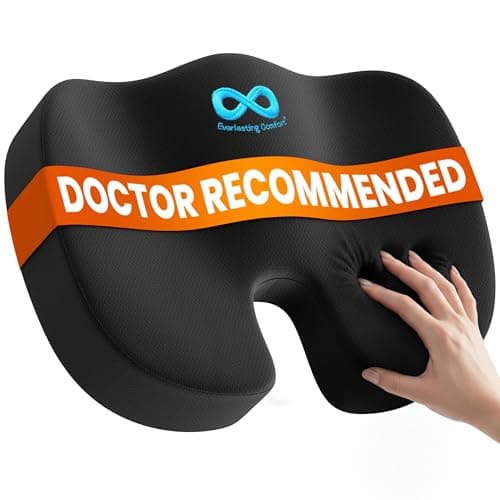
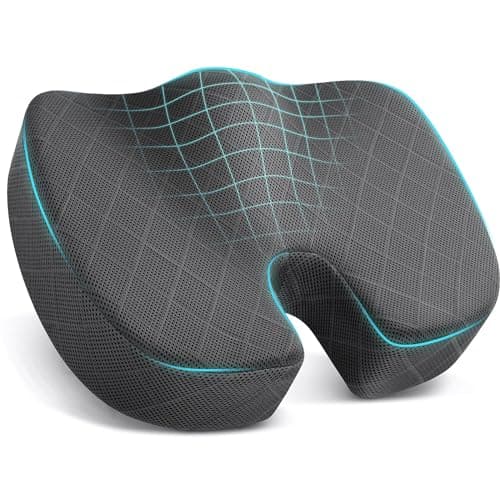
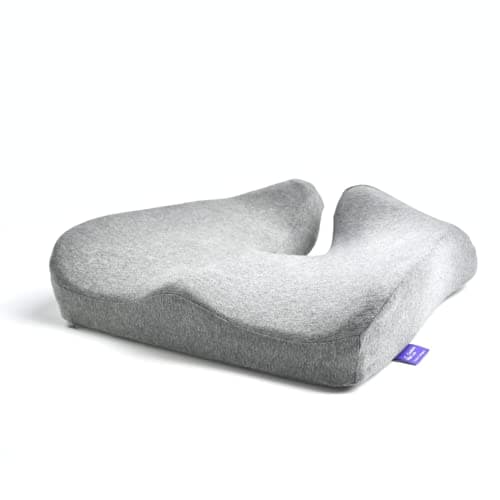
Buy the Cushion Lab. Density is the entire long-term story with seat cushions, and this is the one that is still doing its job after a year of eight-hour days. If you run hot or you have already flattened two memory-foam cushions, buy the Purple instead — an elastomer grid does not compress permanently and it moves air, which foam cannot. Everything below about a hundred dollars is a two-to-three-year part, and that is fine as long as you know it going in.
Why cheap cushions stop working
A seat cushion has one enemy and it is not wear — it is compression set. Polyurethane foam under sustained load loses height permanently, and it does it fastest exactly where you sit. Six months in, a cushion that was two inches thick is one and a quarter inches under your sit bones and still two inches at the edges, which means you are now sitting in a shallow bowl with the highest pressure at the point you were trying to offload.
Density is what resists that. Denser foam costs more per cushion and is the single specification that predicts whether it will still work in year two. Very few listings publish a density figure, which is why the practical proxies are weight, price and how firm it feels out of the box — a cushion that feels luxuriously soft on day one is usually the one that will be flat by spring.
The three materials, honestly compared
- Memory foam.Conforms beautifully, spreads pressure well, gets hot, and takes a permanent set. The default, and the right choice at the low end where the alternatives do not exist. ComfiLife's gel-topped version is the mainstream pick because the gel layer genuinely helps with the heat.
- Gel and gel-foam hybrids. Spread load without conforming as closely, run cooler, and hold their shape longer than plain foam. Heavier, and a puncture is fatal.
- Elastomer grid.A hyper-elastic polymer that collapses only where pressure is applied and stays open everywhere else, which means constant airflow and no permanent impression. Expensive, heavy, and it feels springy rather than cradling — a real preference split. On materials it is also the outlier here: it is not polyurethane foam, so it does not have foam's off-gassing profile at all.
None of these cushions carries a CertiPUR-US or GREENGUARD certificate that we could verify, so the material class is the strongest evidence available. Foam cushions are also among the smellier things you can buy for a desk — unwrap a new one and let it air for a few days, the same routine our break-in guide prescribes for anything new.
Coccyx cutouts: useful, and over-prescribed
A U-shaped rear cutout removes contact with the tailbone. If your problem is specifically tailbone pain — after a fall, after childbirth, or from months on a hard seat — that cutout is exactly the right tool and the deeper the better, which is what the Xtreme Comforts is for. The chair-side half of that decision, including which seat construction keeps load off the coccyx in the first place, is on chairs for tailbone pain.
If your discomfort is general, a cutout is the wrong shape. It concentrates load on either side of the gap, and people frequently report a new ache exactly where the cushion edges are. Buy a flat contoured cushion instead. This is the most common mismatch in the category, largely because almost every cushion is now sold with a cutout whether it needs one or not.
What a cushion cannot do
Three things, and it is worth being blunt because a cushion is often bought instead of the fix:
- It cannot give you lumbar support. That is a backrest job. A seat cushion sits under you; it does nothing for the curve of your lower spine. If your lower back is the complaint, you want a lumbar cushion or a chair with an adjustable lumbar, not this.
- It cannot fix a badly-set desk. A cushion raises you an inch or two, which changes your elbow angle and can strand your feet. Both of those are new problems. Re-check the desk height afterwards, and be ready to add a footrest — that pairing is more common than people expect.
- It cannot rescue a genuinely broken chair. If the seat pan is collapsed, the gas lift sinks, or the backrest will not hold an angle, a cushion is money spent on a chair you are about to replace. Our budget chair roundup exists for exactly that moment.
Fitting one to your chair
Measure the seat pan before ordering. A cushion wider than the pan overhangs the front edge and presses into the backs of your thighs, which is the mechanism behind that dead-leg feeling at hour three. A cushion much narrower slides around no matter how good the base grip is.
Check the height cost too. A two-inch cushion on a chair already at its lowest setting is a chair that no longer fits a short user, and that is not a hypothetical — it is the single most common reason cushions get returned. Aim for the thinnest cushion that solves your problem, which is another quiet argument for the low-profile grid designs.