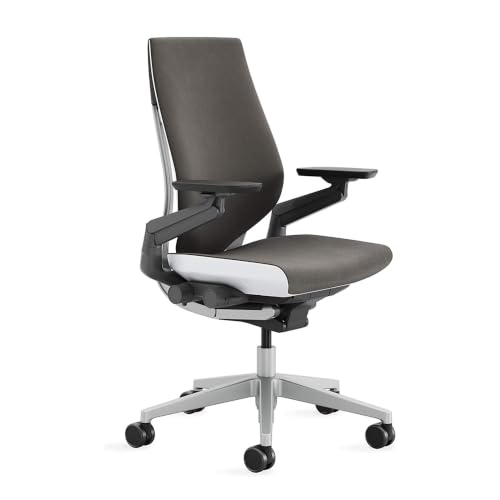
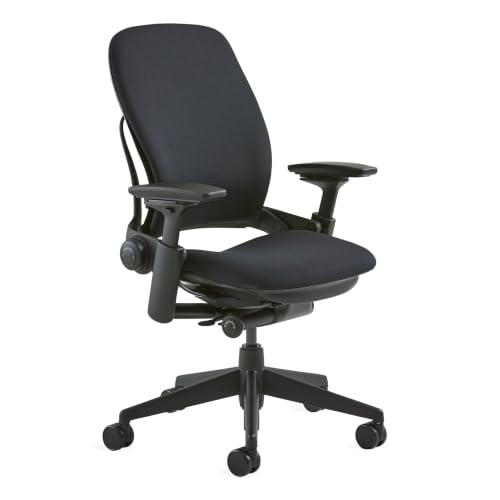
Buy the Leap unless your problem is above your waist. Steelcase publishes the same 400 lb capacity and the same twelve-year, 24/7 parts-and-labor warranty for both chairs, so the price gap is not buying you strength or coverage — it is buying arms. The Gesture's arms move through a full 360 degrees and the Leap's move in four directions, and that is close to the whole difference. If your complaint is a sore lower back, the Leap has a lumbar firmness dial and a back that changes shape, and it costs a fraction of the Gesture. If your complaint is shoulders, elbows and wrists from working across a laptop, a tablet and a phone, the Gesture is the only chair here that answers it. And if what you came for is a certificate, the honest answer is that neither of these two pages gives you one — the cheaper Series 1 does.
Neither Steelcase page names an emissions certificate
This is the finding that matters most for the reader this site is written for, and it is only visible if you read Steelcase's own product pages rather than a roundup.
We read both pages on 30 October 2026. The Leappage names no indoor-air certification anywhere in its body. What it offers instead is "a CarbonNeutral product certification option" — which is a carbon-offset claim about the product's footprint, not a statement about what comes out of the foam and the plastics in your room — and a link to a "Leap Product Environmental Profile" that it says covers "certifications, declarations, and specific sustainability product attributes." The Gesturepage does the same thing in almost the same words: an optional CarbonNeutral certification, and "to learn more about certifications, declarations, and specific sustainability product attributes see the Product Environmental Profile."
So we went to the profile. Steelcase publishes it as an image-only PDF with no text layer, and the same is true of Steelcase's own "seating SCS IAQ Gold" resource document and of the SCS Global Services certificate for Steelcase Americas (SCS-IAQ-04139) that this site already cites elsewhere. All three are pictures of pages. That means nobody — us, you, or a search engine — can search them for the word "Leap" or "Gesture", and we will not tell you a certificate covers a specific model when the document that would prove it cannot be read.
What we will say plainly: Steelcase holds a real Indoor Advantage Gold certificate for seating, and these two chairs are very likely inside its scope. We have not confirmed it for either model, and we are not going to imply we have. Neither chair is GREENGUARD certified — searching UL SPOT for either returns nothing, because SCS Indoor Advantage Gold is a different certifier with a different registry, using the same ANSI/BIFMA chamber method.
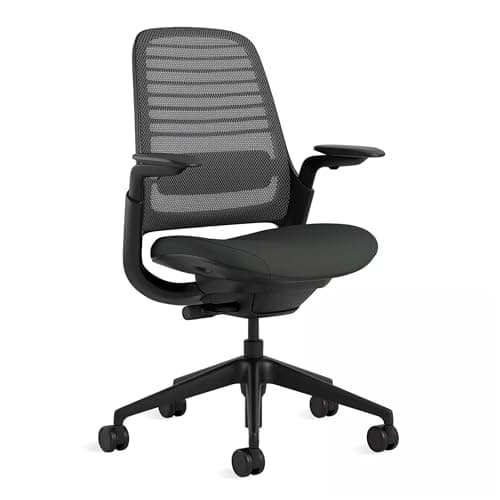
Now compare the Series 1. Its cut sheet (item #25-0000121, February 2025) prints its certifications as readable text: BIFMA Compliant, BIFMA LEVEL 3, CAL 117, SCS Indoor Advantage Gold - Furniture, and an Environmental Product Declaration. There is also a dated Product Compliance certificate, #L2132 of 8 January 2024, covering Series 1 seating to ANSI/BIFMA X5.1 and X5.11 at 400 lb. That is the chair in this brand whose paperwork you can actually check, and it is the cheapest of the three. Our Steelcase Series 1 review walks through all three documents.
What Steelcase publishes identically for both
Put the two listings and the two product pages side by side and the overlap is larger than the price gap suggests.
- Capacity: 400 lb, both.Amazon's Maximum Weight Recommendation field reads 400 pounds for the Leap and 400 pounds for the Gesture, and Steelcase's own pages say "durable enough to handle weight up to 400 lbs" for each. If capacity is your constraint, this comparison is already over — and so is the one against the big and tall field, where 400 lb is at the top of what gets published.
- Warranty: twelve years, both.Word for word on both pages: "Steelcase Limited Lifetime warranty - 12 years, multi-shift, 24/7 parts and labor." Multi-shift matters more than the number of years: it means the term is not void because two people use the chair across a long day.
- Floor type: carpet, both.Amazon's Surface Recommendation field reads Carpet for both listings. These are the carpet-caster builds. On a hard floor you are buying casters separately, or you are buying a chair mat — and a hard caster on a hard floor is the single most common reason a good chair sounds terrible.
- No stature guidance, either one.Amazon's detail table gives one seat height (20.5 in for the Leap, 21 in for the Gesture) and one seat depth (18.75 in and 18.25 in). Those are single points, not ranges, and neither Steelcase page publishes a range or a height-to-chair chart. That is a genuine gap in this brand: Herman Miller publishes a stature range per Aeron size and Steelcase publishes none, which is the axis our Series 1 versus Aeron comparison turns on.
So what does the money actually buy? The arms.
Steelcase describes the Gesture's arms as moving "through a full range of motion - 360 degrees - mimicking the human arm." It does not tell you how many planes of movement that is, which is irritating, but the mechanism is real and it is unlike a conventional 4D arm: the whole arm pivots from near the seat, so it can follow your elbow out to the side and back toward your body rather than only up, in, forward and round.
The Leap's arms, by Steelcase's own list, are "Fully Adjustable Arms" in four directions — height, width, depth and pivot. For a person sitting square to one or two screens at a fixed desk height, four directions is enough, and plenty of chairs costing much more offer less.
The case for the Gesture is specific and it is not about sitting posture at all. It is about arm posture across devices: if you spend the day moving between a keyboard, a tablet held low, and a phone held up, your elbows travel through angles a 4D arm cannot follow, and unsupported arm weight lands on your neck and shoulders. OSHA's Computer Workstations eTool is blunt that forearms should be supported and shoulders relaxed; the Gesture is the chair in this brand built around the fact that where your forearms need to be keeps changing. If that is not your day, you are paying a thousand dollars for a mechanism you will set once.
And the back, which is the Leap's argument
Amazon classifies the Leap's back style as "Solid Back" and the Gesture's as "cushion back", which undersells what is going on. Two named mechanisms sit on the Leap and not on the Gesture page:
- LiveBack. The backrest changes shape as you move rather than pivoting at one hinge. In practice that is the difference between a chair that supports one posture well and a chair that keeps supporting you as you slump, straighten and lean.
- Natural Glide System. The seat glides forward as the back reclines, so your eyes stay roughly where they were relative to the screen. Recline in a chair without it and your screen gets further away, which is why people recline, squint, and then sit back up. If you want the geometry behind that, our monitor height guide has the numbers.
The Leap also gets a height-adjustable lumbar with its own lower-back firmness dial, four recline stops plus an upright lock, flexible seat edges and adjustable backrest resistance. None of those is named on the Gesture page. For a reader who arrived from our office chairs for back pain page, that list is the reason the cheaper chair is the right one.
One number on the Leap listing is wrong, and we would rather say so
Amazon's detail table prints an Item Weight of 22 poundsfor the Leap. A chair of this class is not 22 pounds — Amazon's own field for the Gesture reads 70 pounds, and the Series 1 cut sheet gives 29 lb for a lighter chair with a plastic back frame and shell. The Leap's Product Dimensions field is also inconsistent with its Size field on the same listing (22.75"D x 27"W x 35"H against a Size string beginning 21.75D x 27W x 38.5). We are not going to resolve those by picking the flattering number. Treat the 22 lb figure as a data-entry error in a structured field, and if shipping weight or a weight limit on a mezzanine floor actually matters to you, ask Steelcase rather than trust the listing.
The reseller question, which applies to both
Steelcase's warranty for the Americas — effective 10/15/2018, updated June 2026 — says it "reserves the right to reject warranty claims for products purchased from unauthorized sellers, including unauthorized Internet sites," and that coverage is non-transferable and runs to the original end-use customer from delivery. A twelve-year term is a large part of what you are paying for on either chair, so check the sold-by line before you order and keep the order confirmation. This is the same trap we flag on the Aeron, where it is sharper still.
Who should buy which
- Lower-back pain, long sitting days, one or two screens — the Leap.It has the lumbar dial, the shape-changing back and the recline geometry, at roughly a third of the Gesture's price. This is most people reading this page.
- Shoulder, neck and wrist strain from working across devices — the Gesture. The 360-degree arms are a real mechanism and nothing else in this brand replicates them. Buy it for the arms, knowingly.
- A readable emissions certificate is the point — the Series 1. It is the cheapest of the three and the only one whose certifications are printed as text on a public cut sheet, with a dated compliance certificate behind the 400 lb figure. It also keeps the 12-year term.
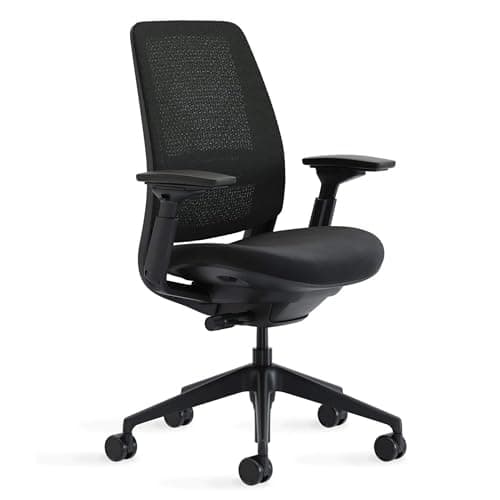
- You want the Series 1 idea with more back — the Series 2. Same 400 lb, same 12-year warranty, an Air LiveBack and adjustable lumbar standard on the knit, quilted and upholstered backs, and SCS Indoor Advantage Gold - Furniture printed on its own February 2025 cut sheet.
If you are still deciding between a better chair and a better desk, our standing desk versus ergonomic chair guide is the honest version of that argument: for a lower back, the chair usually wins first.
Both of these chairs also turn up in a different argument, where they are the answer to “what instead of a Herman Miller Embody” rather than to each other. Herman Miller Embody alternativesputs them next to a chair at a third of the Leap's price that carries an emissions line neither Steelcase page prints.
How to decide this one in five minutes
1. Point at where it hurts
Below the waist — lower back, hips, tailbone — and the Leap's lumbar dial and LiveBack are the mechanism you want. Above the waist — shoulders, elbows, wrists — and the Gesture's arms are the only thing on this page that moves the way your arms do. Everything else about these two chairs is published identically.
2. Decide whether you need the certificate in writing
If you need to be able to show someone a document, the Leap and the Gesture cannot give you one today: both Steelcase pages point at a Product Environmental Profile that is published as an image. The Series 1 cut sheet prints SCS Indoor Advantage Gold - Furniture in plain text. That is a real difference for a procurement form or a sensitive household, and it costs less, not more.
3. Check your floor before you check the chair
Both of these listings are carpet builds. On hardwood, laminate or tile you want soft casters or a mat, and that is a separate order either way.
4. Do not expect a stature chart
Steelcase publishes a seat height and a seat depth as single figures and no range. Measure your own seated elbow height against your desk first — our adjustment guide walks the order to set things in — and if you are notably short or tall, treat fit as the open question rather than assuming a 400 lb rating implies it fits you.
5. Check the seller, not just the price
Twelve years of parts and labor is most of the value here, and Steelcase reserves the right to refuse claims on chairs bought from unauthorized sellers. Confirm the sold-by line.
6. Ventilate it anyway
Whatever the certificate says, a new chair arrives wrapped in plastic with fresh foam and fresh adhesives. Give it a few days in a ventilated room before you sit in it all day — the first 72 hours explains why that single habit does more than most certificates.