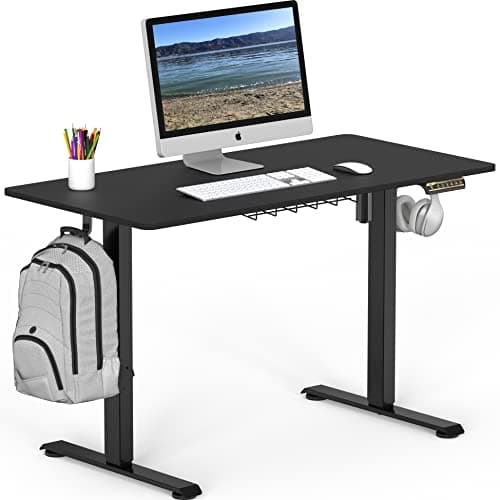
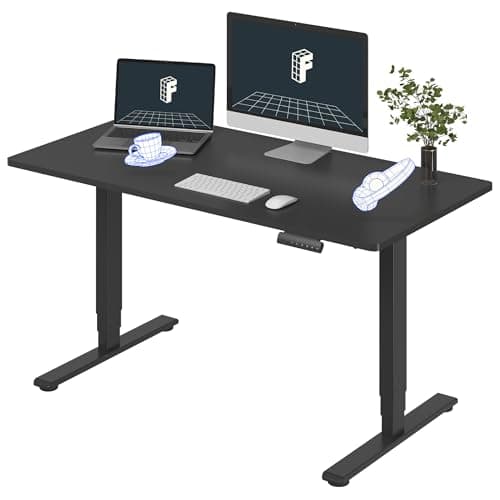
A sit-stand desk is worth it for most desk workers, but the usual reason given is the weaker one. The strong argument is not that you will stand more — it is that a fixed desk is 29 to 30 inches high, most people's seated elbow height is 25 to 28, and a desk that lowers fixes a posture problem you have had for years without noticing.
The height problem nobody talks about
Standard desk height is a convention, not an ergonomic conclusion. Almost all fixed desks are built at 29 to 30 inches, and that number suits a fairly tall person in a fairly tall chair. For everyone else, it is too high.
The consequences are specific. To reach a surface above your elbow height you either raise the chair — which leaves your feet dangling, cutting circulation at the back of the thigh — or you leave the chair correct and reach up, which extends the wrists and lifts the shoulders. Both are sustained low-grade loads held for hours, which is exactly the pattern NIOSH and OSHA describe as a musculoskeletal risk factor.
A sit-stand desk lowers as well as raises. That single fact means the seated half of your day gets fixed too — and since most people still sit for more of the day than they stand, the seated fix may be worth more than the standing one. It is the thing a converter cannot do, and the reason we keep pointing it out.
What the standing part actually buys you
Less than the marketing claims, and more than the backlash claims. The Cleveland Clinic's summary is a good calibration: standing desks are not a weight-loss intervention and the evidence for dramatic health outcomes is thin, but breaking up prolonged sitting is a reasonable goal, and Mayo Clinic's guidance on sitting is about exactly that.
What people consistently report, and what matches the evidence base, is modest: less afternoon stiffness, a bit more alertness after lunch, and — for some — less low back discomfort. Those are real and worth having. They are not the same as the claims on a product page, and we would rather you buy with the accurate expectation. The fuller treatment is in standing desk vs sitting.
What a regular desk genuinely does better
- Cost. A good fixed desk is a fraction of the price of an equivalent electric one, and a solid-wood table has no motors, no control box and nothing to fail.
- Stability. A fixed desk is four legs and a top. Even a good sit-stand frame is a telescoping column, and at full height it will always be less rigid than a fixed desk of the same quality.
- Materials, sometimes. The nicest fixed desks are solid wood, which sidesteps the composite-core question entirely. Most sit-stand desks in the consumer market are laminate over particleboard — regulated under TSCA Title VI in the US, but rarely carrying a low-emission certificate. That comparison is in MDF vs solid wood.
- Nothing to break. No motor, no controller, no cable to snag. The failure modes of a sit-stand desk are covered in when a standing desk will not go up because they are common enough to need a page.
- Aesthetics. A steel column frame looks like office equipment. If the desk is in a living room, that is a legitimate reason to choose otherwise.
The option that gets both
You do not have to choose between a nice top and an adjustable base. A bare electric frame under a solid wood or butcher-block top you choose yourself gives you the full height range, the material you want, and no new composite panel in the room — usually for less than a mid-range complete desk. The FlexiSpot EN1 Standing Desk Frame (no top) is the cheapest way in, and the full case is at best standing desk frames.
This is genuinely the route we would take, and it is the one almost nobody considers, because desks are sold as complete objects and the frame market is not advertised.
Who should not switch
If you sit for two or three hours a day rather than eight, the case is much weaker — the problem being solved is dose. If your desk is a nice piece of furniture you like and a fixed height that already matches your elbows, you have the thing a sit-stand desk is trying to give you. If you rent, share, or cannot replace the desk at all, a converter plus a keyboard tray is a better answer than a desk you cannot install.
How to decide in one minute
- Measure your seated elbow height with your feet flat and shoulders relaxed. If it is well under 29 inches, your current desk is too high and a sit-stand desk fixes that today. The height calculator gives you both numbers.
- Count your desk hours. Six or more a day makes the case; two does not.
- Decide whether you will actually change the height. If the desk has presets you will; if it needs a crank or a held button, most people do not. That single feature decides whether a sit-stand desk becomes an expensive fixed desk.