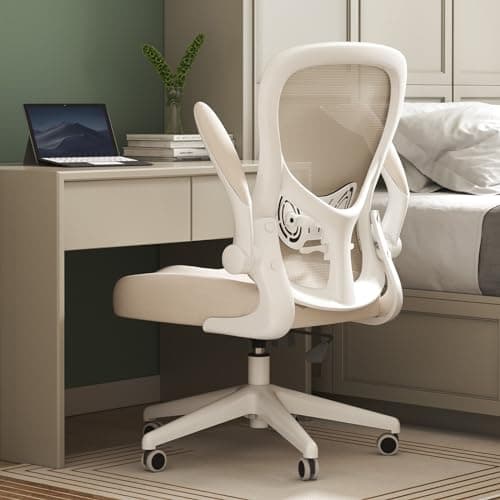
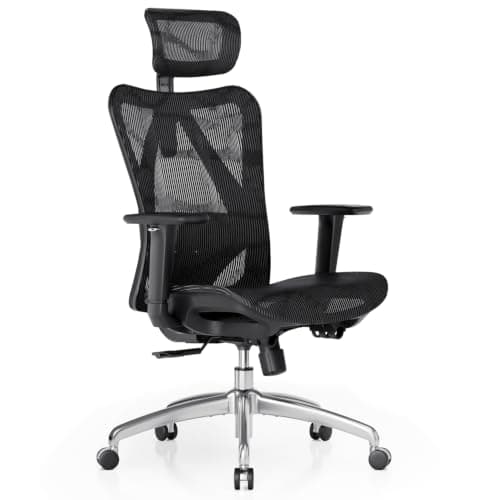
Buy the SIHOO M57 if you are in the chair for a full working day. Three-way armrests and an adjustable lumbar mechanism are the two adjustments that change your posture rather than your opinion, and the M57 has both. Buy the Hbada mesh chair if the chair is for a few hours a day or a second desk — it has real lumbar adjustment at a price almost nothing else does, and its compromises are in the armrests and the seat depth, which matter less at a shorter dose. Neither brand publishes an emissions certificate, and that is the honest headline for this whole tier.
What separates them is adjustment, not comfort
Both chairs are mesh-backed, both have a moving lumbar component, and both will feel fine for twenty minutes. The difference shows up at hour six, and it is mechanical.
The armrests. The SIHOO M57 has 3D armrests — height, plus movement in two more axes. The Hbada's armrests flip up out of the way but do not adjust for height. That sounds like a convenience feature and it is not. OSHA's computer-workstation guidance and the Mayo Clinic office-ergonomics guide both describe the same setup order, and it starts with setting the seat so your elbows sit at roughly desk height with your shoulders down. An armrest fixed too high pushes your shoulders up all day; one fixed too low leaves your forearms unsupported and loads your neck instead. Height adjustment is the armrest adjustment that matters, and only one of these chairs has it.
The seat depth. The Hbada's seat depth is fixed. Cornell's seated workstation guidance puts a few fingers' clearance between the back of your knee and the seat edge, which is a fit you either get by luck or get by adjusting. Shorter legs on a fixed deep seat means the seat edge presses behind the knee; the usual response is to perch forward, which takes you off the lumbar support you bought the chair for.
The foam dose. Both chairs have a foam seat pad, and on both it is the first part to flatten. The variable is hours. At three hours a day the Hbada pad will outlast your interest in the chair. At eight, it is the part you will notice going, and the M57 has more chair around it to carry the difference.
Side by side, on what each listing publishes
| Decision factor | SIHOO M57 | Hbada mesh (adjustable lumbar) | Ticova high-back |
|---|
| Lumbar | Adjustable lumbar | Adjustable lumbar | Lumbar pad that moves up and down as well as in and out |
| Armrests | 3D (height plus two axes) | Flip-up, no height adjustment | 3D |
| Back | Mid-back mesh | Mesh, flip-up arms | High back with adjustable headrest |
| Emissions certificate | None published | None published | None published |
| Structural certification | Some SIHOO chairs are marketed as BIFMA-tested — verify per SKU | None published | Verify any BIFMA claim per SKU |
| Best dose | A full working day | A few hours, or a second desk | A full day if you recline to think |
The certification answer, stated plainly
This site judges chairs through a materials and certification lens, so it has to be said clearly: neither of these chairs is documented. SIHOO does not publish a GREENGUARD certificate for the M57. Some SIHOO models are marketed as BIFMA-tested, and that claim needs checking against your exact SKU with the seller rather than against a listing badge. Hbada publishes no certification of any kind for this chair. Treat emissions and durability testing as undocumented on both.
That is an absence of evidence rather than evidence of a problem, and we treat it that way. But if a certificate is the reason you are shopping, this page is not where the answer is — it is at GREENGUARD-certified office chairs, and the chairs there cost more. The practical middle ground is ventilating a new chair properly for its first few days, which is free and is the single most effective thing you can do about an uncertified product you have already bought.
When the answer is the Ticova instead
There is a third chair in this tier worth naming, because the SIHOO-versus-Hbada question is often really a question about your back. If you recline to think — and a lot of people do — a mid-back chair gives you nothing to lean into above the shoulder blades. The Ticova is the high-back option in this price band, with an adjustable headrest and a lumbar pad that moves up and down rather than only in and out. If you sit upright all day, skip it: a headrest you never touch is just height, and it dominates a small room.
Whichever you buy, do the free step first. A budget chair adjusted properly outperforms a better chair left at factory settings, and if the chair you already own keeps dropping, that is a cylinder fault rather than a reason to replace the whole thing.
Before you buy
Four checks, in order
1. How many hours a day?
Under four, the Hbada is enough chair and the cheapest route to real lumbar adjustment. Six or more, buy the armrest adjustment — that is the SIHOO.
2. Measure your seat depth need
Sit on the chair you have now and check the gap behind your knee. If there is none, a fixed deep seat is the wrong purchase whatever else it has.
3. Do you lean back?
If yes, the high-back Ticova is the chair in this tier built for it. If no, the headrest is money spent on a part you will not touch.
4. Accept that nothing here is certified, then ventilate
No chair in this price band publishes an emissions certificate. Unbox it in a ventilated room and give it a few days before it becomes the thing you sit in for eight hours — the mechanism is in our first 72 hours explainer.