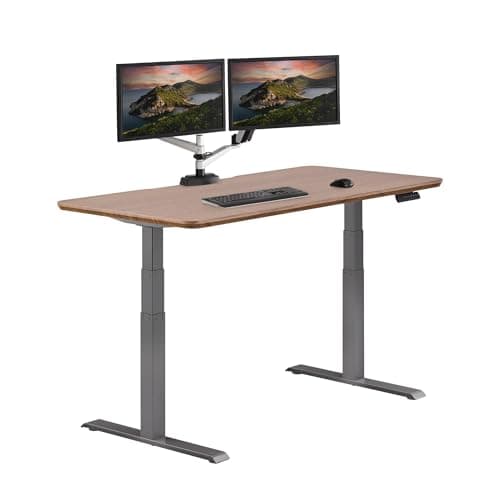
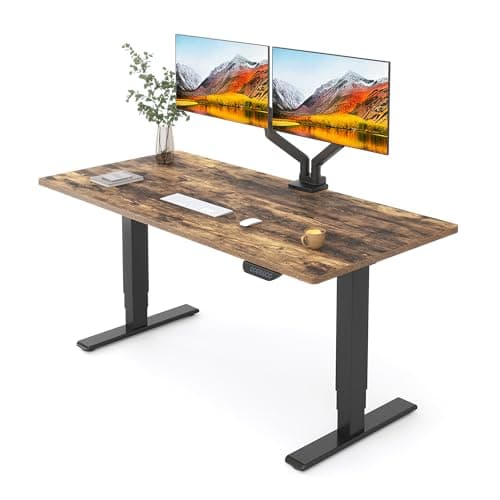
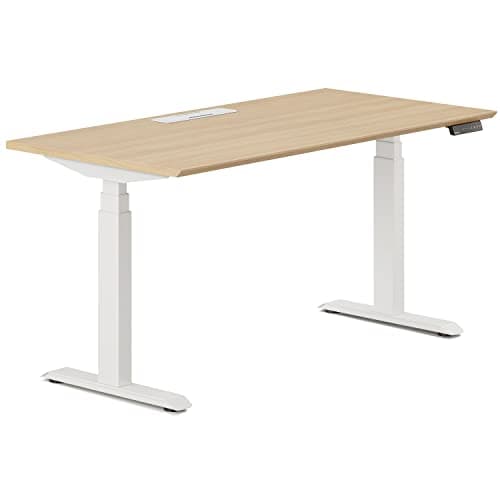
Buy the Branch Standing Desk 48x30. Its Amazon detail table publishes a maximum height of 52 inches, which is the highest figure on any desk this site ranks, and with a walking pad underneath that headroom is the entire decision. A slim pad raises you about 4.2 inches; a full folding treadmill with incline raises you 9. Subtract that from a desk that tops out at 48.8 inches - which is what the popular FlexiSpot E6 publishes - and you are left standing at 44.6 in, or 39.8 in, and the second of those is lower than a normal SITTING desk. That is the mistake this page exists to prevent. The pad is the easy purchase. The desk is the one that has to be right.
The arithmetic, and it is only subtraction
Work out your standing desk height first - our standing desk height calculator does it from your own measurements, and both OSHA's Computer Workstations eTool and Cornell's workstation guidance describe the same target: a surface that lets your forearms sit roughly parallel to the floor with your shoulders relaxed. Then add the deck height of the pad, because the pad is now your floor.
Those are the only two numbers involved, and both are published. Here is the subtraction, using the figures each maker prints and the slim 4.2 in UREVO deck:
- Branch Standing Desk 48x30 - 52 in max. With a 4.2 in pad you still have 47.8 in of effective standing height. With the 9 in Vitalwalk treadmill, 43 in.
- Vari Classic 60x30 - 50.5 in max. 46.3 in effective with the slim pad, 41.5 in with the 9 in treadmill.
- FlexiSpot E6 MAX - 127 cm max, which is 50.0 in. 45.8 in effective, 41 in with the treadmill.
- UPLIFT V3 laminate - 48.7 in max (UPLIFT's own figure). 44.5 in effective, 39.7 in with the treadmill.
- FlexiSpot E6 - 48.8 in max. 44.6 in effective, 39.8 in with the treadmill. We rank the E6 first on our best standing desks page and we would not pair it with a walking pad for a tall walker.
Nothing in that list is a measurement we took. It is each manufacturer's published maximum minus each manufacturer's published deck height, and you can redo it in your head with your own pad.
The pad's deck height is the number nobody puts in a headline
Walking pad listings lead with speed, motor power, incline and app features. The deck height - the thing that changes which desk works - is published inside the Product Dimensions string as the third figure, and it is easy to read straight past. Here is what the three pads we track actually publish:
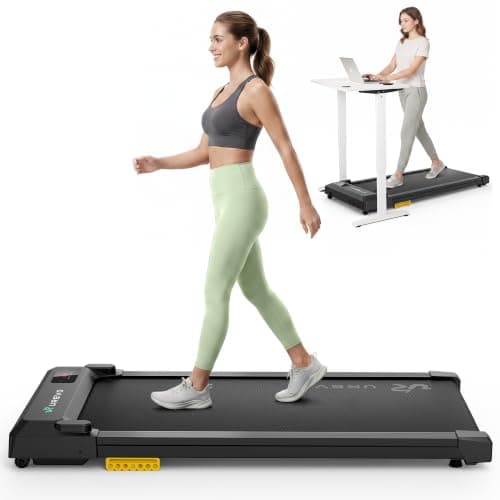
- UREVO Smart Walking Pad: 42.1 x 19.3 x 4.2 in, 265 lb maximum user weight. The 4.2 in is the smallest deck we have a published figure for, which makes it the pad that costs you the least desk height.
- TREAFLOW with incline: 44.5 x 19.3 x 4.3 in, 265 lb. Essentially the same deck, with an 8% incline added - and note that an incline raises the BACK of the belt, so the effective standing height when you use it is higher than the flat figure.
- Vitalwalk folding treadmill: 53 x 29 x 9 in, 350 lb, and 105 lb of its own weight. Nine inches. This is a real treadmill with a 49 x 18 in belt and a 25%/20% auto incline, not a slim pad, and it eats more than twice the height budget.
If you already own the pad, measure the deck with a tape rather than trusting a number: these are low-cost marketplace products and a quarter inch matters less than a published figure being for a different revision. If you are buying both, buy the pad whose deck height you can actually find in writing.
There is a trade hiding in those deck heights, and it is the reason this arithmetic gets harder rather than easier for a heavier walker. The 265 lb pads above are the thin ones — 4.2 and 4.3 in. The pads that publish 350 and 400 lb capacities are 6.5 to 7.9 in thick, because the extra structure has to live somewhere, so choosing for capacity costs you two to four more inches of desk travel. Walking pads for heavy users ranks those pads and publishes every deck height next to every capacity claim, so you can run this same subtraction before you buy.
What the listings get wrong, published side by side
This is a category where the structured data is unusually messy, and since the whole decision is made from two published numbers it is worth knowing which ones to distrust.
The Branch listing contradicts itself on the minimum.Amazon's Minimum Height field reads 25 inches. The Special Feature field on the same listing reads "Lift range of 26" - 52"". Both are Branch's own entries, an inch apart. The maximum - 52 in - is consistent in both places, which is the number this page turns on, so the conflict does not change the ranking. It does tell you to confirm the minimum if you also want to sit at this desk.
FlexiSpot publishes the E6 MAX's two height limits in two different units. Minimum Height: 24.4 inches. Maximum Height: 127 centimeters. On the same table. 127 cm is 50.0 in, so the desk is fine - but a buyer scanning for a number in inches will not see a maximum at all, and that is how people end up with a desk that cannot clear their pad.
The UREVO mixes units inside one table too, giving a 265 pound capacity beside an 18 kg item weight. None of this is dishonest. It is just carelessness in the exact fields a careful buyer needs, which is the reason we print the figures and name the field they came from rather than summarising them.
Height is not the only thing a pad changes
Wobble gets worse at the top of the travel
Every three-stage lift column is least stable fully extended, and a pad forces you to use the top of the range you would otherwise never visit. If you type while walking, the deflection you feel is the desk at its weakest point. Our fix standing desk wobble guide is the practical answer, and the structural one is to pick a dual-motor three-stage frame rather than a single-motor two-stage: see single vs dual motor.
The desk's weight rating is not the constraint - the floor is
A common worry is that the treadmill eats the desk's capacity. It does not: the pad sits on the floor, not on the desk. Vari publishes 200 lb for the Classic, FlexiSpot 220 lb for the E6 and 352 lb for the E6 MAX, UPLIFT 355 lb for the V3 - all of that is still available for monitors and a keyboard. What the pad does affect is the floor: 105 lb of folding treadmill on a carpeted floor behaves differently from 37 lb of slim pad, and on carpet the pad can rock. Standing desks on carpet covers the levelling problem.
Your monitor has to come up too
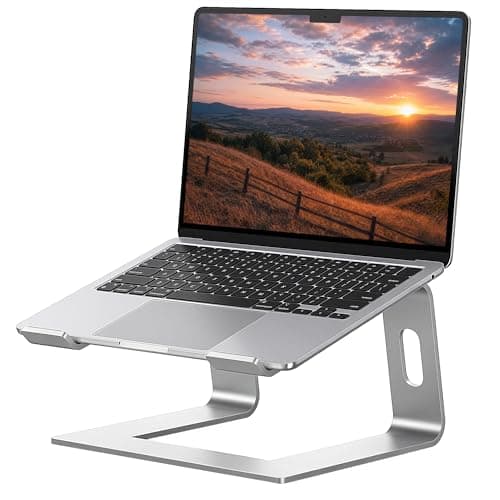
Raise the desk by four inches and the screen goes with it, which usually puts it too low relative to your new eye line rather than too high - because walking changes your head position. If you are already at the top of the desk's travel you cannot fix that by raising the desk further, so fix it at the screen: a monitor arm gives you the extra inches the desk has run out of, and monitor height has the target. On a triple-screen setup the same problem needs a triple monitor arm with enough published per-arm capacity to hold the load at the top of a raised desk.
Noise travels through the desk, not just the air
A pad under a desk transmits motor hum and footfall into the desktop and then into your wrists, and in an apartment into the floor below. We wrote how loud walking pads really are for exactly that, and the short version is that deck thickness and belt length matter more than the quoted decibel figure.
The certification question, honestly
None of these desks carries a GREENGUARD certificate for the configuration you buy on Amazon, and we are not going to pretend otherwise. The UPLIFT V3 is the exception worth naming: UPLIFT publishes a GREENGUARD Gold position for its laminate desktop line, which is why the UPLIFT V3 is ranked here at all despite having the lowest maximum height of the four. It is 48.7 in, so it works with a slim pad for a walker of average height and it does not work with a 9 in treadmill. That is a real trade-off between a certificate and a height, and you should make it knowingly rather than discover it after delivery. Our GREENGUARD-certified desks page is where to go if the certificate is the hard constraint and the pad can be the slim one.
Branch states that its desks "meet the BIFMA standard", which is a manufacturer statement about test results rather than a third-party mark, and publishes no emissions certificate for any desktop - the full version of that is in our Branch desk review. Vari is the brand with a per-SKU published certification table, covered in the Vari Classic review. A BIFMA claim and an emissions certificate are different things, and a desk can have one and none of the other.
Who should skip the pairing altogether
- Anyone under about 5 ft 4 who wants the 9 in treadmill. You are being lifted most of a foot. Even a 52 in desk is then at 43 in, which is far above a short standing height, and there is no way to go lower. Buy the slim pad.
- Anyone who types precisely while walking. Walking and keyboard accuracy do not combine well at any desk height, and the top of a lift column is the wobbliest part of its range. Use the pad for calls and reading, and sit or stand still to type.
- Anyone buying a pad to replace standing. They solve different problems, and we argued it out in standing desk vs walking pad. Alternating sitting and standing properly is still the thing most people have not done yet.
If you want the pads ranked against each other rather than the desks, that is a different page: under-desk treadmills and walking pads.
How to get this right in the order that matters
1. Get your standing height before you look at any desk
Stand with your shoulders relaxed and your elbows at about 90 degrees. The height of your hands is your standing surface height. Our calculator turns your own height into the figure if you would rather not measure.
2. Add the pad's deck height - and read it off the dimensions string
It is the third number in Product Dimensions, the one marked H. 4.2 in for the UREVO, 4.3 in for the TREAFLOW, 9 in for the Vitalwalk folding treadmill. If a listing does not publish a height at all, treat that as a reason to buy a different pad, not a reason to guess.
3. Compare that total against the desk's published MAXIMUM, not its range
A "24.4 to 50 in" desk is a 50 in desk for this purpose. The low end stops mattering the moment a pad is on the floor, and a low minimum - normally the thing we praise most, as on desks for short people - buys you nothing here.
4. Leave yourself an inch, not nothing
Lift columns are least stable at full extension and belts compress underfoot. If your number lands exactly on the desk's maximum, go up a desk. There is no adjustment left to make once it is assembled.
5. Fix the screen at the screen
You have spent the desk's remaining travel on the pad, so the monitor has to be solved with a monitor arm or a stand. Budget for that in the same order rather than discovering it on day two.
6. Check the floor under the pad, not just the desk
On carpet a pad can rock, and a rocking belt under a fully extended desk is the worst combination in this category. Carpet first, pad second.