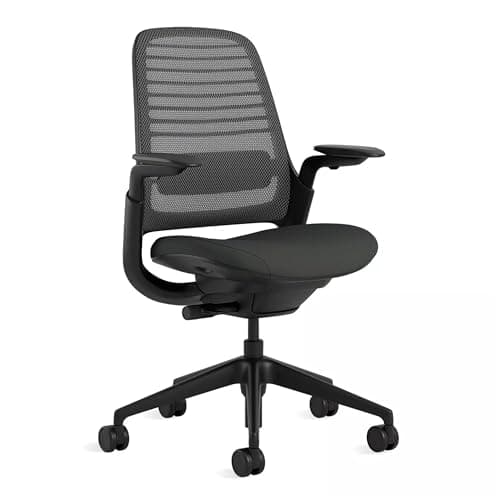
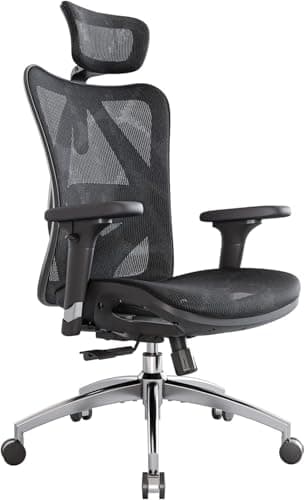
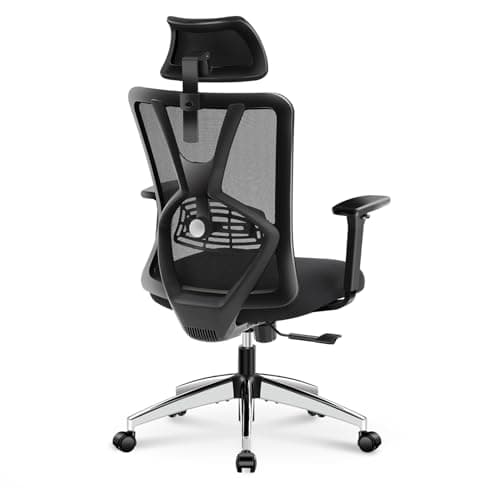
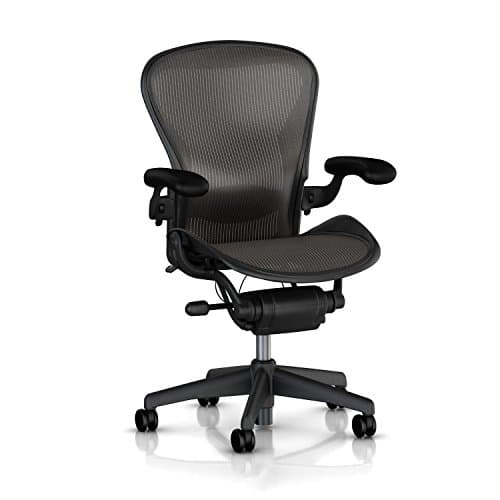
Buy mesh if you run warm, sit for long unbroken stretches, or want the least material off-gassing beside you — the Aeron is the reference, suspending your weight in its 8Z Pellicle with no seat foam to compress at all. Buy foam if you want day-one comfort and a softer surface, accepting that foam warms up, flattens over years, and is where flame retardants live. Most chairs are neither: they are a mesh back over a foam seat, which is the sensible compromise and worth understanding on its own terms.
The mechanical difference, in one sentence each
Mesh suspends. A tensioned membrane carries your weight in tension across a frame, so the material deflects and spreads load rather than squashing. Air passes straight through it. Nothing is being permanently crushed, so the surface you sit on in year five is the surface you sat on in week one.
Foam compresses.A foam seat deforms under the pressure points — your ischial tuberosities, the two bones you actually sit on — and that deformation is what makes it feel soft immediately. Foam also traps heat against you, and it has a service life: the cell structure breaks down under repeated loading, which is why a flattened seat pad is the most common complaint about mid-price chairs and why the SIHOO's foam pad is the first part we expect to go.
Heat is the difference people notice first
If you sit for six or eight hours in a warm room, mesh wins and it is not subtle. A foam seat with a fabric cover has nowhere to put your body heat or moisture, and by the afternoon that becomes a comfort problem that quietly shortens how long you can stay in the chair. This is a large part of why mesh took over the contract-furniture market, and it is the single best reason for a home-office buyer in a hot room to choose it.
Pressure distribution cuts the other way — sometimes
Mesh spreads load well, but a mesh seat has an edge where the membrane meets the frame, and on a poorly designed chair that edge lands under the back of your thighs. Cheap mesh seats are the main offender here; well-engineered ones curve the frame away from the leg. Foam has no edge problem, which is why a lot of very good chairs — including our main roundup favourites — pair a mesh back with a foam seat and get most of both.
For a heavier sitter this matters more, and in both directions: foam bottoms out faster under greater load, while a stretched mesh membrane can sag into a hammock if the chair was not built for the weight. The answer there is documentation rather than material, which is what our big and tall page is about.
The part nobody mentions: foam is the emissions question
This is where the choice matters for the reader this site is written for. A foam chair is several pounds of polyurethane foam, adhesive and fabric sitting in your room at body temperature for eight hours a day. Furniture foam is also historically where flame retardants were added to meet flammability requirements, a class of chemicals the EPA tracks under TSCA — which is why we maintain a whole page on flame retardants in chairs.
A mesh chair does not eliminate the question — there is still a frame, a base, a gas cylinder and usually some foam somewhere — but it materially reduces the volume of soft material involved. It is the same reasoning we apply to desktops in MDF vs solid wood: fewer grams of bound, treated material in the room is a structural answer rather than a claim you have to trust. The seating hub covers this in non-toxic office chairs, and the certificates worth looking for are listed under GREENGUARD-certified chairs.
One honest caveat: "mesh" is not automatically the low-emission choice, and no material is a certificate. Herman Miller and Steelcase both publish low-emission documentation for their chairs; the budget mesh chairs in this comparison publish none at all. Verify any GREENGUARD claim for your exact SKU at UL SPOT rather than inferring it from the material.
Which to buy
Choose mesh if you run warm, sit long, weigh within the chair's documented range, and want less soft material in the room — and expect to spend more for a mesh seat that does not have an edge under your thighs. Choose foam if you want immediate comfort, a softer perch or a lower price, and treat the seat pad as a consumable rather than a permanent part. Choose the hybrid, mesh back over foam seat, if you want the heat benefit where your back is and the pressure benefit where your weight is — which is what most people should probably do.