Keep the desk and shorten the stretches. A sit-stand desk is genuinely useful in pregnancy for one reason: it lets you change position without leaving your work. What the occupational literature treats as the hazard is not standing, it is standing for long unbroken periods — so the change to make is more frequent switching, not more standing. If you buy one thing, buy a mat. If you buy two, add a third position you can perch in.
This page is general information, not medical advice, and we are not clinicians. Your hours and your circumstances are a conversation for your own midwife or doctor. What we can do honestly is lay out what the published guidance says and what the equipment can and cannot do.
What the evidence actually says
Two documents are worth knowing about, because almost everything written on this topic online is downstream of them.
Dick and Waters' 2015 review of prolonged standing at work, published in Rehabilitation Nursing and hosted by the CDC, surveyed the health outcomes associated with standing work. Pregnancy-related complications appear among those outcomes, alongside lower back and leg pain, fatigue and cardiovascular effects. The same review identifies which interventions have evidence behind them, and the list is short and specific: floor mats, sit-stand workstations and chairs, and footwear — including shoe inserts and supportive hosiery. That is the entire evidence-backed shopping list, and it is the same one this site gives everyone, with a sharper reason here.
The Royal College of Physicians' 2009 guidance on physical and shift work in pregnancy is the occupational-health document employers work from. It treats prolonged standing as a hazard to be reduced in late pregnancy rather than eliminated, and it is explicit that an informed worker who wishes to continue should not have restrictions imposed against her will. Read together, those two documents say something quite practical: the sit-stand desk is on the solution side of the ledger, and the thing to manage is duration.
What to change about how you use the desk
Shorten the standing blocks before you shorten the standing day. Four twenty-minute stands are not the same stimulus as one eighty-minute stand, even though the totals match. The unbroken stretch is the variable the guidance is concerned with, so the first change is frequency, not volume. Our how long should you stand page works through ratios for everyone; in pregnancy, bias every ratio towards shorter blocks.
Treat a seated block as the active choice, not the failure. There is a tendency, once someone owns a standing desk, to treat sitting as backsliding. It is not. The thing with evidence behind it is alternation, and the seated half is half of that. The chair you alternate into matters more now, which is why we wrote a separate page on office chairs for pregnancy — forward seat tilt and adjustable lumbar height are the two adjustments that keep a seated block comfortable as things change.
Re-set your desk height more often than you expect to. A standing desk height is derived from your elbow position, and your comfortable standing posture shifts over months. Re-run the number rather than living with the preset you saved in month two — our height calculator takes a minute. If you add a mat, set the height while standing on the mat, because every inch of mat raises you an inch.
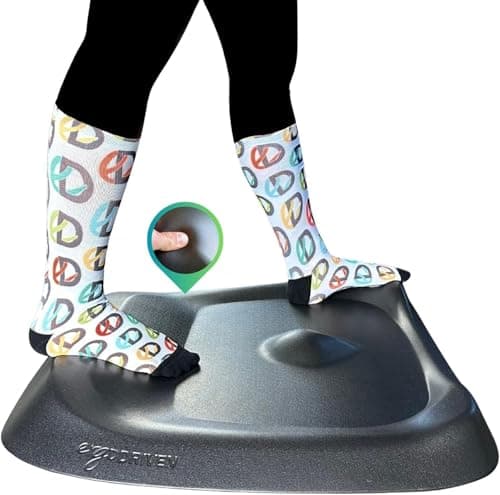
Move your feet rather than standing still. Standing still is the demanding version of standing: it requires continuous low-level contraction in the legs, hips and spine, and it is what makes an hour feel long. Shifting weight, stepping, and changing which foot is forward redistribute that load. This is the mechanism anti-fatigue mats work through, and it is why a sculpted mat that gives your feet somewhere to go beats a flat cushion for most people here.
What is worth buying, in order
1. A mat, and ideally a sculpted one.Mats are on the short list of interventions the 2015 review names, and Bao and Howard's peer-reviewed work on anti-fatigue mats is the study behind our mat recommendations. A flat mat makes standing still more comfortable; a sculpted mat prompts you to change position without deciding to, which is the more useful mechanism when the goal is not standing rigidly. Size it properly — about 36 by 24 inches for most desks, and depth matters more than width, which we explain in what size anti-fatigue mat do I need.
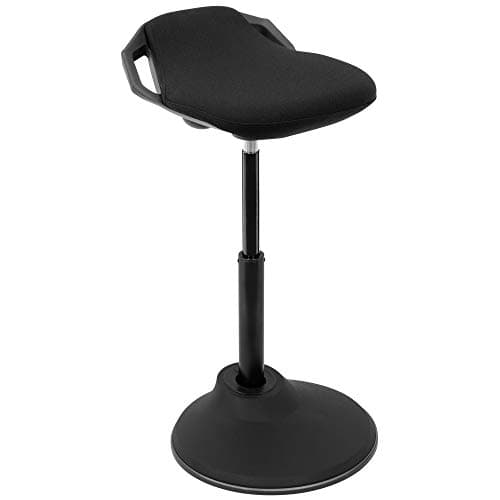
2. A third position. This is the one most people have never considered and it is the single most useful addition to a sit-stand day in pregnancy. A leaning or perching stool is neither sitting nor standing: it takes most of your weight while leaving your hips open and your legs loaded lightly. It gives you somewhere to go when standing has become too much and sitting down feels like giving up the position. The category is ranked on standing desk stools, and if you need a backrest with it, the sit-stand-lean chairs are the ones to look at.
3. Shoes, which cost nothing if you own them already. Footwear and inserts are the third item on the evidence-backed list and the most overlooked, because people stand at home desks barefoot or in slippers on a hard floor. A supportive shoe changes a standing day more than most purchases do — we go through it in standing desk shoes.
4. A footrest for the seated half. As reaching the floor gets less comfortable, a footrest keeps your feet supported with the chair still set correctly for your forearms, and it slightly opens the hip angle. Cheap, and it earns its place. See under-desk footrests.
What a standing desk will not do
It will not substitute for activity. Gentle standing sits well below the moderate-intensity activity public-health guidance is written around, and CDC's physical-activity basics is the reference for what does count. Breaking up sedentary time is a real and separate goal; it is not a walk.
It will not fix back pain on its own either. Lower back discomfort in pregnancy has causes a desk cannot reach, and the honest sequence is desk height, then the chair, then movement — adding standing to a badly set-up workstation just means standing in a bad position. We cover the general case in does a standing desk help back pain and the counter-case — standing causing pain — in when a standing desk causes back pain.
And it will not tell you when to stop. Swelling in the feet and ankles, light-headedness, or pain that arrives with standing and leaves when you sit are signals to sit down and to raise them with a clinician, not problems to solve with better equipment. We would rather say that plainly than sell you a mat for it.
One note on the desk itself
If you are buying a desk now rather than adapting one, the figure to check is the minimum height, not the maximum. The seated half of your day is the half that has to work, and a desk whose floor is 28 inches or higher is a standing desk that never descends below a conventional fixed desk — which we found on more than one premium model in Branch vs UPLIFT. Buy on the floor, not the ceiling, and keep the memory presets for the positions you actually use.