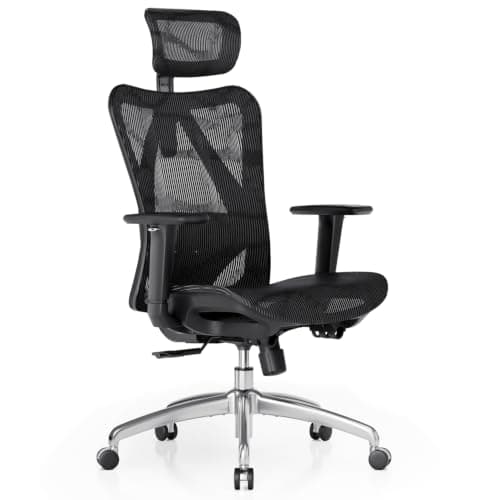
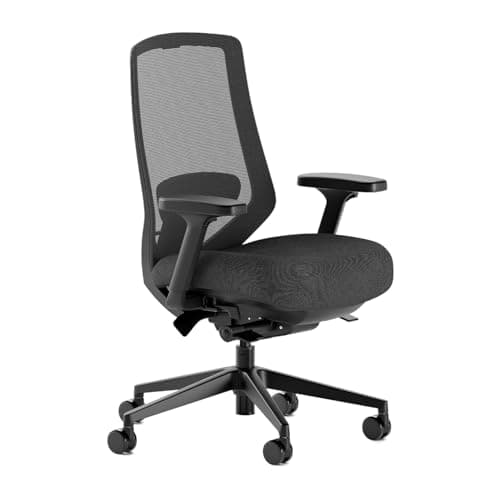
Buy the Branch Ergonomic Chair Pro — not because it is designed for pregnancy, because nothing is, but because it publishes the three adjustments that matter when your centre of gravity moves forward: a forward seat tilt, a lumbar pad that slides up and down, and a seat depth you can shorten. On a tighter budget the SIHOO M57 covers two of the three. And consider a footrest and a lumbar cushion before a chair upgrade at all — between them they fix more, per dollar, than any chair does.
One thing stated plainly up front: no chair we rank is marketed, tested or certified for pregnancy, we have no clinical standing to tell you how to work, and nothing on this page is medical advice. What follows is an ergonomics and materials read, which is the part we can do honestly.
What changes, in ergonomic terms
Two things change about sitting, and both are mechanical. Your centre of gravity moves forward and up, which increases the pull on the lower back in an upright seated posture. And the lumbar curve you are supporting changes shape and position across months rather than staying put. A chair fitted to you in month two is not fitted to you in month seven — so what you need is not a different chair shape, it is a chair whose shape you can keep changing.
That is why the feature list here is short and specific. Forward seat tilt angles the front of the seat down a few degrees, opening the hip angle so the pelvis can sit neutral rather than tucked under; it is the adjustment aimed most directly at a forward-shifted load, and it is rare below premium prices. Lumbar height adjustment lets the support follow the curve as the curve moves. Seat depth matters because a seat pan that suits you now may press behind the knee later, and pressure behind the knee is a circulation complaint you would rather not add.
Everything else is comfort, and comfort is not nothing — but the three above are the ones that change what your spine is doing. The same reasoning drives our office chairs for back pain ranking, which is the page to read if lower-back pain is already the problem rather than a risk.
Standing is the other half, and the evidence is specific about it
If you have a sit-stand desk, the honest answer is to use both positions and change between them more often than you used to — not to stand more. Dick and Waters' 2015 review of prolonged standing at work, published in Rehabilitation Nursing, lists pregnancy-related complications among the health outcomes associated with prolonged standing, alongside lower back and leg pain and cardiovascular effects. The interventions it identifies as having supporting evidence are floor mats, sit-stand workstations and chairs, and footwear — the same three things this site recommends for everyone, with a sharper reason here.
Occupational guidance points the same way: the Royal College of Physicians' 2009 guidance on physical and shift work in pregnancy treats prolonged standing as a hazard to be reduced in late pregnancy rather than one to be eliminated. Practically, that makes a sit-stand desk an asset and a standing-only setup a bad idea. If standing is part of your day, an anti-fatigue mat is the cheapest intervention with evidence behind it, and how long to stand at a standing desk covers the ratio question. Your own hours are a question for your own clinician; that part is not ours to answer.
The materials question this page takes seriously
Here is the angle most pregnancy chair roundups skip. A new office chair is a large piece of polyurethane foam, laminated board and adhesive arriving into a small room that you then sit in for eight hours a day for months. Foam that is going to off-gas does most of it early, which makes the sensible move boring and free: unbox it, leave it somewhere ventilated for a few days, and keep the room aired while it settles. Our first 72 hours guide covers the mechanism.
On certificates, be careful what you accept. A GREENGUARD Gold claim is an emissions certification — a chamber test of what comes out of a product into the air — and UL states that GREENGUARD Gold screens for more than 360 VOCs against the California Section 01350 criteria. It is not an ingredient audit, and UL's own description of the program does not call out phthalates by name. Of the chairs here, Branch publishes the GREENGUARD Gold line on its Ergonomic Chair, Verve and Daily and not on the Pro; Steelcase publishes SCS Indoor Advantage Gold; SIHOO publishes neither. What each certificate does and does not reach is the subject of phthalates in office furniture.
If published emissions paperwork is your deciding factor and the Pro's adjustments are not, the Branch Verve is the chair in that range whose own page carries the emissions line — the trade is six adjustment points instead of fourteen. That comparison is laid out in Steelcase vs Branch.
What to buy before you buy a chair
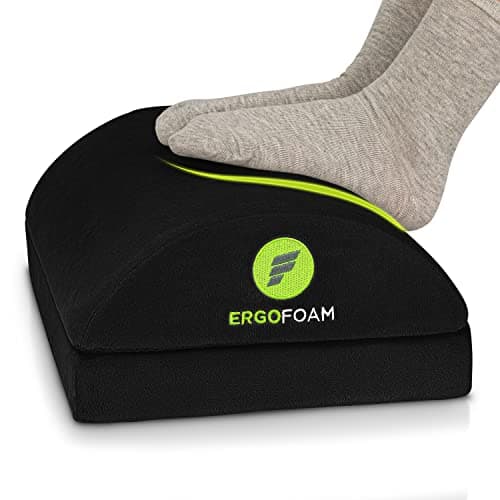
If the chair you already own adjusts in height and has a backrest you can recline, two cheap additions get you most of the way. A lumbar cushionplaces support where the chair's fixed shape does not, and it can be moved up or down daily as things change — which an expensive molded back cannot. A footrest keeps your feet supported once the chair is set for your forearms, which matters more as reaching the floor gets less comfortable; it also slightly opens the hip angle, which is what forward tilt does, for a fraction of the money.
Both are polyurethane foam with no published certificate, and that is the honest trade: they are the cheapest real ergonomic improvement available and they are undocumented on materials. Air them out first. Our lumbar support and footrest pages rank both categories properly, and seat cushions covers the third option if your seat pan has flattened.
Setting a chair up as things change
1. Re-set the chair monthly, not once
This is the actual advice. Height, lumbar position and seat depth all want revisiting as your shape and your comfort change. A chair you cannot easily readjust is the wrong chair for these months.
2. Open the hip angle rather than closing it
Forward seat tilt of a few degrees, or a footrest, or both. A seat that slopes backwards tucks the pelvis and loads the lower back, which is the posture to get out of.
3. Support the curve where it is now
An adjustable lumbar pad, or a cushion you can slide. Fixed lumbar shapes are the first thing to stop fitting.
4. Keep pressure off the back of the knee
Two or three fingers of clearance between the seat edge and the back of your knee. Shorten the seat depth if you have the adjustment; move forward and add a lumbar cushion if you do not.
5. Air new foam out before it lives next to you
A few ventilated days for any new chair, cushion or footrest. It costs nothing, and it is the only part of the materials question you fully control.