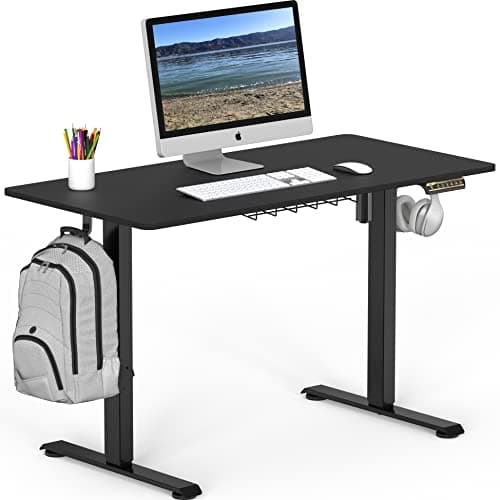
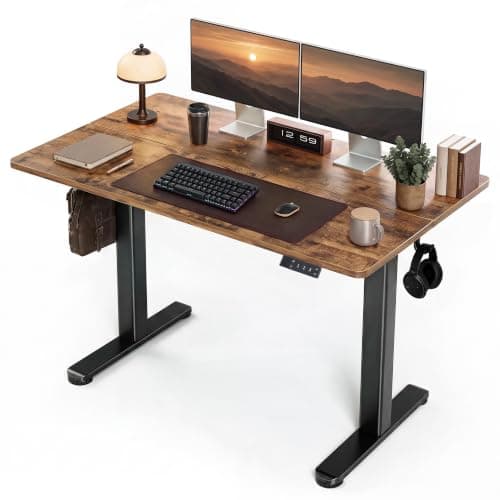
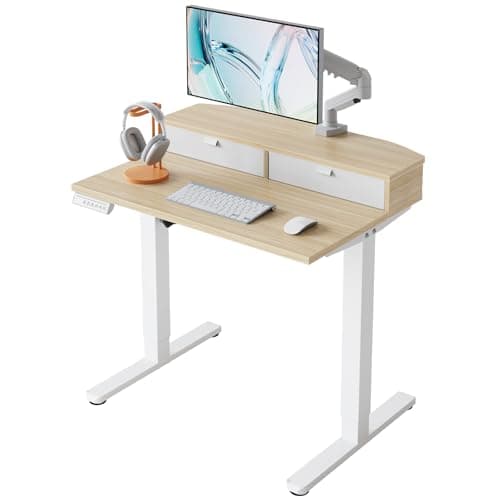
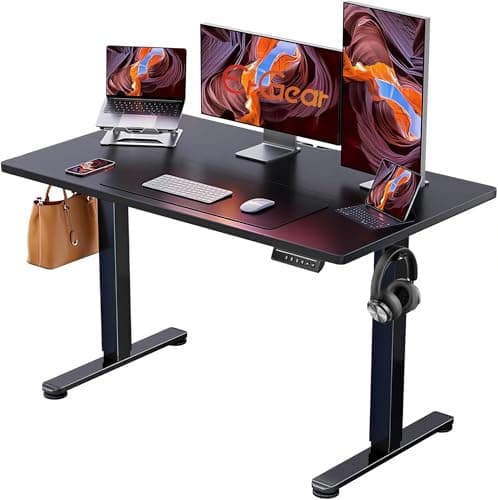
Buy the ErGear 48×24. It sits at the point on the curve where a small amount of extra money buys a noticeably better frame, and below it the savings start coming out of stability rather than features. If you already own a desk, buy the FlexiSpot EN1 frame instead and keep your top — that is the best-value option on this page and it is not close.
What actually gets cheaper
A standing desk has four costs: the frame steel, the motor and controller, the desktop, and the warranty behind all three. Budget desks save money on all four, but not equally, and the savings are not equally harmful.
- Safe to cut — the desktop finish. A cheap laminate looks and wears essentially like an expensive one for the first several years. This is where the marketing money goes and where your money should not.
- Safe-ish to cut — motor count.A single-motor desk is slower and less balanced, but if you are shorter than about 5'10" with a light setup, you will probably never care.
- Expensive to cut — frame steel. This is the one that turns into wobble, and wobble is what makes people stop raising the desk. A desk you stop raising has cost you everything you spent.
- Expensive to cut — warranty and support. Motors and controllers are the parts that fail. A two-year warranty from a brand with no support channel is functionally no warranty.
The frame-only route beats almost everything here
The single best budget move in this whole category is to buy a bare electric frame and bolt your existing desktop to it. You skip the cost of a new top entirely, you keep a surface you already like, and — the part nobody mentions — you avoid adding another slab of uncertified composite wood to the room. As we cover in formaldehyde in desks, the emissions question in a standing desk lives entirely in the top. A frame has no emissions story because a frame is steel.
It costs you an afternoon with a drill and a tape measure. If that is a real obstacle, buy a complete desk with a clear conscience; if it is not, this is the option to take.
What a budget desk should still have
There is a floor below which a cheap standing desk stops being a standing desk. Insist on all four of these regardless of price:
- Electric adjustment, not a crank. This is the one place we would spend before anything else — see electric vs manual for why. A crank desk gets raised less often, and frequency is the entire health argument.
- A published weight rating. Not because you will approach it, but because a brand that publishes one has thought about the frame.
- Memory presets if you can get them. A one-button desk gets used two or three times a day; a hold-the-button desk gets used until the novelty passes.
- An anti-collision or overload cutout. Cheap desks eat drawers, window sills and chair arms. The cutout is what stops that from becoming a dead motor.
Where budget desks are silent: materials
Every desk on this page is uncertified on emissions. Not "probably fine" — actually undocumented, because certification costs money that a desk at this price cannot carry. That is not a reason to avoid them; it is a reason to handle them correctly. Unbox the top somewhere ventilated, give it a week of airflow before you spend eight hours a day with your face over it, and understand what you have bought. Our off-gassing guide is the practical version of that.
If a documented low-emission surface is the priority and the budget is fixed, the honest answer is a cheap frame plus a solid-wood or bamboo top, not a cheap complete desk. It costs about the same and it removes the composite core from the equation entirely.
Total cost, not sticker price
A standing desk that saves you eighty dollars and lasts three years is more expensive than one that costs eighty more and lasts eight. That is obvious and everybody ignores it. The two costs that actually decide this are the frame warranty and the availability of replacement controllers — a dead keypad on a brand with no spares turns the whole desk into scrap, which is a much bigger loss than the original saving.
Budget for the mat, too. A cheap desk on a hard floor with no mat is a desk you will stand at for four days. The mat roundup has options that cost a fraction of the desk and change whether you use it.
How to buy a cheap standing desk without regretting it
Set the floor at electric
Powered adjustment is the feature that changes behavior. Everything else on a budget desk is negotiable; this is not.
Check whether the frame or the top is the bargain
A cheap desk with a decent frame and a plain top is a good buy. A cheap desk with a pretty top on a thin frame is not. Photographs sell the top; the frame decides whether you keep using it.
Read the warranty on the motor, not the desk
"Five-year warranty" often means five years on the frame and one or two on the electronics. The electronics are what fail.
Buy the smallest top that fits your work
Width amplifies wobble. On a budget frame a 48-inch top will feel steadier than a 60-inch one, and it costs less.
Do the frame-only math
Price a bare frame plus keeping your current top against a complete desk. The frame route is usually cheaper, always steadier for the money, and it is the only budget path that also improves the materials story.
Budget for the two accessories that decide whether you use it
A mat and a cable tray. Together they cost a fraction of the desk and they remove the two most common reasons a standing desk quietly becomes a sitting desk.