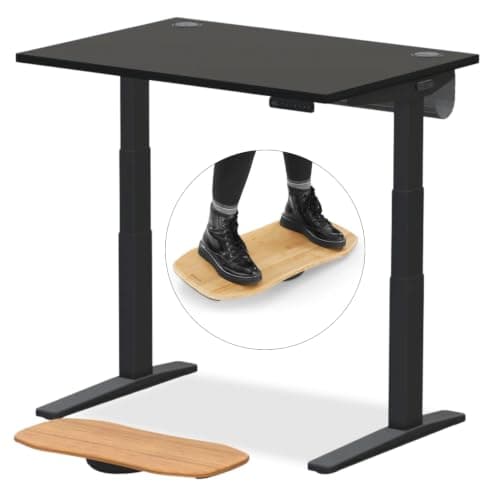
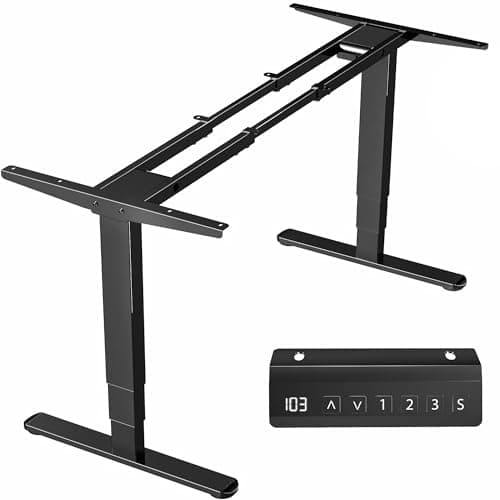
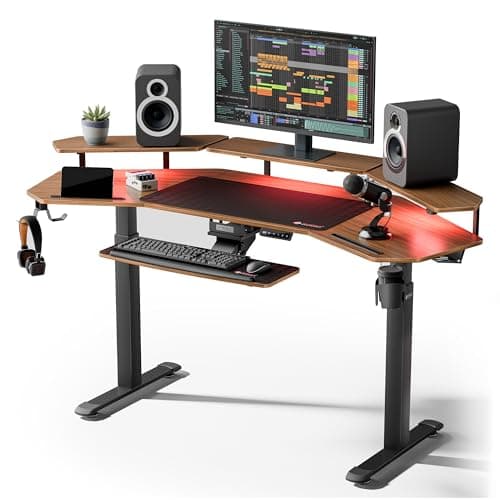
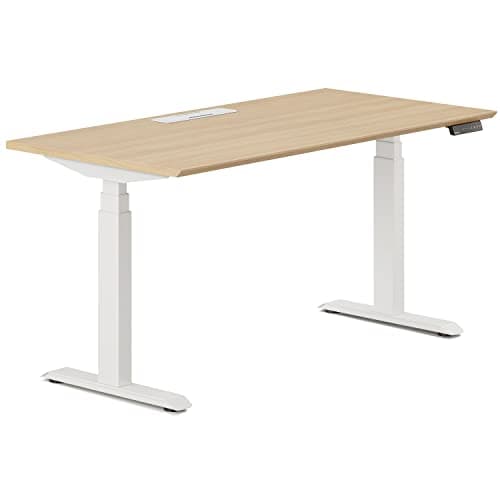
Buy dual motor if your desk is wider than about 48 inches, carries two monitors, or you intend to raise and lower it several times a day — which is the entire point of owning one. The honest shortcut: ignore the motor count and read the published load rating and travel range, because those are the figures that tell you what the base can actually do. The Branch 48×30 is the pick here on exactly that basis: Branch publishes a 26 to 52 inch range on a 3-stage dual-motor lift, which is the widest travel of any desk we rank. A single motor is not a defect. It is a cheaper desk that moves slower and flexes sooner, and for a light 40-inch top it is often the right purchase.
What a second motor physically changes
A single-motor desk has one motor driving both legs through a crossbar or a drive shaft. A dual-motor desk has a motor in each leg, synchronized by the controller. Four consequences, in the order they matter:
- Load. Two motors share the work, so the published capacity goes up. That matters less for the weight of your monitors than for the margin — a base running near its limit is the one that stalls and drifts out of sync.
- Speed. Dual-motor bases travel faster. Sounds like a luxury; it is actually the adoption feature. A desk that takes 30 seconds to rise gets raised less often than one that takes 12, and a desk that never rises is a fixed desk.
- Racking.On a long top, one motor pulling through a crossbar lets one end lead the other very slightly, which shows up as side-to-side movement at full height. Two motors each driving their own column is stiffer. VIVO states this directly on its own dual-motor frame: "dual motors keep a long, heavy top level instead of racking at one end."
- Noise. Two motors are not automatically louder — the quiet figures published in this category are mostly on dual-motor bases. Where a number exists, it is usually stated as under 50 dB.
What a second motor does not fix is wobble at the top of the travel, which is mostly a function of leg stage count, frame geometry and how the top is fastened. If your existing desk shakes, read how to fix standing desk wobble before you buy anything.
The spec that actually decides it: 2-stage vs 3-stage legs
This is the under-discussed half of the question, and it is bound up with the motor count because the premium bases tend to have both. A leg "stage" is a telescoping segment. A 2-stage leg has two; a 3-stage leg has three.
More stages means more travel from the same collapsed height — which is why 3-stage bases reach both lower minimums and higher maximums. Compare what the makers publish:
| Desk or frame | Motors | Stages | Published travel / span | Published load |
|---|
| Branch Standing Desk 48×30 | Dual | 3-stage | Branch states 26-52 in | Branch rates 275 lb |
| UPLIFT V3 laminate 42×30 | Dual | 3-stage | UPLIFT states 22.6-48.7 in | UPLIFT rates 355 lb |
| FlexiSpot E6 | Dual | 3-stage | Not published for this SKU | FlexiSpot rates 220 lb |
| VIVO dual-motor frame | Dual | 3-stage | VIVO states 40-85 in tops | Not published |
| VIVO single-motor frame | Single | Not published | VIVO states 41-74 in tops | Not published |
| EUREKA 72 in studio desk | Dual | Not published | Not published | Not published |
Two things fall out of that table. First, the desks with the widest travel are all dual-motor 3-stage bases — a 22.6-inch minimum or a 52-inch maximum is not available on a budget single-motor frame. Second, the budget end mostly publishes nothing. "Dual motor" on a listing with no load rating and no travel range is a marketing word, not a spec, and this is the single most common pattern in the category.
When a single motor is the correct buy
We rank a single-motor VIVO frame on this site deliberately, and the reason is instructive: it is the cheapest honest route to a desk with no composite panel at all, because it pairs with a solid wood top you buy separately. For a 41 to 74-inch top, one laptop and one monitor, it does the job. Its own trade-offs are stated plainly by VIVO and by us — slower travel, more flex than a dual-motor base, and a lower load ceiling.
Buy single motor when all of these are true:
- The top is under about 48 inches and light — no 1.5-inch butcher block, no three monitors.
- You raise and lower it once or twice a day, not every half hour.
- The desk is against a wall, which absorbs most of the front-to-back movement.
- The price difference is the difference between buying a sit-stand desk and not buying one.
That last one matters more than any spec. The health argument for a sit-stand desk — the reason Dick and Waters' review names sit-stand workstations among the interventions with supporting evidence — comes from alternating posture, not from motor count. A cheap desk you actually raise beats an expensive desk you cannot afford.
Where none of this is certified
BIFMA publishes ANSI/BIFMA X5.5, the performance standard for desk and table products including height-adjustable bases. Almost nothing in the consumer tier carries a verifiable X5.5 certificate, and every load and travel figure on this page is a manufacturer statement rather than a third-party test result. We mark them as such because the distinction is the whole point: a published number you can hold a brand to beats an unpublished one, and neither is a lab report. The same applies to emissions — the frame is powder-coated steel and emits nothing, so on a frame-plus-top build the materials question moves entirely to the top, verified at UL SPOT.
Reading a base spec in four steps
1. Find the published load rating
If there is no number, treat the base as unrated. If there is, add up your top, monitors, arm and peripherals and leave real headroom — the figures in this category are maker statements, not third-party tests.
2. Find the travel range, both ends
Minimum height decides whether the desk works sitting; maximum decides whether it works standing. A 3-stage base is how you get both.
3. Count the stages, not just the motors
"Dual motor" with 2-stage legs has less travel than "dual motor" with 3-stage legs, at a similar price. The stage count is on the spec sheet of every brand that publishes one.
4. Decide what the top weighs before you choose
A laminate top and a 1.5-inch solid slab are different machines to lift. If you are fitting your own solid top, buy dual motor and do not argue with yourself about it.