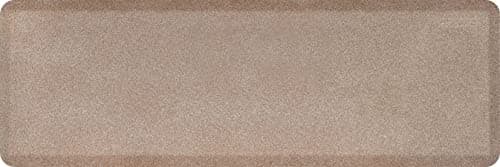
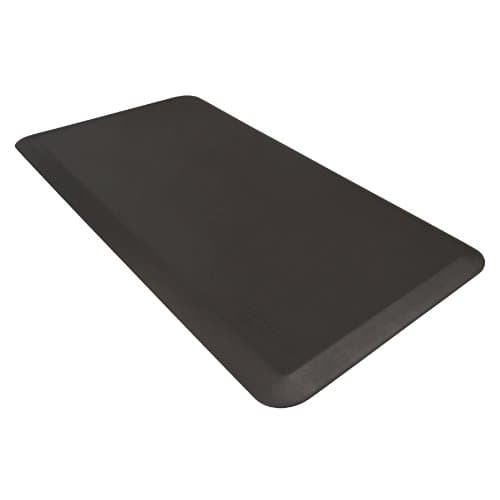
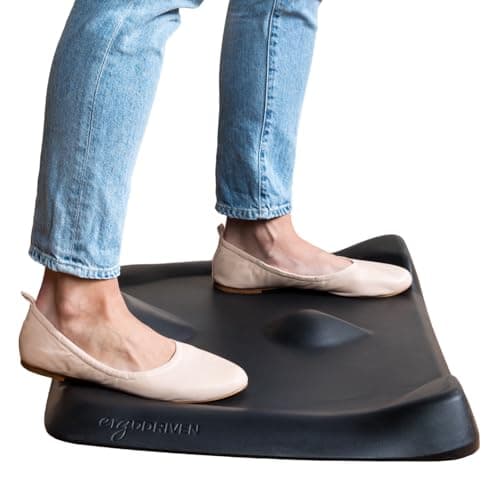
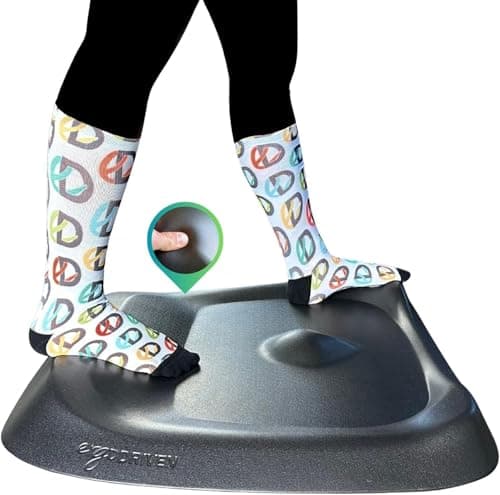
Buy the full-size Topo. For a sore lower back the property that matters is not softness but movement — a surface that keeps prompting small weight shifts stops the static loading that makes standing hurt. The Topo's sculpted terrain is the only design here built around that idea rather than around cushion depth. If you want the same principle in a firmer, longer-lasting material, the WellnessMats polyurethane slab is the alternative.
Why standing hurts your back in the first place
Standing still is a static posture, and static postures are the problem. Held long enough without movement, your pelvis drifts forward, your lumbar curve deepens, your knees lock and the small stabilizing muscles that should be sharing the load switch off. The ache that follows is not caused by standing; it is caused by not moving while standing. That is why the honest advice is always to alternate — the evidence behind that is in our does a standing desk help back pain guide.
A mat cannot fix your desk height, your monitor height or your habit of standing for three straight hours. What it can do is remove the hard-floor discomfort that makes you lock up, and — with the right surface — actively invite the weight shifts that keep your hips and spine from setting like concrete.
Firm beats soft, and it is not close
The intuition that a sore back wants a plush mat is understandable and wrong. A deep, soft foam mat lets your feet sink, which means your ankles, knees and hips spend the whole day making micro-corrections against an unstable surface. Some people find that tiring rather than relieving, and it is a common reason a mat gets bought and abandoned. It also encourages you to stand still, because shifting on a squishy surface feels unstable.
A firm mat with real rebound does the opposite: it takes the sharp edge off a hard floor while still giving your feet something solid to push against. Every mat that ranks well on this page is on the firm end, and the softest one — the plush GelPro Eco-Pro — is here for people whose problem is heel and foot pain rather than lumbar ache.
The three properties we ranked on
- Encouraged movement. Does the surface make you shift? Sculpted terrain does this by design; a flat mat does not. This is the property most strongly linked to standing comfort over hours.
- Firmness with rebound. Support without sink. Dense polyurethane holds up; open gel and cheap memory foam bottom out within months and become a flat sheet.
- Edge bevel. The unglamorous one. A thick mat with square edges is a trip hazard exactly where you step off it, and catching a toe is a much more immediate back problem than any of this.
The mat is one of four things, and the other three matter more
We would rather sell you less than let you buy a mat and expect it to fix a workstation problem. If standing hurts your back, work through this order:
- Desk height. A desk an inch too high makes you shrug and arch. Get your number from the height calculator, not by eye.
- Monitor height. A low screen pulls your head forward, and a forward head loads everything below it. This is what a monitor arm is for.
- Duration. Standing for four unbroken hours will hurt on any mat. See how long to stand per day.
- Then the mat. Which is where you are, and it does help — it is just fourth.
What about the materials question?
A mat is a slab of foam you stand on barefoot in a warm room, so the material question belongs here as much as anywhere. The short version: polyurethane is the lower-concern class and PVC is the one worth avoiding, and PFAS can hide in coated or stain-resistant surfaces. WellnessMats publishes the most specific exclusion list in the category, and Ergodriven states the Topo is PVC-free. Everything else here is undocumented, and we say so on each card. The full mechanism is in PFAS and PVC in anti-fatigue mats, and the material-first ranking is at best non-toxic anti-fatigue mats.
A note on what this page is not
None of this is medical advice, and a mat is not a treatment. Persistent or severe back pain — and anything with numbness, radiating leg pain or a known disc problem — is a conversation with a clinician, not a shopping decision. What we can say honestly is that a firm, movement-friendly surface makes standing sustainable for most people, and sustainable standing is what the evidence actually supports.
How to choose a mat when your back is the problem
Choose firm, not thick
Thickness is the number on the box; density is the property that matters. A dense three-quarter inch mat outperforms a soft one-inch mat for lumbar comfort every time.
Choose contoured over flat if you can live with it
Sculpted mats are divisive because they are not a neutral surface — that is the point. If the terrain suits you, it does more for a sore back than any amount of extra foam.
Match the size to your actual standing area
A mat you keep stepping off is a mat you stop using. Measure the patch of floor where you stand, and buy a mat that covers it plus a step in each direction.
Check the bevel
Square edges on a thick mat are a genuine trip hazard, and on carpet they curl. Beveled edges on all four sides, every time.
Buy the grip you need for your floor
On tile or laminate, a mat that slides is worse than no mat. On carpet, grip does not matter and you should not pay for it.
Give a new mat a few days of air
Almost no mat here publishes an emissions certificate, and new foam can carry an odor. Unwrap it somewhere ventilated before it lives under your feet all day.