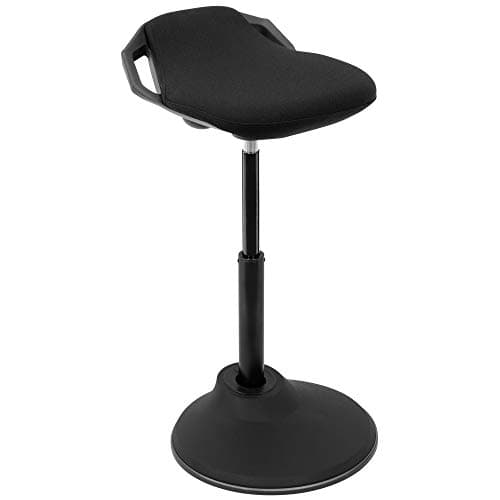
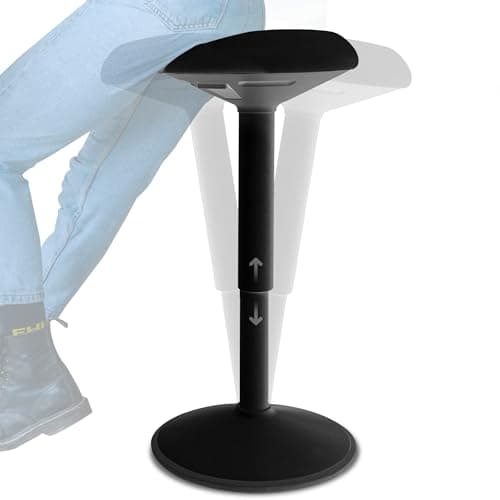
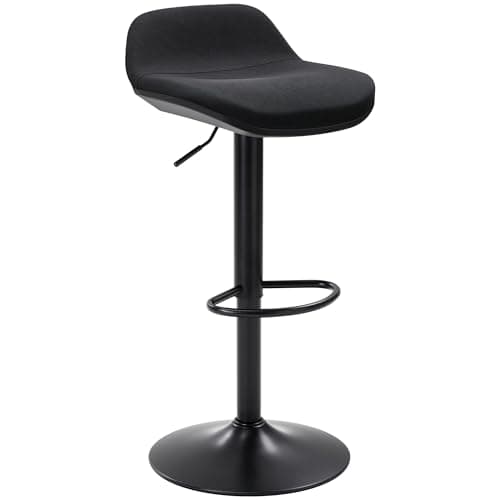
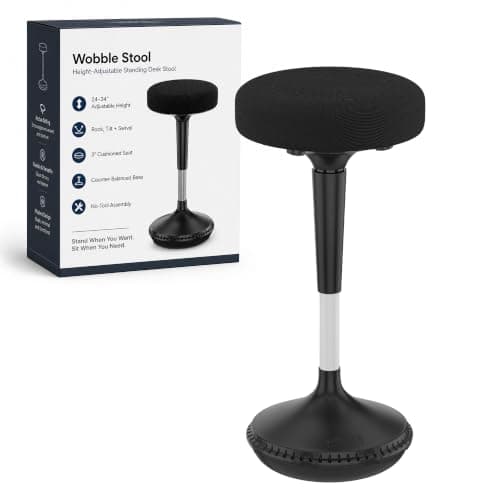
Buy the Uncaged Ergonomics wobble stool. It has the height range to reach a genuine standing desk, a tilt that keeps your core involved without dumping you off the seat, and it comes from a company that only makes this kind of thing. If you need back support, the Newtral standing chair is the pick — it is the only seat here with a real backrest.
The third position, and why it matters
Sit-stand advice is usually framed as a binary, but a working day has three useful postures, not two: seated, standing, and perched. Perching — half-sitting on a high seat with your feet still taking some weight and your hips open — is the position that lets you keep working when your legs have had enough of standing but you do not want to drop the desk and lose ten minutes of momentum.
That is the actual argument for a standing-desk stool. It is not that active sitting builds core strength — the evidence for that is thin and we are not going to sell it to you. It is that a third position lowers the friction of changing posture, and changing posture often is the thing the evidence actually supports.
Four different products get called "standing desk stool"
- Wobble stools. A domed or gimbaled base that tilts in every direction. Keeps you moving; no back support at all.
- Leaning perches. An angled seat on a fixed or lightly tilting post. You lean rather than sit, weight shared with your feet. Closest to true perching.
- Saddle stools. A split, horse-saddle seat that opens the hip angle dramatically. Loved by dentists and hygienists; divisive elsewhere, and cheap ones are uncomfortable.
- Standing-desk chairs. A tall chair with an actual backrest and often a footring. Heavier, pricier, and the only category that supports your lumbar spine.
These are not interchangeable. Buying a wobble stool when what you needed was a supported chair is the most common mistake in this category, and it usually ends with an expensive stool in a cupboard.
Height range is the spec that decides it
A stool has to reach your desk at standing height. If your standing desk sits at 44 inches, a stool topping out at 28 inches leaves you looking up at your keyboard — which is worse for your neck than either sitting or standing. Get your desk's standing height from the height calculator, subtract roughly 10 to 12 inches for a perch, and check that number against the stool's published range before anything else.
This is the single most common reason a standing-desk stool disappoints, and it is entirely avoidable with two minutes of arithmetic.
A footring matters more than the seat
Perching without somewhere to put your feet quietly transfers load onto them, which defeats the point. Any seat above about 26 inches needs either a footring or a footrest — and if the stool does not have one, budget for a separate under-desk footrest. This is why the Newtral chair, which includes a ring, is the comfortable choice for long sessions even though it costs the most.
Who should not buy an active stool
If you have an existing lower-back problem, a backless stool asks your spine to hold itself upright for hours, which is exactly the demand an irritated back cannot meet. That is not a reason to sit badly in a bad chair — it is a reason to buy a properly supported ergonomic chair and use the standing desk for the variety. Our chairs for back pain roundup is the right page for that, and lumbar support cushions are the cheap interim fix.
Materials and certification, honestly
Almost nothing in this category publishes a certificate. These are foam-and-fabric seats on steel bases, sold largely by brands with no certification program at all — so unlike the desk and mat categories, there is no documented low-emission option to point you at. We say so on each card rather than implying otherwise. If certification is your deciding factor across the whole workstation, the seating page to read is non-toxic office chairs, where the certified options actually exist.
How to use one without wasting it
Set the stool at perch height, not sit height — you should feel your feet still carrying real weight. Keep the desk at its standing height and leave it there; the point of a stool is that you stop moving the desk. And treat it as a third position rather than a chair: twenty minutes perched between a standing stint and a proper seated break is the pattern that works.
There is one other reason people end up on a backless stool, and it is worth naming: no armrests and nothing to fold a knee around makes a stool the easiest seat in the house to sit on cross-legged. If that is why you are here, the task-chair options that allow the same position are in office chairs for sitting cross-legged.
How to buy a standing-desk stool
Do the height math first
Standing desk height minus 10 to 12 inches is roughly your perch height. Check that number against the stool's published range before you look at anything else.
Decide whether you need a back
No back means active sitting. If you have back trouble, or if you plan to spend more than about half an hour at a time on it, buy a seat with a backrest instead.
Insist on a footring or plan a footrest
Feet dangling from a perch is how a stool ends up unused. Either the stool provides the ring or you buy a footrest.
Check the base diameter against your floor
Wobble stools need a base wide enough to feel safe and, on hard floors, enough grip not to walk away from you. On carpet, check the base is not so grippy that tilting becomes a fight.
Sit on it for a week before you judge it
Active seats are genuinely uncomfortable for the first few days because muscles that were doing nothing start doing something. Give it a week before deciding; if it still hurts after that, it is the wrong seat.