OEKO-TEX STANDARD 100 certifies what is in a textile. GREENGUARD certifies what comes out of a finished product into the air. If you are buying an office chair, a desk or a mat, the certificate that answers your question is almost always the emissions one — and if you are buying a fabric, a cushion cover or children's bedding, it is OEKO-TEX. They are not ranked versions of each other, and a product can hold one and not the other without either brand hiding anything. The practical finding for this site: we have not found an office chair whose maker publishes an OEKO-TEX certificate, and we are not going to imply one exists.
What OEKO-TEX STANDARD 100 actually is
STANDARD 100 is a product label for textiles tested for harmful substances. OEKO-TEX's own description is specific: "Every item bearing the STANDARD 100 label is certified as having passed safety tests for the presence of harmful substances", tested against a list of over 1,000 harmful substances. The published limit-value documentation sets limits across substance groups including formaldehyde, heavy metals, pesticides, chlorinated phenols, phthalates, bisphenols, PAHs, PFAS, flame retardants and banned azo colorants, with the individual substances listed by CAS number in the annexes and the list reviewed annually.
Three features of the program matter when you are reading a label:
- It is tested at the component level. Every thread, button and accessory has to comply, not just the main fabric. That is why the label is a credible statement about a finished textile article rather than about one roll of cloth.
- There are four product classes, and they are not equally strict. Class I is articles for babies and small children up to three years; class II is products with direct skin contact; class III is products without direct skin contact; class IV is home textiles and decoration materials. The requirements get stricter as skin contact gets more intensive and the skin gets more sensitive. A class IV certificate and a class I certificate are both "OEKO-TEX certified" and they are not the same bar.
- Certificates are issued for one year. That is unusually short for a product certification, and it is a strength: an OEKO-TEX label should be current rather than historic. You check it by scanning the QR code on the label or entering the certificate number in OEKO-TEX's Label Check.
The thing to take from all of that: OEKO-TEX is a content certification. It is about what is present in the article you are about to put against your skin.
What GREENGUARD does instead
GREENGUARD runs the other test. A finished product goes into a controlled chamber, the air in that chamber is sampled, and the certificate says the product's emissions stayed under published limits. The furniture version of that method is ANSI/BIFMA M7.1 / X7.1, which descends from the CDPH Standard Method, and the same chamber approach sits behind SCS Indoor Advantage Gold.
So GREENGUARD is an emissions certification. It is about what leaves the product and ends up in the air of the room you work in. The two programs can disagree in both directions without either being wrong: a fabric can be OEKO-TEX certified and sit on a chair whose adhesives and composite panels have never been chamber tested, and a chair can hold GREENGUARD Gold with upholstery that has never been screened for azo colorants.
The four certificates on an office chair, side by side
| Certificate | What it measures | What it covers on a chair | Where you verify it |
|---|
| OEKO-TEX STANDARD 100 | Substances present in the textile, against limit values | The fabric and its components, if the maker certified them | OEKO-TEX Label Check, by certificate number or QR code |
| GREENGUARD / GREENGUARD Gold | Emissions from the finished product in a chamber | The whole chair as assembled | UL SPOT |
| SCS Indoor Advantage Gold | The same chamber method, issued by a different certifier | The whole chair as assembled | SCS Certified Green Products Guide |
| CertiPUR-US | Flexible polyurethane foam content and emissions | The foam only, not the fabric or the frame | CertiPUR-US certified-products listing |
| ANSI/BIFMA X5.1 | Structural performance and durability | Strength and stability — nothing chemical at all | The certificate the maker publishes |
Read that table as a set of non-overlapping scopes rather than a ranking. The full version of it, product by product, is our certification matrix, and CertiPUR-US explained covers the foam row in detail.
Why OEKO-TEX barely appears on office furniture
The honest answer is market structure rather than conspiracy. OEKO-TEX grew up around apparel and home textiles, where the article is the fabric and the buyer's question is about skin contact. Office furniture is certified through the furniture programs instead, because a chair is an assembly of foam, plastic, steel, adhesive, finish and fabric, and the question workplace buyers ask is about the air in an open-plan office.
A few upholstery mills do hold OEKO-TEX certificates for their textiles, and a chair maker could in principle tell you that the seat fabric it buys is certified. We have not found one that does. So when you see "OEKO-TEX" next to a desk chair in a buying guide, the likely explanations are, in order: it is a mattress or bedding product miscategorized; the claim belongs to one component rather than the chair; or somebody copied a badge. Check the certificate number in Label Check — a one-year certificate with a verifiable number is easy to confirm, and that is the point of the system.
So what should you actually filter on?
If you are buying for a room you work in all day, filter on emissions and on construction:
- Buy the emissions certificate if there is one — GREENGUARD Gold or SCS Indoor Advantage Gold on the finished product, verified in the right registry. Our certified chairs page lists the few chairs where this is checkable.
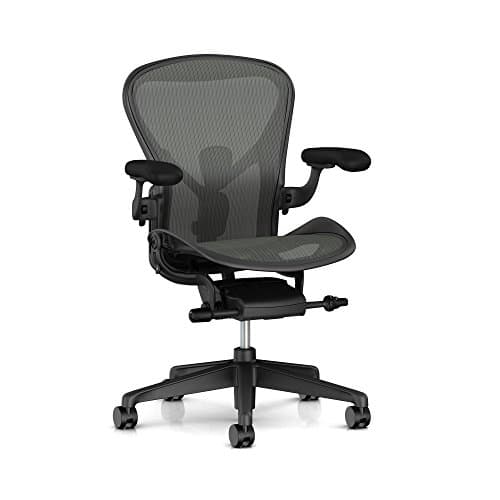
- Reduce the number of materials rather than certifying all of them. A suspension seat has no foam and no upholstery fabric, so the foam question and the textile question both disappear — that is the structural argument in mesh versus foam, and it is why the Aeron is the first pick below.
- Ventilate anything new. Free, effective, and it does more in the first week than any certificate does. The protocol is in the first 72 hours, and the symptom version is why your office chair smells.
- Use OEKO-TEX where it belongs. A seat cushion cover, a fabric chair slipcover, a desk pad in textile, a footrest cover — these are textiles, OEKO-TEX is the right certificate to look for, and the certificate number is verifiable in a minute.
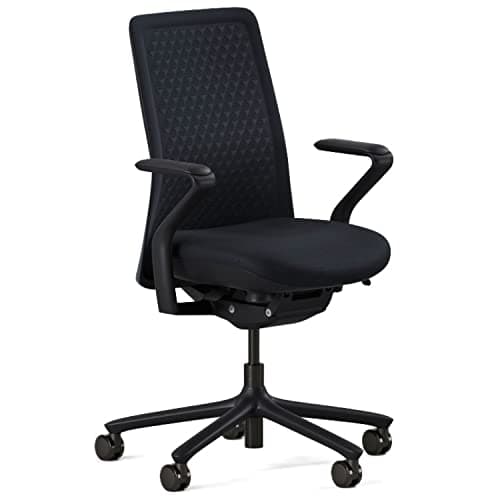
The two chairs below are what we would buy on this reasoning. Neither carries an OEKO-TEX certificate, because no chair we rank does. What each one has is stated in its own words on its card, and the reason they are here is that each removes or documents the material question in a different way: the Aeron by having no foam and no seat upholstery at all, the Branch Verve by being one of the chairs whose maker publishes GREENGUARD Gold for low VOC emissions on the product page.