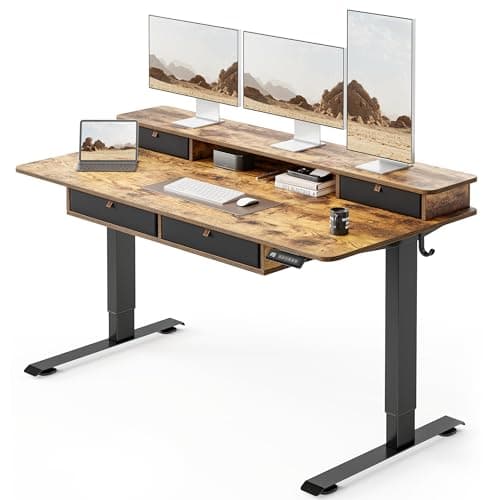
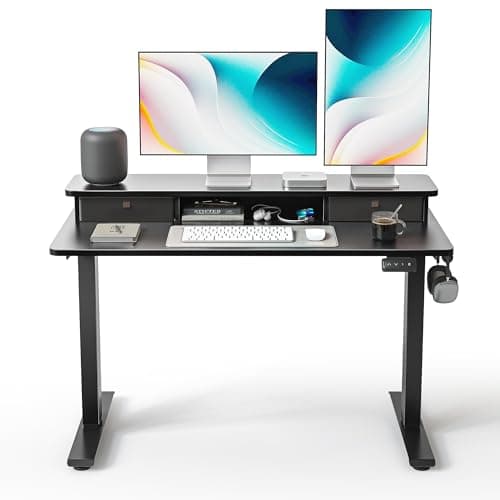
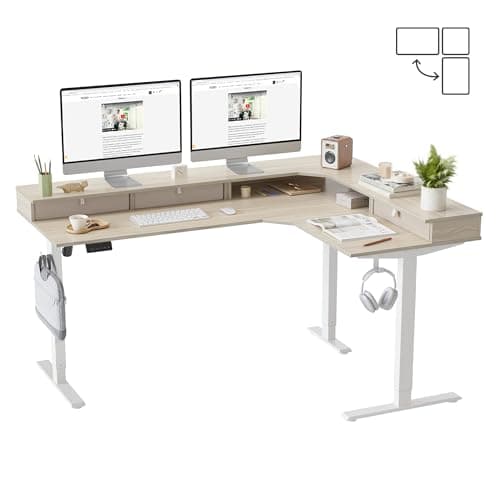
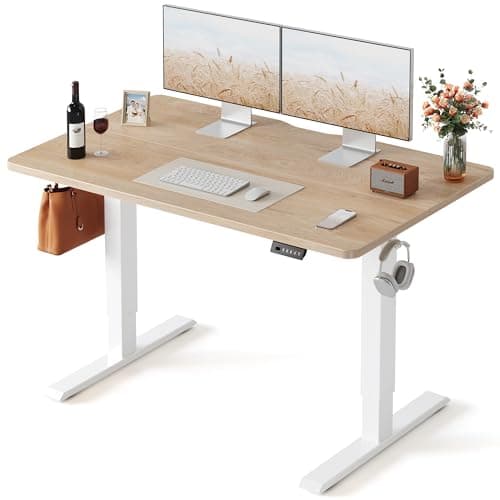
If you are buying a FEZIBO, buy the plain 48×24 with no drawers. It is the cheapest desk the brand sells, it is the one with the least composite panel in it, and every extra FEZIBO feature — drawer banks, monitor shelves, splice boards, an L-shaped return — adds more undocumented engineered wood to the room and more unsupported weight to a budget frame. That is the whole review in three lines, and if you have already decided that price wins, you can stop reading and go and buy it.
The longer answer is the one this site exists for. FEZIBO is a fine budget desk brand and a bad one to buy on trust, because trust needs something to attach to and FEZIBO publishes almost nothing you can check. Below is exactly what it does publish, exactly what it does not, and what the difference is worth.
What FEZIBO actually is
FEZIBO is a marketplace-first furniture brand: electric sit-stand desks, converters, chairs, balance mats and accessories, sold mostly through Amazon, Walmart and Wayfair alongside its own store. Its desks sit at the bottom of the electric price band — well under what a FlexiSpot costs, and a fraction of an UPLIFT or a Vari — and the range is built on variants rather than models: the same basic frame under a 40, 48, 55, 60 or 71-inch top, in a dozen wood-look finishes, with or without drawers, in straight or L-shaped layouts.
That is not a criticism. The volume brands in this category compete on configurations, and FEZIBO is good at it — if you want a specific size in a specific finish with a specific storage arrangement, FEZIBO probably makes it and the cheaper brands probably do not. It is also why a "FEZIBO review" is really a brand review: there is no single flagship model, there is a catalog.
What FEZIBO publishes — and it is more than you expect
Two things genuinely count in FEZIBO's favor, and both are unusual at this price.
The warranty is not a token.FEZIBO's published warranty policy gives electric standing desks two years on the motor and electronics — controller, power adapter, cords — and five years on the rest of the desk. Converters get two years on frame, MDF top and mechanism; mats get one year; shelving, storage and other tables get one. It is non-transferable, and it explicitly covers purchases made through authorized third-party channels including Amazon, Walmart and Wayfair, which matters because plenty of budget-brand warranties quietly evaporate the moment you buy anywhere but the brand's own site.
The listings state real numbers.On the models where FEZIBO does publish specs — the drawer desks especially — you get a height range, a load rating, a noise figure and an anti-collision claim rather than adjectives. Our entry for the double-drawer 48-inch model quotes FEZIBO's own 27.36 to 46.06 inches of travel, its under-50 dB figure and its 176 lb rating, because FEZIBO printed them. Plenty of brands in this band print nothing at all.
Five years of structural coverage and a stated load rating is a reasonable deal for a desk that costs less than a decent office chair. Judged as a budget desk, FEZIBO earns its sales.
What FEZIBO does not publish
Now the part that decides where it ranks here. Across the FEZIBO desks we track, there is:
- No GREENGUARD certificate. Not Gold, not standard, not for any desktop line. Nothing appears under the brand in a form you can look up.
- No third-party BIFMA certification mark for the desks.FEZIBO's ergonomic chair listings carry BIFMA wording; its sit-stand desks, as far as we can find, do not — and a chair's test result says nothing about a desk frame.
- No per-model spec sheet on FEZIBO's own site.This one surprised us. We opened FEZIBO's desk product pages looking for a height range, a load figure, a motor count and a desktop thickness, and found configuration options, shipping terms, a 60-day return window and the warranty — but no specification table. The numbers live on the marketplace listings, written by the storefront, not on the brand's own domain.
That last point is the tell. When a number exists only on a marketplace listing and nowhere on the maker's site, there is no document behind it to check and no one to hold to it later.
The CARB and EPA sentence, translated
FEZIBO does make a materials claim, and it deserves to be quoted rather than caricatured. In its own published desk-materials guide, FEZIBO says its bamboo desks are "FSC-certified, ensuring responsible sourcing", and describes "E0-grade particle boards that use formaldehyde-free adhesives" which meet "strict environmental standards like CARB and EPA guidelines".
Read carefully, that sentence is doing less work than it looks like it is doing.
- CARB and EPA compliance is the legal floor, not a feature.The federal TSCA Title VI rule — built on California's CARB Phase 2 program — sets formaldehyde emission limits that every composite wood product sold in the United States must already meet. Saying a desk complies is saying it is legal to sell. Our formaldehyde in desks explainer covers what those limits actually cap and why the floor is genuinely useful — but a floor everyone stands on is not a reason to pick one brand over another.
- "E0-grade" is a real grade with no registry behind it. E0 is a stricter panel emission class than E1, so the claim is meaningful in principle. In practice FEZIBO names no testing body, no certificate number and no panel supplier, and there is no public registry where you can enter a FEZIBO model and see the grade confirmed. Compare that with UPLIFT, which publishes a document naming the test standards behind its laminate line, or Vari, which publishes certification per SKU.
- FSC is a forestry claim, not an air-quality one. FSC certification is about where the wood came from and how the forest is managed. It is a good thing and it is not evidence about what the finished panel emits into your room.
So FEZIBO's materials position is a marketing-page statement rather than a certificate. That does not make the desks unsafe — the overwhelming majority of desks sold in this country are uncertified and unremarkable — and it does not make FEZIBO dishonest. It means there is nothing to verify, which is a different problem, and the one that matters if you came to this site because a certificate is what you are shopping for.
The bamboo we could not buy
FEZIBO's strongest materials story is its bamboo line — a solid, rapidly renewable surface with no adhesive-bound composite core, which is the same argument that puts the UPLIFT V3 bamboo on our non-toxic list. When we searched Amazon for a bamboo FEZIBO desk on 29 August 2026, every live listing that came back was laminate over engineered wood. We do not rank products we cannot confirm are buyable, so the bamboo is not among the picks below. If you find one live, it is the FEZIBO we would buy on materials — just understand that FSC-certified bamboo is a sourcing claim, not an emissions certificate, and that a bamboo top usually costs enough to put you within reach of a documented desk instead.
Which FEZIBO to buy
Rank them by how much undocumented panel you are bringing into the room and how much weight you are hanging off a budget frame, and the order writes itself.
The plain 48×24 winsbecause it is the least of everything: the smallest top, no drawer boxes, no monitor shelf, no seam. It still gives you three memory presets, which is the single feature that decides whether a sit-stand desk gets used or gets parked at one height and becomes an expensive table. As a first standing desk — the "do I even like this?" purchase — it is hard to argue with.
The 60×30 with drawers is the one to buy if this is your main desk and you want the storage to travel with it. Sixty by thirty inches is the size where two monitors and a keyboard stop fighting, and our two-monitor desk page has the depth numbers that decide it. It is also the largest uncertified composite surface of any desk we rank, which is exactly the case where the break-in below stops being optional.
The 48×24 double drawer is the cheapest way to get storage that moves with the desk, and it is the FEZIBO with the most published numbers behind it. The trade is a single-motor lift and the lowest load ceiling in the range, which the drawers start spending before your monitors do.
The 63×48 L-shape with drawers is last here and would be last anywhere on this site, because it is the maximum amount of undocumented engineered wood FEZIBO will sell you in one purchase. Buy it if the corner layout is the requirement; see our L-shaped desk roundup for what else the shape costs you in stability.
How to buy a FEZIBO without pretending
There is an honest way to own an uncertified desk, and it is not complicated. Unbox and assemble the desk somewhere ventilated — a garage, a porch, a spare room with the window open — and give it two to three days before it enters the room you work in. Emissions from a new composite panel are front-loaded; the first days account for a disproportionate share of the total, and the first 72 hours of airflow are free.
Then stop worrying about it. A ventilated break-in on a legally compliant panel puts you in a genuinely reasonable place. What it does not do is turn the desk into a certified one, and any page that tells you a budget laminate desk is "non-toxic" because the brand used the word eco is selling you something. Our non-toxic standing desk roundup is the list of desks that can actually back the claim.
Where FEZIBO costs you
The predictable places. Budget frames are steadiest at seated height and least steady at full standing height, which is where a laptop bounce becomes noticeable — if that is your experience already, our wobble fix guideis the cheap answer before a new desk is. Load ratings in this band are modest, and a drawer bank eats into the rating before your equipment does. Assembly on the larger tops is genuinely a two-person job. And the range's biggest tops are also its biggest composite panels, which is the one trade this site will always flag.
The other cost is the one you cannot see: no document, no registry entry, no third-party mark. You are buying on photographs, review counts and a five-year structural warranty. Sometimes that is exactly the right trade. It should be a decision, not an accident.
The brand FEZIBO is actually shopped against is FlexiSpot, not UPLIFT, and the difference there is disclosure rather than price: FlexiSpot publishes a spec table and a load rating on its own site, FEZIBO publishes neither. The direct comparison is FEZIBO vs FlexiSpot.
How it compares to the desks we rank higher
Against the best standing desks overall, FEZIBO is a tier below on hardware. The FlexiSpot E6 costs meaningfully more and buys you dual motors and 3-stage legs, which is the difference you feel at full height rather than on a spec sheet — our FlexiSpot E6 review is also clear that FlexiSpot publishes no emissions certificate either, so that upgrade buys stability, not paperwork.
Against the documented brands, it is not a contest and it is not meant to be. UPLIFT publishes a GREENGUARD Gold document for its laminate desktop line; Vari publishes certification per SKU. Both cost several times what a FEZIBO costs, and our brands ranked by what they publish page is the head-to-head. If a certificate is your deciding factor, the honest advice is to skip this entire price band rather than to hunt for the best-documented cheap desk, because there is not one.
And if what you actually want is a surface with nothing engineered into it, the cheapest route is not a FEZIBO at all — it is a bare frame under a solid wood top, which removes the composite question entirely and often lands close to a mid-range FEZIBO on price.
Who should buy one, plainly
Buy a FEZIBO if you want to find out whether a sit-stand desk changes your working day without spending several hundred dollars finding out; if you need a specific size, finish or storage layout the better brands do not make; or if you are furnishing a second desk where the material question is not the one keeping you up. Take the plain 48×24 unless storage is a requirement, ventilate it properly, and you have made a sensible purchase.
Do not buy a FEZIBO if a checkable certificate is your first filter, if you run a heavy multi-monitor setup that wants a high load rating and a rigid frame, or if you are buying because a listing used the word eco-friendly. Nothing in the range carries a document, and no amount of shopping within the brand will find you one.