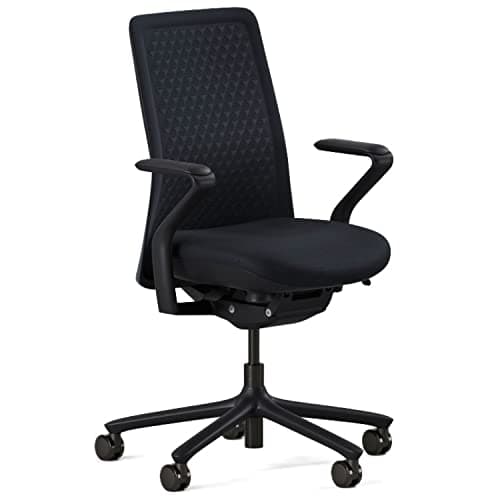
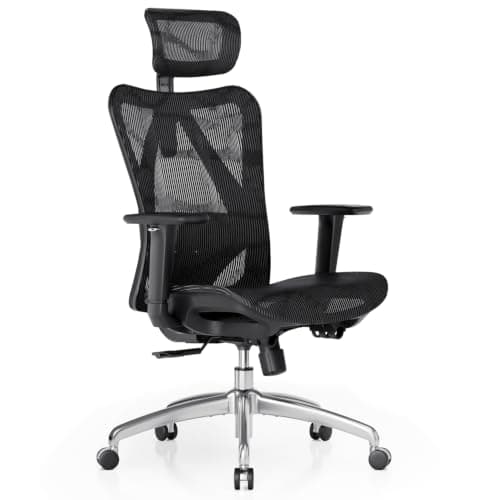
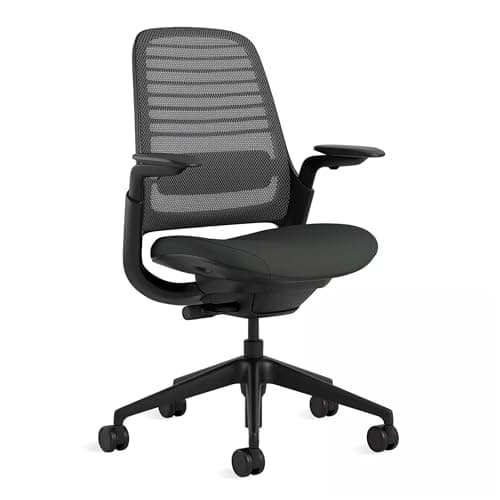
A chair built and warranted to commercial standards lasts seven to twelve years in a home office; the cheapest tier lasts two to three. The figure to buy on is the published warranty, because it is the only durability number a brand will commit to in writing — Steelcase publishes 12 years on the Series 1, Branch publishes 7 on the Verve and 5 on the Daily, and most budget chairs publish 1 or nothing. Divide the price by the warranty years before you decide anything. What fails first is almost never the part people worry about.
What the durability standard actually simulates
ANSI/BIFMA X5.1 is the North American performance standard for general-purpose office chairs. It is a voluntary standard, and it is a set of mechanical abuse tests rather than a lifespan prediction — but the parameters tell you what "built to last" is supposed to mean. CORSAIR's own standards explainer, written for its chair buyers, describes X5.1 as covering strength, durability, stability and safety across eleven tests and over one million cycles of overall testing, including 270 lb placed on the chair and swiveled 120,000 times, and 240 lb loaded onto the seat and tilted back and forth 300,000 times.
The published test list runs through the components in turn: back strength, drop, swivel, tilt mechanism, seating durability, stability, arm strength, backrest durability, caster durability, leg strength and footrest. If you sit down and stand up thirty times a working day, 300,000 tilt cycles is a very long time — which is why a chair that passes is a chair whose mechanism is unlikely to be what ends its life.
Steelcase is the clearest example of a brand that publishes the paperwork: a dated compliance certificate covering Series 1 seating to ANSI/BIFMA X5.1 and X5.11 at 400 lb, plus a 12-year warranty and an SCS Indoor Advantage Gold emissions certificate. Most chairs on Amazon publish none of those three documents, and we say so on each row rather than inferring quality from a price.
What actually fails, in the order it happens
| Component | Typical first failure | Repairable? |
|---|
| Seat foam | Compresses and stops recovering — the chair "goes flat" years before anything breaks | Partly: a dense cushion buys time; re-foaming rarely makes sense |
| Gas cylinder | Loses its seal and the seat sinks under load | Yes — a cylinder is a cheap, standard-size replacement part |
| Casters | Wheels pick up hair and grit, then flat-spot or seize | Yes — casters are a universal 11 mm stem on most chairs |
| Armrest pads | Surface wears through where forearms rest | Sometimes, if the brand sells pads |
| Mesh back | Loses tension or tears at the frame edge | Rarely — usually ends the chair |
| Seat plate / base welds | Structural failure, which is the dangerous one | No — stop using the chair |
That last row is not hypothetical. CPSC has recalled office chairs for exactly that failure mode: a 2025 recall of WorkPro chairs where the bolts connecting the back of the chair to its base can fail, and a 2012 recall of desk chairs where the weld connecting the seat plate to the gas lift can fail. A chair that creaks under load in a new way is telling you something — and the one failure that is normal, common and fixable is the sinking gas cylinder, which we cover in detail in why your chair keeps sinking.
The warranty-per-dollar math
This is the calculation that reframes the whole category. Take the published warranty term as a proxy for design life — it is the brand's own number, and the brand pays if it is wrong — and divide the price by it.
| Chair | Published warranty | Published capacity | Published durability / emissions documents |
|---|
| Steelcase Series 1 | 12 years, multi-shift | Steelcase rates 400 lb | Dated X5.1 and X5.11 certificate; BIFMA LEVEL 3; SCS Indoor Advantage Gold; EPD |
| Branch Verve | 7 years | Branch rates 275 lb | "Meets the BIFMA standard" and "Certified Greenguard Gold", no certificate number published |
| Branch Daily | 5 years, parts and components | Branch rates 225 lb | GREENGUARD Gold wording, no BIFMA line at all |
| SIHOO M57 | Short — check the current listing term | Not published for this model | None published |
A chair at four times the price with six times the warranty is, on the brand's own numbers, the cheaper chair per year — and it comes with a capacity figure and an emissions certificate the budget tier does not publish. That is not an argument for always buying the expensive chair: it is an argument for doing the division before you decide, and for treating an absent warranty as a real number rather than a blank.
One caveat we will not skip. A warranty is only worth the path to claiming it. Branch's own warranty page names Amazon as an authorized third party, which is why we rank Branch chairs sold by Branch itself; the Herman Miller listings sold by third-party sellers come with a 12-year term that depends on that seller being authorized, and we flag that on the row. Buy from the brand or an authorized seller or the number on the page is decoration.
How to make the chair you own last longer
- Clean the casters twice a year. Hair and grit wrapped around a wheel axle is the most common reason a chair rolls badly, and it is five minutes with tweezers.
- Check the bolts annually. Seat-plate and base bolts work loose with thousands of sit-downs. A creak that is new is a bolt, until proven otherwise — and if it is not, the motion that triggers it tells you which part it is. That is the whole method in why your office chair squeaks.
- Replace the cylinder, not the chair. A sinking seat is a $25 part on a standard taper. It is the single most wasteful reason chairs get thrown out.
- Do not store it in a conservatory or a garage. UV and damp are hard on mesh, plastics and foam. Fabric fades and mesh loses tension.
- Use the right casters for your floor. Hard casters on a hard floor wear both. Our chair roundup notes which builds ship with soft hard-floor wheels, and replacement chair casters covers the aftermarket swap — tread material, stem fit and the glides option for carpet.
And one piece of context worth keeping in view: the chair is not the only thing wearing out. A seat pan you have sat in for a decade has compressed under exactly one posture, which is a good argument for alternating with a standing desk or a stool rather than buying a thicker cushion — see how long to stand and standing-desk stools.
Buying for lifespan, in four checks
1. Find the warranty term in years, in writing
Not "lifetime" and not "guaranteed". A number of years, with a statement of what it covers — parts, labor, foam, mesh, cylinder.
2. Divide the price by that number
Then compare chairs on cost per year rather than on sticker price. A 12-year chair at four times the price of a 2-year chair is half the cost per year.
3. Look for a durability standard, not a durability adjective
ANSI/BIFMA X5.1, ideally with a dated certificate and a stated capacity. "Heavy duty" is not a standard.
4. Check who you would claim from
Brand-sold or authorized-seller listings only. A long warranty routed through an unauthorized marketplace seller is not a warranty.