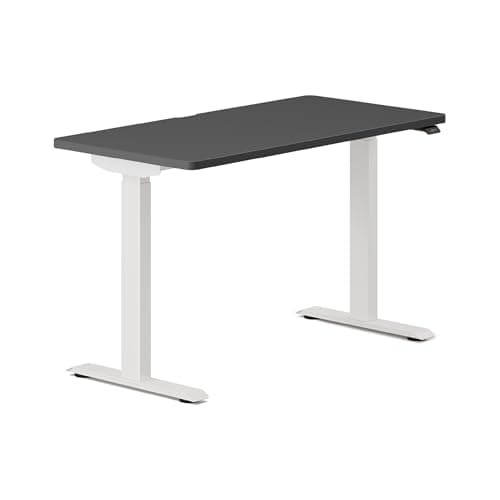
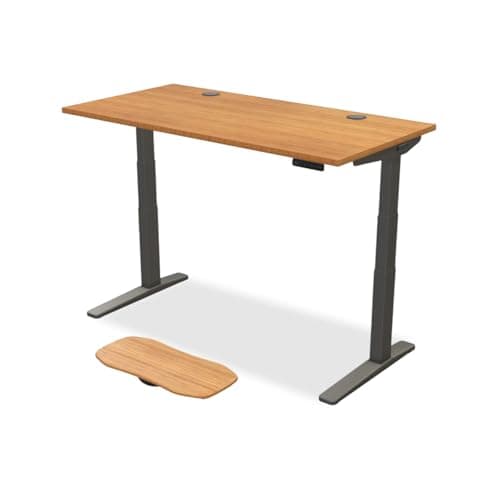
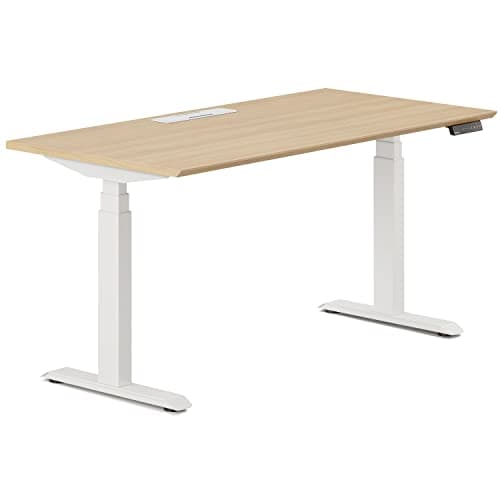
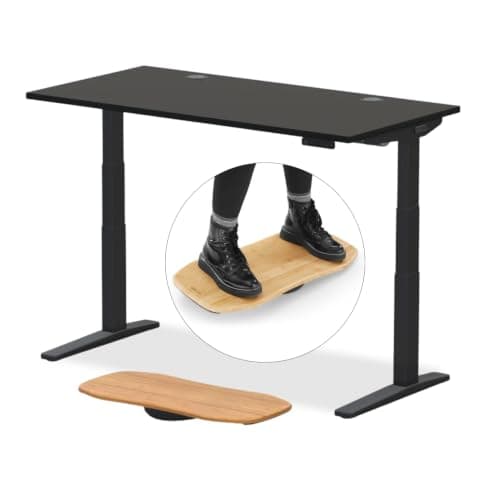
Buy the UPLIFT V3 laminate. It descends to a published 22.6 inches against the Branch Duo's 28, it is rated for 355 lb against 275, it carries a 15-year warranty against 10, and UPLIFT publishes a GREENGUARD Gold document covering its laminate desktops while Branch publishes no emissions certificate for any desktop it sells. Buy Branch instead if you want a 10-year warranty from a brand with a smaller, simpler range and a desk that arrives looking like furniture rather than like equipment — and if nobody at your desk is under about five foot eight.
The height floor is the first thing that separates them
A sit-stand desk has two useful numbers and most buyers only check the top one. The minimum height decides whether the desk works seated, which is where you will spend most of your day, and it is the figure that quietly rules desks out.
UPLIFT states 22.6 to 48.7 inches of travel for the V3. Branch states 28 to 47.3 inches for the Duo and 26 to 52 inches for its three-stage 48×30 Standing Desk. Cornell's workstation guidance puts a conventional fixed desk around 28 to 30 inches — so the Duo's lowest setting is roughly where the fixed desk it replaces already sat. For a taller sitter that is irrelevant. For anyone who needs a seated surface below 28 inches, which is most people under about five foot eight working without a footrest, the Duo cannot reach it and no amount of build quality fixes that. If the person using the desk is short, the three-stage Branch at 26 inches or the UPLIFT at 22.6 are the only two options here — the fuller argument is in standing desks for short people.
The certificate difference, stated precisely
This is where the two brands genuinely diverge, and both positions are more nuanced than their marketing.
UPLIFT publishes a document and names its test methods.Its "GREENGUARD Gold Certified Laminates" document states that all of its laminate desktops are GREENGUARD Gold certified, over a 45 lb density E-1 rated particleboard core wrapped in thermally-fused melamine with 3 mm PVC edge banding, and it names the standards used — ASTM D-5116 and D-6670, ISO 16000. What it does not print is a per-SKU certificate number, and the Amazon listing itself carries no GREENGUARD wording at all. So it is line-level certification you should still confirm at UL SPOT for your exact top before treating it as settled.
Branch publishes nothing on emissions for its desks.It says the Duo "meets BIFMA standard for commercial-grade use" — a manufacturer compliance statement, not an independently issued mark — and the top is laminated MDF with no GREENGUARD certificate. The notable part is that Branch plainly knows how to certify a product: it publishes GREENGUARD Gold for its Ergonomic Chair, Verve and Daily chairs. The certificate is on the chair, not on the desktop. That is the single sentence worth taking away from this comparison, and it is why we rank the UPLIFT first for the buyer whose filter is material safety.
Note what neither brand's wording buys you on formaldehyde specifically. Every composite wood panel sold in the United States must already meet the EPA's TSCA Title VI emission standards, which mirror the California Air Resources Board measure — so "CARB compliant" is the legal floor rather than a distinction. A GREENGUARD Gold certificate is the step above that floor, which is exactly why its presence or absence matters.
Side by side, on published figures only
| Decision factor | UPLIFT V3 (laminate / bamboo) | Branch Duo 48×24 | Branch Standing Desk 48×30 |
|---|
| Published travel range | 22.6-48.7 in | 28-47.3 in | 26-52 in |
| Published load rating | 355 lb | 275 lb | 275 lb |
| Warranty | 15 years | 10 years | 10 years (desks bought after 1 Jan 2023) |
| Desktop emissions certificate | GREENGUARD Gold document for the laminate line; bamboo not covered by it | None published | None published |
| Structural claim | UPLIFT states the frame meets ANSI/BIFMA X5.5-2021 (own statement) | "Meets BIFMA standard" (own statement) | "Meets BIFMA standard" (own statement) |
| Top material | 1 in laminate over E-1 particleboard, or 1 in solid bamboo | Laminated MDF | Laminated MDF |
Every cell above is a figure one of the two makers publishes, or an absence we are naming. We have not measured a desk and we are not going to imply we have.
The bamboo trap, and UPLIFT's own honesty about it
The instinct for a materials-first buyer is to reach for the solid bamboo top, and it is a reasonable instinct — solid bamboo avoids the adhesive-bound composite core entirely. But UPLIFT's GREENGUARD Gold document covers the laminateline, and UPLIFT publishes that distinction itself rather than letting one line's certificate shelter the other. It states the bamboo top is finished with a low-VOC UV-cured finish and backs it with the same 15-year warranty, but there is no GREENGUARD Gold certificate for bamboo.
So you are choosing between a lower-risk materialwith a manufacturer statement behind it, and a composite material with a third-party certificate behind it. Both are defensible. If your decision rule is "a certificate on the surface I actually receive", the laminate wins and it is also the cheaper of the two, which is an unusual way round. If your rule is "no engineered panel in the room", buy the bamboo and accept the manufacturer statement. We set out both rules at length in MDF vs solid wood.
Where Branch earns the money anyway
Two places. The 48×30 three-stage desk has a 26-inch travel range, a depth most 48-inch desks do not offer, and genuinely more range than the Duo — it is the Branch to buy if the Duo's floor rules it out. And Branch's warranty page names Amazon as an authorized third party, which sounds like a technicality until you read the policies of other direct-to-consumer desk brands that exclude "dealers or resellers" from cover entirely. On that specific point, Branch is unusually clean.
Branch is also the easier desk to live with aesthetically — a smaller range, fewer configuration choices, and a finish set that looks like household furniture. If you are buying for a room rather than for a workshop, that is worth something, and our Branch Duo review goes through the build in detail.
Who should buy which
Buy the UPLIFT V3 laminate if anyone using the desk is shorter than about five foot eight, if you are loading more than 275 lb of monitors and gear, or if a third-party emissions certificate is why you are shopping at this price at all. Buy the UPLIFT V3 bamboo if you want to avoid an engineered panel entirely and will accept a manufacturer statement instead of a certificate. Buy the Branch Duo 48×24 if everyone at the desk is tall, the load is modest, and you want the simplest premium desk to order and look at. Buy the Branch 48×30 three-stage if you want Branch build with a usable minimum height and 30 inches of depth for two monitors — the case for which is standing desks for two monitors.
If both of these are above your budget, the honest answer is that the gap between a premium desk and a good budget one is mostly warranty, load rating and documentation rather than day-to-day function — which is the argument we make in FEZIBO vs FlexiSpot and in best budget standing desks.
Four checks before you order either one
1. Check the minimum height against your seated elbow height
Measure from the floor to your elbow while seated with your shoulders relaxed. If that figure is under 28 inches, the Branch Duo is out. This is the check almost nobody runs and the one that causes the most expensive returns.
2. Add up what goes on top
Two 27-inch monitors, an arm, a laptop, a dock and a lamp add up faster than people expect. The 355 lb and 275 lb figures are the makers' own; stay well inside them, because load affects stability long before it affects the motors.
3. Decide whether you want the certificate or the material
UPLIFT laminate for a third-party document; UPLIFT bamboo for a solid surface with a manufacturer statement; Branch for neither, with build quality and a 10-year warranty instead.
4. Verify the certificate for your exact top
UPLIFT's GREENGUARD Gold document is line-level and carries no per-SKU number, and the Amazon listing repeats no certification wording. Search the certifier's registry for the current certificate before you treat it as the reason you bought.