For an inclining pad under a desk, buy the MERACH W60. It is the only pad on this page that publishes a continuousmotor rating next to its peak — 1.25 HP continuous behind a 3.5 HP headline — and continuous output is the figure that decides whether a pad is still comfortable in hour three of walking uphill, which is exactly what incline makes you do to it. It also steps its 12% incline across twelve levels rather than six, and at 6.5 inches overall it is lower than either full-deck pad here, which matters because every inch of deck is an inch of desk travel you no longer have. If you want the steepest slope available, the Vitalwalk reaches 20% and publishes a 74 lb pad weight behind its 400 lb claim. The budget pick is the TREAFLOW, which gives you 0–8% on a 4.3-inch deck — the lowest deck on this page — for a fraction of the others. Every price is read from the Amazon Creators API with the date it was read.
This page exists because incline is the one walking-pad feature that actually changes the arithmetic of a working day. Speed is capped by your hands: past roughly 2 mph most people stop being able to type, and the CDC's activity guidance counts brisk walking as moderate intensity, so the question is how to reach moderate intensity at a speed your keyboard tolerates. Slope is the answer. It is also a trade, and the trade is vertical.
We rank these pads on capacity, deck size and noise elsewhere — under-desk treadmills is the general ranking and walking pads for heavier users is the capacity page. This one ranks them on slope, and it reaches a different first pick for a reason we can state.
The thing nobody tells you about incline
An inclining pad raises your feet, which lowers your desk.Deck heights here run from 4.3 to 7.9 inches before the incline mechanism lifts anything. Add a shoe and a few degrees of slope and you can be standing four to five inches higher than you planned. If your standing desk is already near its maximum height, that is the end of the experiment — your keyboard goes out of reach and your shoulders come up to meet it. Check your desk's top figure before you check anything else; our height calculator gives you the number to compare against, and standing desks for walking pads is the ranking of desks with travel to spare.
Walking uphill changes your posture at the keyboard. On a slope your torso pitches forward slightly and your reach changes. You will need to re-set the desk height after the pad arrives, not before, and you will probably set it differently for incline days than for flat ones.
Peak horsepower is the wrong number. Almost every listing in this category publishes a peak figure and nothing else. Peak tells you what the motor can do for a moment; incline asks it to hold load for an hour. One listing on this page publishes a continuous rating, which is why it wins.
Granularity matters more than maximum. Twelve incline levels to 12% lets you find the one setting you can sustain while working. Six levels to 15% means the useful setting may sit between two stops. The highest number on the box is rarely the setting you will use.
And the honest framing on all of it: NIOSH is clear that prolonged standing is a hazard in its own right rather than a cure for sitting, so an inclining pad is a tool for varying your day, not a license to be upright for eight hours of it. How long to stand is the dosage page.
Who each pick is for
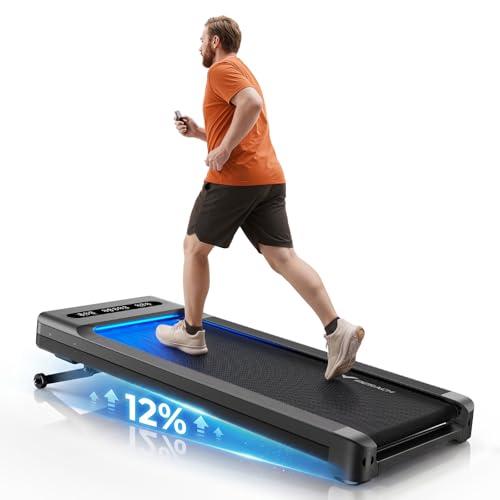
- MERACH W60— the default. 1.25 HP continuous published alongside a 3.5 HP peak, 12% incline across twelve levels, a 0.6–4.0 mph walking-only speed range, 400 lb claimed and 6.5 inches of overall height. Buy it if you intend to use the incline for real working hours.
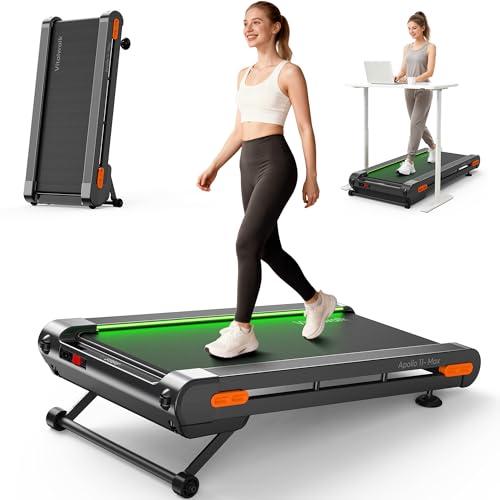
- Vitalwalk full-deck, 20% auto incline— the steepest. 400 lb claimed against a published 74 lb pad weight, a 43 by 18 inch belt, 35 dB published, and a warranty split into five years frame and two years motor. Buy it if you are a heavier walker who wants slope and will accept the height.
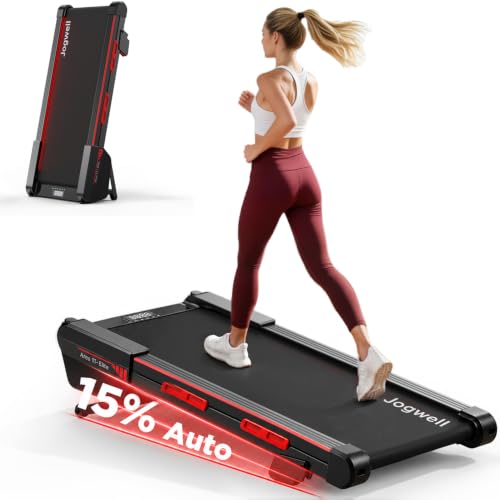
- Jogwell full-deck, 15% auto incline— incline per dollar. A named “reinforced dual-steel frame” behind a 350 lb figure, under 35 dB published, a 51 lb pad and self-standing vertical storage in a stated 1.5 sq ft. Buy it as the mid-price pick if you are under about 320 lb.
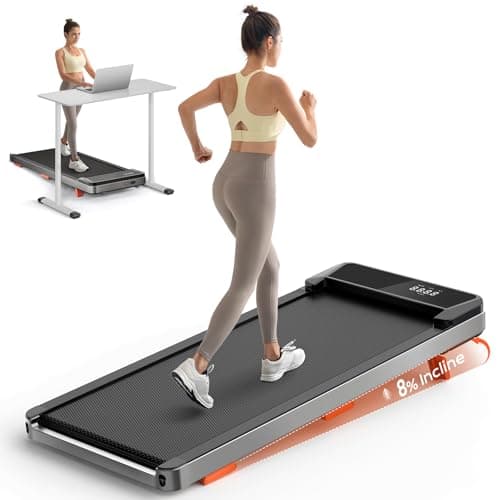
- TREAFLOW with incline (budget pick)— the cheapest way to find out whether incline suits you, and the lowest deck here at 4.3 inches with a 37 lb pad you can actually move. 0–8% slope, 265 lb claimed, under 45 dB. Buy it if your desk is tight on travel or your budget is tight on everything.
The honest trade in each one
The MERACH publishes no item weight at all.That is the one structural cross-check a buyer has on a 400 lb claim, and MERACH does not give it. Its listing also states two different warranty lengths — two years in Amazon's warranty field, three years in its own bullet — and we print the conflict rather than quoting the better number. No frame construction is described beyond “heavy duty” in the title, no decibel figure is published, and the features the listing leads with are RGB lighting and a Bluetooth speaker.
The Vitalwalk is the tallest problem here.7.6 inches of deck plus a shoe is nearly nine inches of lost desk travel. It is also 74 lb, which is not something you move casually between rooms even with wheels, it is the most expensive pad on this page by a wide margin, and its “200k+ impact tested, 2x industry standard” line names no standard and publishes no report, so it is a manufacturer claim.
The Jogwell has the tallest deck of the four at 7.9 inches— the opposite of what you want under a desk — a one-year warranty against the Vitalwalk's separate five-year frame term, a 3.0 HP peak with no continuous rating published, and 350 lb rather than 400. If you are near the top of that figure the margin is thin and there is no certificate to appeal to.
The TREAFLOW tops out at 8%, which is a gentle slope rather than a hill, and its 265 lb claim is the lowest here. Under 45 dB is also the loudest published figure on the page. It is the right pad for finding out whether you like walking uphill at a desk, and the wrong one if you already know you do.
What we would actually do
Measure your desk's maximum height, subtract the deck height of the pad you want, and only then decide. Half the disappointment in this category is a pad that works perfectly in a room where the desk cannot rise to meet it. If the arithmetic is tight, buy the TREAFLOW and its 4.3-inch deck; if it is comfortable, buy the MERACH and use the twelve incline levels to find the one you can sustain.
Two things to buy alongside it. A pad on a hard floor transmits into the room below and into your own joints — walking pad noise covers the mitigation, and an anti-fatigue mat is what you stand on for the flat half of the day. And if a pad is not the right machine for you at all, the under-desk pedals are the quieter and cheaper route to the same goal: under-desk bikes and ellipticals is that page, and it is the one most readers of this one should check first.
Before you buy
How to buy an inclining walking pad
1. Do the height arithmetic first
Your desk's maximum height, minus the pad's deck height, minus your shoe, is your real standing height. If that is above your comfortable elbow height, no other spec on the pad matters.
2. Look for a continuous motor rating, not a peak
Peak horsepower is a marketing number. Continuous output is what the motor sustains, and incline is a sustained load. One pad on this page publishes both; prefer it.
3. Count the incline levels
You will use one setting almost all the time. More steps means a better chance that one of them is the setting you can walk at while working. A high maximum you never select is worth nothing.
4. Read the capacity claim against the pad's own weight
No walking pad has a third-party duty standard to be certified against, so a capacity figure is always the maker's own. The one cross-check available is the machine's published weight: a 400 lb claim on a 74 lb pad is a more conservative claim than a 400 lb claim on a pad whose weight is not published at all.
5. Cap the speed you actually need
A pad whose range stops at 4 mph is a coherent walking machine. A 10 mph top speed on a handrail-free pad is a spec, not an invitation, and it tells you the product was designed for a different use.
6. Plan where it lives when it is not under the desk
Self-standing vertical storage and a published footprint are worth more in a small room than any performance figure. A 74 lb pad that has to be dragged out of a cupboard gets used less than a 37 lb one that stands beside the desk.