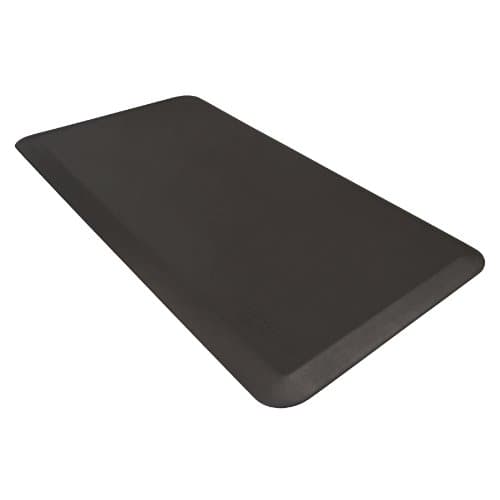
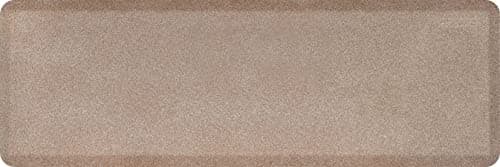
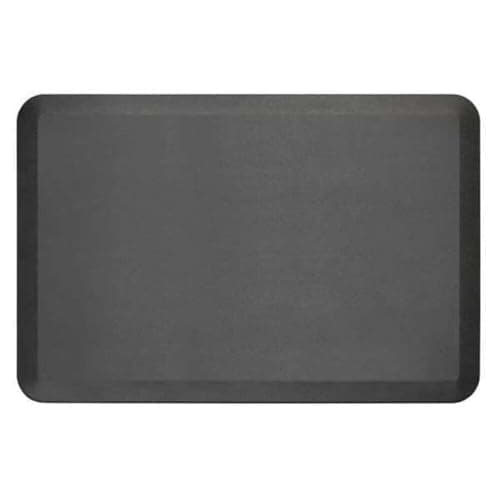
Buy the NewLife by GelPro Eco-Pro in 24 by 36 inches. It is one solid piece of Bio-Foam with no gel layer bonded to it, three-quarters of an inch thick, and its bottom surface carries a National Floor Safety Institute high-traction certification — a genuine third-party certification, of slip resistance rather than of chemistry, and the only third-party anything in GelPro's range. The 24-inch depth is the reason to prefer it over the better-known 20 by 48: depth is what keeps your heels on the mat when you step back from the desk.
The odd thing about this brand
Go to gelpro.com and you are offered three lines: GelPro Elite, described as a "patented gel layer over energy-return foam"; Designer Comfort, described as "premium energy-return foam"; and a Commercial range with custom logos. Those are the mats the brand presents, and the Elite is its flagship.
Now search Amazon for a GelPro standing desk mat, and the product you are sold is "NewLife by GelPro … Eco-Pro Foam Anti-Fatigue Comfort Mat — Standing Desk Pad". The NewLife / Eco-Pro line does not appear in gelpro.com's own navigation at all. Its specification — Cellulon polyurethane technology, Bio-Foam from a plant-based renewable resource, three-quarters of an inch thick, one-piece construction, an NFSI-certified high-traction bottom, a five-year warranty, made in the USA — is published through GelPro's commercial distributors rather than by GelPro to consumers.
We are stating that plainly rather than quietly using the figures, because it matters how you weigh them. These are the maker's stated specifications reaching you through a reseller, and this site has withdrawn a certification claim before for exactly that provenance — the GREENGUARD line we once carried for the Branch Ergonomic Chair Pro came from a reseller's republished spec sheet and turned out not to be Branch's claim at all. The difference here is that the NFSI certification is checkable at the certifier and the construction is visible in the product, so we are comfortable describing both — while noting that a brand which does not present a line to consumers is also not standing behind its consumer-facing claims about it.
The charitable and probably correct reading: Eco-Pro is a commercial and industrial line that happens to be the right product for a home standing desk, and GelPro sells it through distribution rather than through its own storefront. That is also why its finish is plain black rather than decorative.
Eco-Pro against Elite: the construction difference
This is the decision inside the brand, and it comes down to one word: layers.
The Elite is a gel layer over energy-return foam. That is a genuinely more comfortable mat at the same thickness — gel deforms differently from foam and the combination is softer underfoot than either alone. It is also a multi-layer build, which means a bond between two materials, and the brand publishes no emissions certificate and no NFSI certification for it.
The Eco-Pro is one piece. No gel layer, no bond line, nothing to delaminate after three years of a chair rolling onto its edge. And it carries the NFSI high-traction certification that the Elite does not. For the buyer this site is written for — the one whose first question is what the thing is made of — a single-piece construction with one real third-party certification beats a softer mat with neither. That is the same reasoning that puts the single-piece WellnessMatsat the top of our materials ranking, and it is why the Elite is ranked third here despite being the brand's premium product.
Be clear about what this is not: nobody has shown that a laminated mat emits something a one-piece mat does not. It is a structural preference — fewer materials, no adhesive bond, nothing to come apart — not a hazard finding, and we are not going to inflate it into one.
The four sizes, and why 24 × 36 wins
| Mat | Footprint | Construction | NFSI high-traction base |
|---|
| Eco-Pro 24 × 36 | 24 in deep × 36 in wide | One-piece Bio-Foam, 3/4 in | Yes |
| Eco-Pro 20 × 48 | 20 in deep × 48 in wide | One-piece Bio-Foam, 3/4 in | Yes |
| Eco-Pro 20 × 32 | 20 in deep × 32 in wide | One-piece Bio-Foam, 3/4 in | Yes |
| GelPro Elite 20 × 36 | 20 in deep × 36 in wide | Gel layer over energy-return foam | Not stated |
Three of the four are 20 inches deep, which is the kitchen-counter convention: long and narrow, designed for a surface you move sideways along. We worked through why that is the wrong shape for a desk in what size anti-fatigue mat do I need — at 20 inches your heels reach the bevelled edge every time you lean back for a drawer or a mug, which is both less comfortable and the most common way people trip over their own mat.
The 24 × 36 is the one mat in this range built like a desk mat. It gives up a foot of width against the 20 × 48 and buys four inches of depth, and for a person standing in one spot in front of a keyboard that is the better trade every time. The 20 × 48 remains the right buy for one specific setup: a long desk where you work at two positions and want to step sideways without leaving the foam.
On thickness, all three Eco-Pro sizes are three-quarters of an inch, which is where the whole category has converged and which we explain at length in how thick should an anti-fatigue mat be. GelPro is not doing anything unusual here, and that is a compliment.
The certification, read precisely
GelPro publishes one third-party certification across this range and it is worth understanding exactly what it covers. The NFSI high-traction certification applies to the bottom surface of the Eco-Pro mats. It means an independent body tested how well the mat resists sliding on a floor. It says nothing whatsoever about the foam, the emissions or the chemistry.
That is still useful, and on some floors it is the single most useful thing on the spec sheet. A mat that slides on tile, laminate or sealed concrete is worse than no mat — it is a fall risk and you will stop using it. If your floor is hard and smooth, buy the base before you buy the foam.
What GelPro does not publish, and we checked: no GREENGUARD or GREENGUARD Gold certificate (no GelPro mat appears in UL SPOT), no CertiPUR-US certificate for the foam, and no PVC-free or phthalate-free statement of the kind WellnessMats prints. On the last point the comparison is instructive: WellnessMats states its mats are 100% polyurethane and free of formaldehyde, heavy metals, PVC, BPA, latex, plasticizers and phthalates. GelPro says the Eco-Pro is Bio-Foam from a plant-based renewable resource and leaves it there. Both are manufacturer statements; one is far more specific. The programmes themselves, and what each would and would not cover, are set out in what CertiPUR-US actually certifies and phthalates in office furniture.
One claim we are deliberately not making: "Bio-Foam" and "plant-based renewable resource" describe feedstock, not emissions. Plant-derived polyols still make polyurethane. A bio-based mat is a reasonable environmental preference and it is not a low-emission certificate, and any page that treats the two as the same thing is selling you something. The related trap — a "stain-resistant" surface treatment, which is where PFAS can hide in this category — is covered in PFAS in mats.
Where GelPro sits against the rest of the category
Against WellnessMats:WellnessMats wins on disclosure, decisively. It is also one piece, it is 100% polyurethane, it names the substances it excludes, and it carries a 20-year residential warranty against the Eco-Pro's five. GelPro wins on the NFSI certification and on price. If chemistry disclosure is your filter, buy the WellnessMats; if grip on a hard floor is the problem, the GelPro base is the certified one. The full head-to-head, row by row, is at WellnessMats vs GelPro.
Against the Ergodriven Topo: different products with different mechanisms. The Topo is sculpted terrain that prompts you to change position; a GelPro is a flat cushion that makes standing still more tolerable. We compare the two directly in Topo vs the GelPro Eco-Pro, and the short version is that if you stand rigidly in one spot for an hour the sculpted mat is the better intervention.
Against the budget flat mats:ComfiLife and Sky Solutions land at the same three-quarter-inch thickness for less money, with no NFSI certification and thinner material disclosure. GelPro's premium over them buys a certified base and a US-made one-piece construction, which is a real if unglamorous thing to pay for. The whole field is ranked in our best anti-fatigue mats roundup.
And the honest prior question: a mat is one of the few desk purchases with real evidence behind it — Dick and Waters' 2015 review of prolonged standing at work names floor mats among the interventions with supporting evidence, alongside sit-stand workstations and footwear, and Bao and Howard's work is the peer-reviewed study we lean on. But if your floor is carpeted and you alternate sitting and standing properly, you may not need one at all, which we say out loud in do you need an anti-fatigue mat.
Who should buy which
Buy the Eco-Pro 24 × 36 if you stand in one place at a desk and want the depth to step back — the default recommendation on this page. Buy the Eco-Pro 20 × 48 if your desk is long and you work at two positions along it. Buy the Eco-Pro 20 × 32 only if the mat has to fit a recess. Buy the Elite if comfort underfoot is the single thing you care about, you want a finish that suits a room, and you accept a layered build with no third-party certification. Buy the WellnessMats Granite instead if your first question is what the foam is made of — it answers that question better than anything GelPro publishes, and that recommendation costs us money on this page.