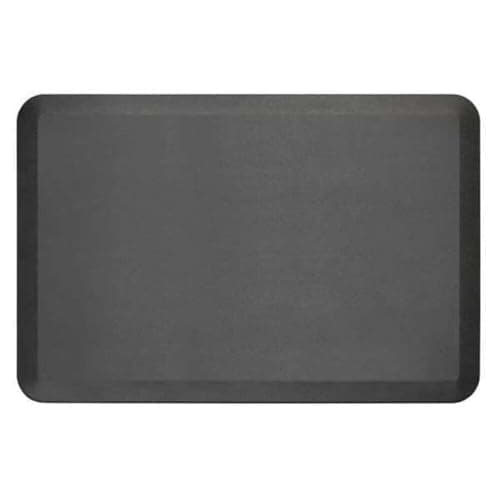
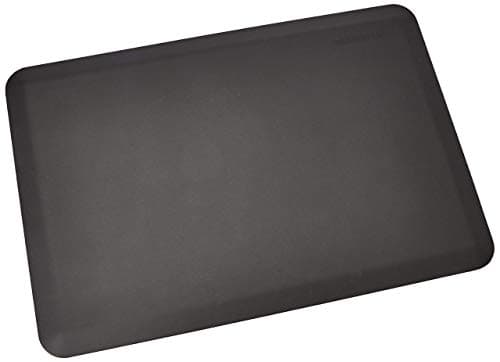
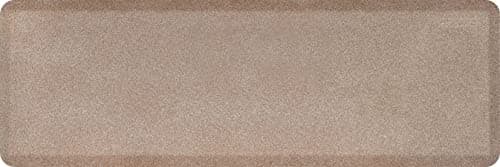
Buy WellnessMats if your first question is what the mat is made of. It is the only brand in this category that publishes a named exclusion list — the maker states 100% polyurethane, free of formaldehyde, heavy metals, PVC, BPA, latex, plasticizers and phthalates, odor-free, and passing CFR 1630/1631 surface-flammability testing — and it backs the mat for 20 years in a residential setting. Buy the NewLife by GelPro Eco-Pro 24 x 36 if your first question is whether the mat will slide or whether you can step back onto it: it is the one mat in either range with 24 inches of depth, and its base carries a National Floor Safety Institute high-traction certification, which is a genuine third-party mark. Neither brand holds an emissions certificate. Nobody in this category does, and any page that implies otherwise has not looked.
The two brands document different halves of the problem
This is not a comfort shootout. Both of these are firm, one-piece polyurethane mats in a category mostly made of laminated vinyl and bonded gel, and both will feel better under your feet at hour three than the cheap mat you are replacing. The useful difference is on paper.
WellnessMats publishes the ingredient position. Not the word "non-toxic" — an actual exclusion list, naming the substances the mat does not contain, plus a statement that it will not off-gas the way rubber, vinyl and biodegradable foam mats do, plus a flammability standard it passes. That is a manufacturer disclosure rather than a third-party certificate, and it is still the most specific material statement any mat brand makes. If you came to this site because you filter products on what they are made of, this is the document you were looking for.
GelPro publishes a performance certificate. The Eco-Pro specification describes one-piece Bio-Foam from a plant-based renewable resource and a National Floor Safety Institute high-traction certification for the bottom surface. The NFSI mark is third-party, which the WellnessMats exclusion list is not — but it certifies slip resistance rather than emissions or foam content. It is the right certificate to care about on tile, polished concrete or sealed LVP, and the wrong one to read as a materials claim.
There is one caveat on the GelPro side worth stating because we had to go looking for it: gelpro.com does not present the NewLife / Eco-Pro line at all. The brand's own site sells GelPro Elite, Designer Comfort and Commercial. The Eco-Pro specification is published through GelPro's commercial distributors instead, which makes it the maker's stated specification rather than first-party disclosure. We rank the mat anyway, because the specification is consistent and the product is the better shape for a desk — but a reader filtering on documentation should know where the document lives.
Side by side, on what each maker publishes
| Decision factor | WellnessMats Granite | GelPro Eco-Pro 24 x 36 | GelPro Elite 20 x 36 |
|---|
| Construction | One solid piece, 100% polyurethane | One piece Bio-Foam, 3/4 in thick | Gel layer bonded over energy-return foam |
| Material disclosure | Named exclusion list: no formaldehyde, heavy metals, PVC, BPA, latex, plasticizers or phthalates | Plant-based renewable resource, stated via distributors | Maker describes a patented gel layer; materials position undocumented |
| Third-party certification | CFR 1630/1631 surface flammability (stated by the maker) | NFSI high-traction certification on the base | None stated for this line |
| Emissions certificate | None — no GREENGUARD or equivalent | None | None |
| Depth (the dimension that matters) | Varies by collection; 36 x 24 in the Original line | 24 in — the deepest here | 20 in |
| Warranty | 20-year residential | Not published in the distributor specification | Not published |
Why depth beats width, and why that decides the GelPro choice
The spec almost nobody publishes for a standing desk mat is depth, and it is the one that decides whether the mat works. Width matters if you move along a long desk. Depth matters every time you step back from the desk to think, stretch or reach something — and if the mat is 20 inches deep, your heels come off the foam and land on the bevel or the floor.
That is why the 24 x 36 Eco-Pro is the GelPro pick here and the flagship Elite is not. The Elite is softer and it is the line the brand actually markets, but it is 20 inches deep, it is a bonded multi-layer build where the Eco-Pro is one piece, and no NFSI certification is stated for it. On a site that ranks construction, a bond line between two materials is a real distinction rather than a nitpick: a one-piece mat has nothing to delaminate.
The matching advice on the WellnessMats side is the opposite of upselling. If a 36 x 24 footprint suits one standing position, the Original 36 x 24 is roughly half the price of the larger Granite collection mats with the same single-piece polyurethane construction and the same material position. Buy the cheaper one and spend the difference on a footrest or nothing at all. Our mat size guide has the footprint math, and thickness covers the other half.
What a mat actually does, so you can judge the price
Both of these cost several times what a budget polyurethane mat costs, so the honest framing matters. The published research on anti-fatigue mats is about discomfort and fatigue during prolonged standing rather than about injury prevention — Bao and Howard's review of anti-fatigue mats for standing workers is the clearest summary of what the evidence supports and what it does not. A mat makes standing more tolerable so that you stand more often. It does not fix a desk at the wrong height, and it is not a medical device.
So the value case for either brand is durability and construction rather than a bigger comfort number. A 20-year residential warranty on a single piece of polyurethane is a real argument. A plant-based one-piece foam with a certified high-traction base is a real argument. "Softer underfoot" is a feeling, and you cannot check it from a listing.
Who should buy which
- WellnessMats Granite — your filter is the ingredient list, and you want the longest warranty in the category.
- WellnessMats Original 36 x 24 — the same material position, the desk-sized footprint, roughly half the price.
- GelPro Eco-Pro 24 x 36 — you want depth, and you want the slip certification because your floor is tile, polished concrete or sealed vinyl.
- GelPro Elite — you want the softest mat in either range and you accept a layered build with no stated certification.
- Neither — if you have not yet proven you will stand. Start at the best anti-fatigue mats, where the cheaper mats are ranked honestly, or read do you need a mat at all.
Before you buy
Four checks
1. Measure the depth you need, not the width you want
Stand at your desk and step back the way you actually do. That distance is the depth figure. 20 inches is a compromise; 24 is the one that keeps your heels on foam.
2. What is your floor?
On tile, polished concrete or sealed LVP, slip resistance is the spec that matters and the NFSI certification on the Eco-Pro base is the only third-party mark in this comparison that speaks to it. On carpet the question barely applies.
3. Decide which document you want
A named exclusion list from the maker, or a third-party certificate about slip. They are not the same kind of evidence and neither is an emissions certificate — no mat in this category holds one.
4. Check one piece against layers
Single-piece construction has no bond line to fail and no laminated top layer to develop a dead spot. Both WellnessMats collections here and the Eco-Pro are one piece; the Elite is not.