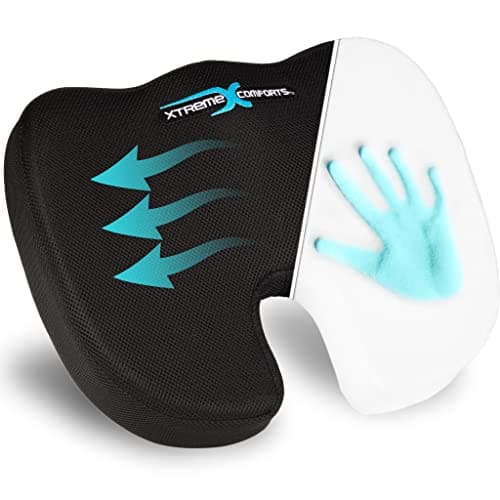
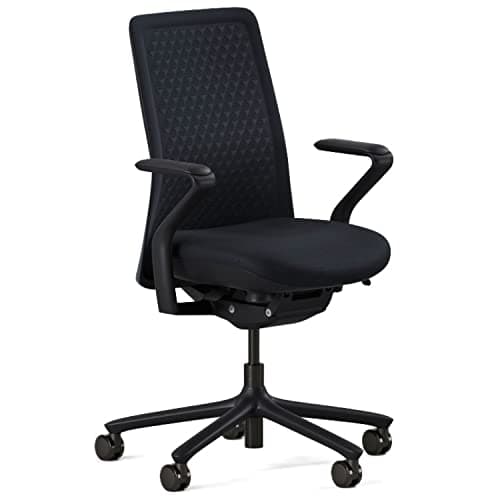
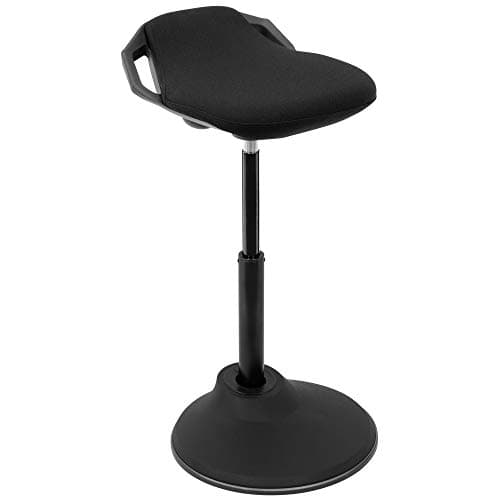
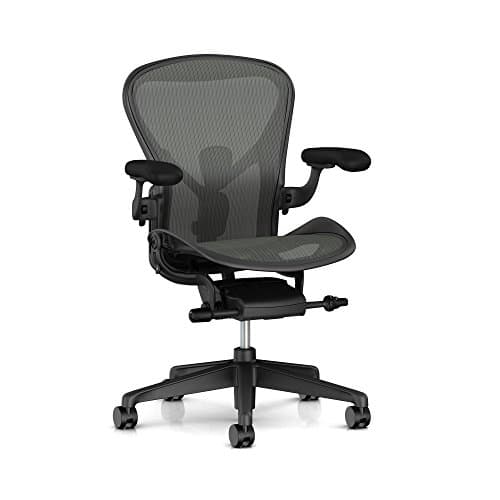
Start with the $30 fix, not the $1,500 one. A deep-cutout cushion removes the contact under your tailbone directly, and the evidence for the cushion approach is better than the evidence for any chair feature. If you are replacing the chair anyway, the Herman Miller Aeron is the one whose seat is a tensioned membrane rather than a foam pan with a rigid rim — nothing to bottom out onto. The Branch Verve is the mid-price chair that gets the one adjustment that matters here, seat depth. And the Mount-It! perch is the cheapest way to take the coccyx out of the loop entirely, by tipping the pelvis forward so your weight rides on your thighs.
One honest frame before the picks. Cleveland Clinic's line on coccydynia is that tailbone pain "usually goes away on its own in a few days with the help of home remedies and a little bit of patience." If yours has not, the answer is a clinician rather than a chair — and the chair is still worth getting right, because the thing most likely to keep irritating a coccyx all day is the surface you sit on for eight hours.
Where your weight is supposed to sit
Sitting is meant to load two bony points at the bottom of the pelvis, the ischial tuberosities, which most people call the sit bones. The coccyx sits behind and between them, higher up when you are upright. In a neutral seated posture it carries very little. Slump or recline and the pelvis rotates backwards, the sit bones move forward off the contact patch, and the load slides rearward onto the soft tissue over the coccyx. That is the whole mechanism, and it explains why the pain is so reliably positional.
Cleveland Clinic names the two conditions that aggravate it in exactly these terms: "Sitting for long periods of time can place excess pressure on your tailbone, especially if you sit on hard surfaces," and one of the classic symptoms is "tailbone pain that worsens when you go from sitting to standing." It also notes that coccydynia is "five times more likely to occur in females than males", and that the risk runs at both ends of the body-composition range — extra weight can push the tailbone backward, while low body fat means, in the clinic's own phrasing, "less cushioning in your butt."
So there are exactly three levers, and they are the structure of this page: remove the contact, change the surface, or change the pelvic angle.
Lever 1: remove the contact (and buy the wedge, not the donut)
A cutout cushion does the most direct thing available — it deletes the material under the coccyx, so there is nothing there to press back. It is also the only intervention on this page with a published comparison behind it. Foye and colleagues reported on 55 patients who had tried both cushion types: 19 (35%) preferred wedge cushions, 4 (7%) preferred donut cushions, and 23 (42%) preferred neither. Among the patients who did have a preference, they were "almost 5 times more likely to prefer wedge cushions as compared with donut cushions."
Two things worth drawing out of that. First, the donut — the ring cushion everybody pictures — lost, and it lost decisively. A ring that is open at the center still supports the rim right where the coccyx is, which is the opposite of the intent. A wedge with a rear cutout opens the back edge instead. Second, and this is the part a product roundup usually hides: 42% of patients preferred neither cushion. That is close to half the sample finding no benefit from either. A cushion is the cheapest first move and the right first move; it is not a guaranteed one.
Our pick here is the Xtreme Comforts coccyx cushion because its cutout is deeper than the general-purpose contoured cushions, which is the only spec that matters for this complaint. If your discomfort is general rather than localized behind the tailbone, you want a flatter, denser cushion instead, and the density argument is laid out properly on the seat cushions page.
Lever 2: change the surface the sit bones land on
Most task-chair seats are a foam pad over a rigid plastic pan. Foam compresses; the pan does not. After a year or two of eight-hour days, the foam under the sit bones is thinner than the foam everywhere else, and what you are really sitting on is the shell — which is hard, and exactly the hard surface Cleveland Clinic names as an aggravating factor. This is the failure that makes a chair that was fine in year one intolerable in year three, and we cover its timeline in how long office chairs last.
A suspension seat changes the problem rather than padding it. Herman Miller's Aeron uses a tensioned 8Z Pellicle membrane for both seat and back: there is no foam to compress and no pan rim underneath to find, and the membrane deflects where load is applied instead of concentrating it at the edges. Herman Miller publishes real fit data for it too — size B is stated for 5 ft 2 in to 6 ft and up to 350 lb — which matters here because a seat that is too deep or too wide for you pushes you into exactly the slumped, posteriorly-rotated position that loads the coccyx. On materials, Herman Miller's own page names BIFMA Level 3 and "Indoor Advantage Gold certification, SCS Global Services' highest level of indoor air quality performance" — not GREENGUARD, which is a distinction we had to correct on this site and which we explain in SCS Indoor Advantage Gold explained. Our full write-up is the Herman Miller Aeron review.
The honest objection is the price, and it is a real one: this is several times the cost of everything else on the page, and a membrane seat is still firm at its rear edge. If a suspension seat is not in the budget, the next best surface change is a well-chosen cushion on the chair you own — which is lever 1, at two percent of the cost.
Lever 3: change the angle of the pelvis
This is the lever almost nobody sells, and mechanically it is the strongest. If the pelvis tips slightly forward, the sit bones come back under you, the lumbar curve returns, and the coccyx lifts away from the seat. Two ways to get there.
Seat depth, on a normal chair.Depth adjustment lets you sit all the way back against the lumbar support without the front edge of the pan pressing behind your knees — and pressure behind the knee is the thing that makes people slide forward and slump, which rotates the pelvis the wrong way. OSHA's Computer Workstations eTool makes the same two points about the seat pan: the front edge should be rounded, and the seat should not press behind the knee. The Branch Verve is the mid-price pick here because it has both height-adjustable lumbar support and seat depth, which are the two adjustments that actually change where your weight sits rather than how soft it feels. Branch publishes a GREENGUARD Gold line for the Verve as a manufacturer statement with no certificate number, so verify it at UL SPOT before you treat it as decided; the full picture is in our Branch chair review.
A perch, for part of the day.A leaning stool holds the pelvis at an open angle with your weight shared between the seat and your feet. The coccyx is simply not in contact. It is not a chair you spend four hours in and it has no back support, which is why it belongs in a rotation rather than as a replacement — the same third-position argument we make for standing-desk stools. One practical note if you perch on a hard floor: a stool that wanders every time you shift your weight will not let you hold the position, and the cheapest fix is to take the wheels off it entirely — see the glides section of our chair caster roundup.
The fix that is not a chair
If sitting is what hurts, the most effective intervention is less sitting. That is not a slogan on this site; it is the one place where the review evidence is reasonably direct about sit-stand workstations being among the interventions with support behind them. A standing desk breaks up the load pattern instead of redistributing it, and for a coccyx that is irritated by contact, removing the contact for half the day beats optimizing it.
The caution specific to this symptom: do not swap eight hours of sitting for eight hours of standing. Our how long to stand page covers the ratios, and standing desk feet hurt covers what happens when people overcorrect. Start at the standing desk roundup if that is the direction you are going.
What will not fix it
- A softer seat. Soft is not the same as unloaded. A plush pad lets you sink until the pelvis rotates back, which puts more weight over the coccyx, not less. Firm and contoured beats soft and deep for this complaint.
- A donut cushion. Covered above. The published preference data went the other way, and the geometry explains why.
- A recliner posture.Deep recline feels like relief and loads the lower sacrum and coccyx region as the pelvis rolls back, especially without proper lumbar contact. If reclining is how you work, the lumbar support has to come with you — see lumbar support.
- A gaming chair with a bucket pan. A fixed bucket seat cannot be fitted to a femur and tends to hold the pelvis in one rotation all day, which is the one thing you do not want here. That comparison is its own page.
The non-shopping part, because it is most of the answer
Cleveland Clinic's self-care list for coccydynia is short and worth doing before any of this: sit on a donut pillow or a wedge-shaped gel cushion to take pressure off the tailbone, apply hot or cold packs to the lower back for about 20 to 30 minutes several times a day, take NSAIDs to reduce pain and swelling, and use physical therapy "to stretch your muscles and improve your posture." The same page notes the usual course is a few days, that more severe injuries take longer, and that at the far end a coccygectomy carries a recovery measured in months. Which is to say: cushions and breaks first, chairs second, and a clinician if it persists.
Choosing in five checks
1. Localize the pain before you spend anything
Press a finger on the bone at the very base of your spine, then on the two bony points you sit on. If the base of the spine is the sore one, you want a rear cutout. If the sit bones are sore, you want density and pressure distribution instead — a different purchase entirely.
2. Buy the wedge shape, not the ring
A cutout that opens the back edge; not a donut that supports a rim around the sore spot. The published preference data is almost 5 to 1 in the wedge's favor among patients who preferred either.
3. Check whether the seat depth adjusts
Sit all the way back. If the front edge of the seat presses behind your knees, you will slide forward and slump, and the slump is what loads the coccyx. Depth adjustment fixes that; a cushion does not.
4. Press your thumb into the seat where your sit bones land
If you can feel the plastic pan through the foam, the chair is finished for this purpose regardless of what it cost. That is the hard surface the clinical guidance warns about, and no cushion fully undoes it — it just adds a layer on top of a bottomed-out one.
5. Plan a position rotation, not a chair
Sit, perch, stand. Any posture held for eight hours is the problem; a coccyx that is only loaded for a third of the day recovers in the other two thirds. A standing desk, a perch and one good cushion beat any single chair purchase for this specific complaint.